The AI Voice Cloning Scam: What to Do When the Voice Sounds Exactly Like Your Daughter
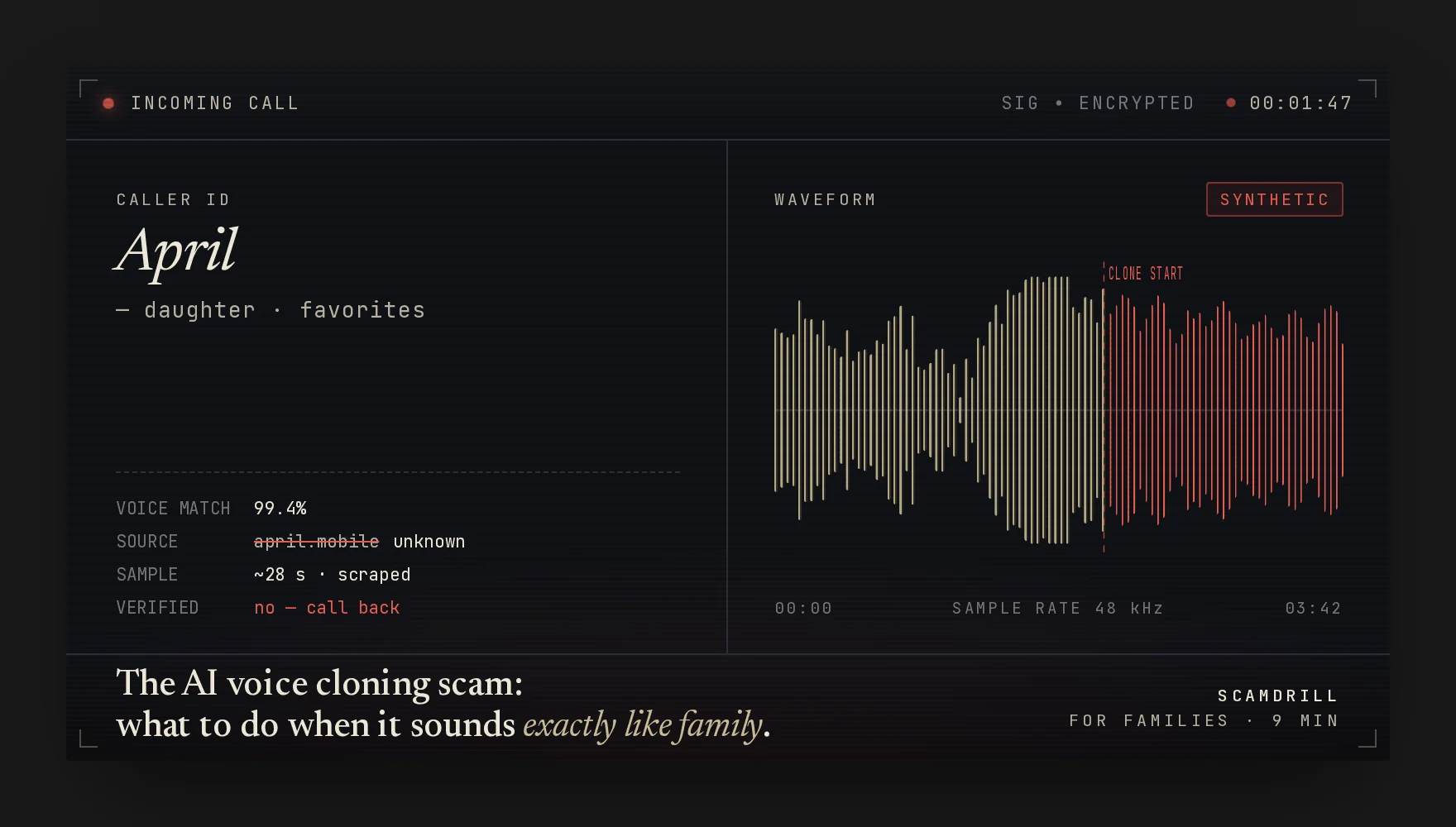
On a Tuesday afternoon in July 2025, Sharon Brightwell’s phone rang. The voice on the other end was her daughter April — sobbing, terrified, explaining that she’d been in a car accident, that a pregnant woman had been hurt, that there was blood everywhere and the police were there.
Sharon knew her daughter’s voice. She had known it for 40 years. The voice on the phone was her daughter’s voice.
Except it wasn’t. It was her daughter’s voice fed through an AI cloning tool, trained on about 30 seconds of audio scraped from somewhere — a voicemail, a TikTok, a company Zoom that was inadvertently posted online. Within 90 minutes, Sharon had withdrawn $15,000 in cash from her bank and handed it to a “courier” who showed up at her door to collect bail.
The Brightwell case is one of thousands like it in 2025. And according to the FBI’s 2025 IC3 report, Americans lost $893 million to AI-enabled scams in that year alone — up from a negligible number just two years earlier.
This article explains exactly how the scam works, why it’s nearly impossible to detect in the moment, and the specific family protocols that reliably stop it.
What is an AI voice cloning scam?
An AI voice-cloning scam uses a few seconds of someone’s recorded voice — often pulled from social media — to fake a loved one in distress who calls begging for money or gift cards in an emergency. The panic is the point: it rushes you past stopping to verify.
How AI voice cloning scams actually work
There is no mystery to this. The technical stack is embarrassingly simple and, in most cases, free.
Step 1: Source the voice
The scammer needs 10–30 seconds of clear audio of the target voice. In 2026, this is trivially available for most people. Sources include:
- TikTok and Instagram Reels (the most common source — public by default)
- Your outgoing voicemail greeting (“Hi, you’ve reached Jamie, leave a message” — perfect sample)
- Any public Zoom webinar, podcast appearance, or YouTube video
- LinkedIn video posts
- Facebook Lives and old stories
If any member of your family has ever posted video content online, their voice is already scrapable.
Step 2: Clone the voice
Consumer AI voice cloning tools like ElevenLabs, Speechify Studio, Descript’s Overdub, and a dozen open-source alternatives can produce a convincing clone from a 15–30 second sample in less than a minute. Some free tiers exist. More sophisticated tools can clone emotion (crying, shouting, whispering) from neutral speech samples.
Step 3: Identify the target
The scammer needs to call the right person. For this, they use public data and social engineering: LinkedIn (who works where, who’s married to whom), Facebook (family relationships, birthdays), obituaries (recent deaths create emotional vulnerability), property records (home addresses). For about $20 in aggregated data-broker fees, a scammer can often put together a complete family tree.
Step 4: Make the call, create urgency
The call almost always follows a pattern. The target — usually a parent or grandparent — answers. The “family member” is in crisis: car accident, arrest, medical emergency, kidnapping. They’re sobbing. They need money right now. There’s a “lawyer” or “officer” who takes the phone to explain. Bail, bond, medical bills — usually in the $5,000–$25,000 range, though we’ve seen $50,000+. Payment is by cash courier (most common), wire transfer, cryptocurrency, or gift cards. The same fake-“officer” pressure drives the jury duty “arrest warrant” scam, where the officer on the line is the whole con from the first ring.
The call rarely lasts more than 8–10 minutes. That’s by design. The scam works because the victim’s amygdala is flooded with fear and empathy, and the brain’s slower reasoning systems — the ones that would normally say “wait, this doesn’t quite add up” — don’t get a chance to engage.
Why you cannot “just listen more carefully”
A common piece of advice you’ll see: “Listen for robotic intonation, weird pauses, or unnatural phrasing.” That advice was reasonable in 2023. It is essentially worthless in 2026.
Current-generation AI voice models reproduce vocal fry, breath sounds, micro-pauses, regional accents, and emotional affect with very high fidelity. A 2026 study by University College London asked subjects to distinguish real human voices from AI-cloned voices. Trained listeners correctly identified cloned voices only 73% of the time. Untrained listeners — which is to say, everyone — scored essentially at chance, around 50%.
Add to this: your own mother, under the stress of believing her grandchild is in a car wreck, is not going to do any kind of forensic voice analysis. She is going to hear her grandchild in pain, and she is going to act.
The 10-second rule that actually works
Here is the single protective behavior we recommend to every family:
If anyone you know calls with an emergency, say you need to call them back in 10 seconds, hang up, and call the number you have saved for them.
That’s it. Ten seconds. One hang-up. One outbound call.
This works because AI voice cloning scams depend on a real-time, continuous call. The scammer is typing prompts into a voice-cloning tool in near-real-time, or using a pre-scripted conversation tree. They cannot be successfully called back on their spoofed number — it either doesn’t connect, or connects to a different, confused person entirely, or the scammer simply refuses to answer.
You do not need to detect the scam. You only need a ritual that breaks the real-time loop the scam depends on.
The family safe word (the 10-second rule’s backup)
Sometimes you can’t hang up. Maybe your grandma is flustered, the scammer is applying pressure, the “officer” is on the line. In those cases, the family safe word is your second line of defense.
Agree, today, on a word or phrase that every family member knows. “Blue giraffe.” “Uncle Larry’s boat.” “Pumpkin spice.” It doesn’t matter what it is — it just needs to be:
- Known to every family member
- Never posted, tweeted, or shared in writing (so it can’t be scraped)
- Not obvious to someone who’s been researching your family online
- Memorable enough that a stressed grandparent will remember to ask for it
If the “emergency” call is real, your grandchild will say “blue giraffe” the moment you ask. If it’s a scam, the scammer will fumble, get angry, say “what are you talking about this is an emergency!” — and you’ll have your answer.
How to pick a safe word that sticks
Families that successfully use safe words tend to pick phrases that are slightly fun — an inside joke, a weird family memory, a made-up phrase from when the grandkids were little. Phrases that are emotionally sticky get remembered. Boring security phrases get forgotten. Don’t pick “authentication phrase 4724.” Pick “Grandpa’s mustache.” For the full walkthrough — where to store it, how to test it without scaring anyone, and the workplace version — see our guide to setting up a family safe word.
What to do in the moment
If you get one of these calls — or if your parent calls you asking if it’s real — here’s the sequence:
- Pause. Literally say “hang on, I need a second.” Breathe. The scammer will hate this. That’s fine.
- Ask for the safe word. If you have one, use it.
- If you don’t have a safe word: ask a question only the real person would know. Not their birthday or pet’s name — those are scrapable. Ask something like “what did we have for dinner last Sunday?” or “what was the name of that restaurant we went to last month?”
- Hang up and call back on the saved number. This is the golden rule. Your grandchild’s real number, the one in your contacts. If they don’t pick up, try their partner, parent, or roommate.
- Never pay anyone in cash, gift cards, wire transfer, or crypto based on a phone call alone. These are the four payment methods scammers use because they’re irreversible.
If money has already moved
Speed matters enormously. If you wired funds in the last 24 hours, call your bank’s fraud line immediately — many wire transfers can be recalled if reported quickly. If you bought gift cards, call the card issuer (Apple, Google, Amazon) and report the fraud; some balances can be frozen. File with the FTC at reportfraud.ftc.gov and the FBI at ic3.gov. Call the AARP Fraud Watch Helpline (1-877-908-3360) for emotional support and case guidance — this is not optional; the psychological aftermath of these scams is severe.
The longer-term fix: reduce your voice’s digital footprint
You can’t eliminate your voice from the internet entirely. But you can reduce the surface area:
- Replace your outgoing voicemail greeting with the carrier’s default. (This is the single highest-leverage change most families can make.)
- Set TikTok, Instagram, and YouTube accounts to private, or restrict who can save and download your videos.
- Review and remove old public Zoom webinars, Facebook Live recordings, and podcast appearances where your voice is clearly captured.
- If your job requires public video content, be aware that your voice is at higher risk and that the safe-word protocol is especially important for your family.
Build the habit, not the paranoia
You will not prevent AI voice cloning scams by being vigilant in the moment. The attack is too fast, too emotional, and too convincing.
You prevent them by installing a ritual — hang up, call back on the saved number, ask for the safe word — that runs on autopilot, so the emotional part of your brain never has a chance to override it.
Have the safe-word conversation with your family this weekend. It’s the highest-return two minutes of scam protection available to any family in 2026.
Rehearse the ritual. Don’t just plan it.
ScamDrill sends simulated emergency-scam messages to family members so everyone practices the “pause, verify, call back” reflex in a safe setting. The first time your mom practices it shouldn’t be the day a scammer calls.
Try a family plan →See also: how to protect elderly parents from scams, phishing simulation for families, and our roundup of the scam trends spiking in 2026 — AI voice cloning sits inside a broader wave of AI-driven fraud. For a parallel routine that catches losses if a clone gets through, see the monthly bank-statement review. The cloned-voice emergency is one of the four scams that do most of the damage to older adults, if you want the printable version.