Scammed? Here’s Exactly What to Do — A 2026 Family Recovery Guide
You realize it about ninety seconds after the call ends. The number was spoofed. The “bank fraud officer” was not from your bank. The wire you just approved is gone, and the polite voice that walked you through it is already calling the next person on a list.
Almost no one is ready for that moment. There’s no muscle memory for it. The FBI’s 2025 Internet Crime Complaint Center report logged $20.9 billion in reported losses across more than a million complaints last year — a 26% jump in a single year — and the FTC testified to Congress in March that consumer fraud losses hit a record $15.9 billion in 2025. An AARP survey released earlier this year found that 4 in 10 Americans have lost money to fraud at least once.
If you, your parent, or your kid just got hit, this is the guide you want pinned to the fridge. The first hour matters more than the next month, and a small number of moves — some boring, some unintuitive — pull most of the recoverable money back.
The first 60 minutes
Speed is the whole game. If a scammer just moved money from your account, every minute matters in a way that very few other emergencies behave like. Don’t shower, don’t Google “what should I do,” don’t call your kid. Do this:
- Call the bank or card issuer printed on the back of the card. Not the number the scammer gave you, not a number from a Google search. The bank can sometimes recall a wire, freeze an ACH, or open a Zelle dispute — but the window measures in hours.
- Write down what just happened in three sentences while it’s fresh. Names used, phone numbers, amounts, time. You’ll be asked for this five times in the next week and you will not remember it.
- Change the password on the affected account from a different device if you can. Use a real password manager if you have one; if you don’t, write the new one down on paper for now.
- Take screenshots of everything — the texts, the emails, the website URL, the caller ID. Don’t delete the messages. The bank, the FTC, and the FBI will ask.
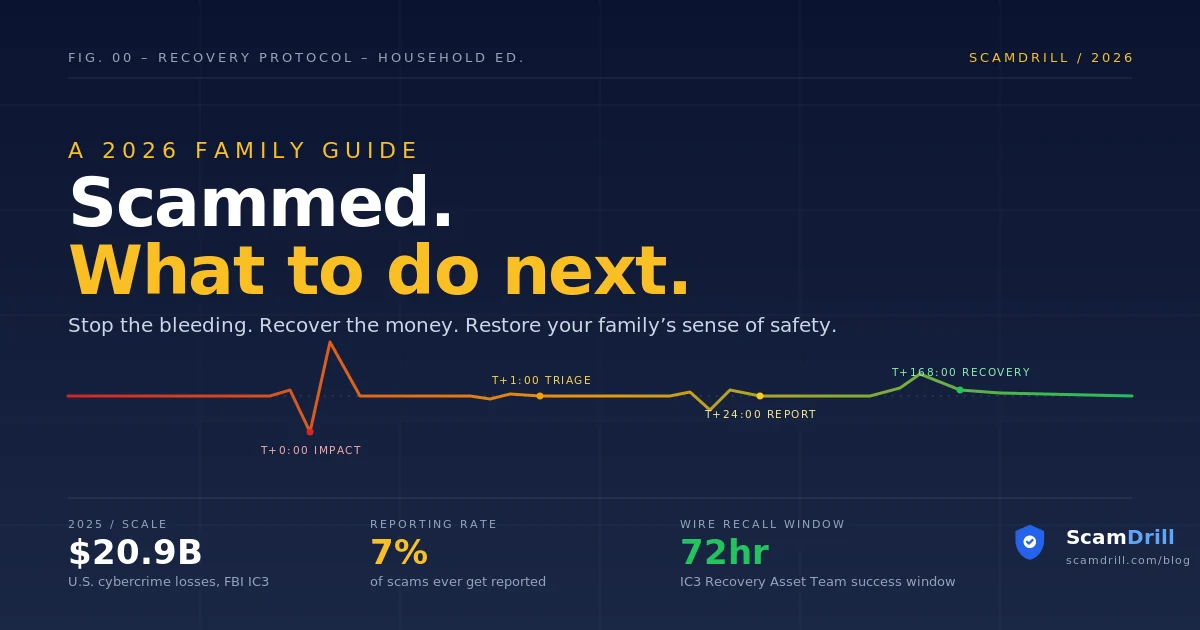
If money moved by wire, ACH, or Zelle, the second call — ideally happening in parallel with someone else dialing the bank — is to the FBI’s Internet Crime Complaint Center at ic3.gov. Their Recovery Asset Team coordinates with receiving banks to freeze accounts before the money is laundered out. It is not a guarantee, but in 2025 they recovered roughly six of every ten dollars they got to in time.
Figure 01 — The recovery clock
The first 24 hours
By the time you’ve called the bank and dialed IC3, you have one more job before you sleep: shrink the scammer’s footprint inside your life. Most scams compromise more than one thing. A fake-IRS call gets your card; a phishing email gets your password; a romance scam gets your trust and sometimes your ID photos. Treat the breach the way a doctor treats a wound: clean wider than where it bled.
Change passwords in the right order. Email first, always. If a scammer has your email, they can reset everything else, and they will. Then your bank, then anything sharing the same password (yes, all of them — use a password manager so you only have to do this once). Turn on two-factor authentication on email, bank, and any account holding money. Authenticator apps beat SMS codes; the FBI has been warning since 2024 that SIM-swap attacks are routinely defeating text-based 2FA.
Report the scam in the two places that matter. File at reportfraud.ftc.gov — that feeds the FTC’s Consumer Sentinel database, which is what state attorneys general and the FBI use to spot patterns. Then file at ic3.gov for the Recovery Asset Team. If any government-issued ID, Social Security number, or driver’s license image was shared, also file at identitytheft.gov, which generates a personalized recovery plan and pre-fills the dispute letters you’ll need.
Freeze your credit at all three bureaus. This is the single highest-leverage move you can make and almost no one does it. It’s free, takes ten minutes online, and the FTC reminded consumers in a September 2025 alert that it’s the only thing that reliably stops a fraudster from opening new accounts in your name. Lift it later in about a minute when you actually need credit. The bureaus: Equifax, Experian, TransUnion.
If gift cards were involved
Call the gift card issuer immediately — Apple, Google Play, Amazon, Target — even if the cards have been redeemed. Some issuers can claw back funds if the cards haven’t been spent yet. Save the cards and the receipts; the FTC has a gift-card scam guide with the specific issuer phone numbers. Recovery odds drop fast, but it’s worth the twenty minutes.
The first week
The urgent work is done. The longer work is making sure the same scam can’t re-enter through a different door.
Pull your credit reports. Free weekly at annualcreditreport.com. Look for accounts you didn’t open. If you find any, dispute them through the same FTC identity theft portal — the dispute letter generator is the part most people don’t know about.
Check the rest of the household. Scammers reuse phone numbers and SSNs the same way they reuse photos. If your phone number got harvested, your spouse’s may have been too. If a parent was hit, also check their statements for the kind of slow drain we wrote about in our piece on auditing an 80-year-old’s bank statements — the $19 monthly “tech support subscription” that’s been quietly running for two years is almost always the same incident.
Tell your family. The AARP and FTC both reported in late 2025 that fewer than half of fraud victims warn anyone, mostly because of shame. The data is unambiguous: families that talk about it openly have fewer second incidents, because the next scam call — and there is always a next call — gets answered with the family already on alert.
What you must NOT do
- Don’t pay anyone who calls offering to “recover” the money. The FTC has been warning for years that no legitimate paid private recovery service exists for consumer fraud losses. Recovery scams target the freshly-scammed because their name is already on a list.
- Don’t click any link in any text or email about your case — even one that looks like it’s from your bank, the FBI, or your card issuer. Log in by typing the URL yourself.
- Don’t change email passwords on the device that may be compromised. Use a different computer or your phone.
- Don’t blame the victim. Including yourself. The scams have been engineered against a billion attempts; landing on someone’s third worst day was the whole plan.
If your loved one was the one scammed
Most people reading this guide aren’t the victim themselves. They’re the adult child, the spouse, the friend. The data backs that up: adults 60+ reported $7.7 billion in losses last year, according to AARP’s analysis of the 2025 FBI numbers, and most of those cases get found and reported by family members.
Lead with empathy, not interrogation. The AARP Fraud Watch Network runs a free peer support group for victims and families and a helpline at 877-908-3360 staffed by people who’ve been through this. If the victim is an elderly parent, our 2026 family playbook covers the harder conversations — about Power of Attorney, about who picks up the phone — that almost always follow the first incident. If it was a romance scam, our romance scam guide has the exact language other families used when the “he’s real” conversation went badly.
The drill that prevents the next one
The most uncomfortable thing about scams in 2026 is that nobody’s knowledge gap is the problem. Two-thirds of victims surveyed by AARP in April said they knew the warning signs — they just didn’t see them in time, because the call sounded plausible, or the text matched a real charge, or the “granddaughter” sounded exactly like the granddaughter. The fix is not more information. It’s reps.
Workplace security teams have known this for fifteen years: people get better at spotting phishing only after they’ve safely fallen for one. The same logic finally arrived at the kitchen table. Sending the family a few realistic, gentle simulations a month — toll-text smishing, a fake bank verification, a fabricated “package failed to deliver” alert — teaches the reflex in a way reading articles cannot. We wrote up the research in our family simulation guide if you want the full case.
Run a phishing drill on your family this weekend.
ScamDrill sends safe, realistic scam simulations to the people you love — texts, emails, even AI-voice scenarios — with an instant teachable moment when someone clicks. It’s the difference between reading about scams and actually noticing them.
Start free →The pattern, in one line
You can’t out-research a scammer at 8:47 on a Tuesday night when they’re using your grandchild’s voice. What you can do is decide, today, that the first call is the bank, the second is IC3, the third is the credit bureaus, and that you’ll be telling your sister about it by Friday. That sequence is most of the difference between “we lost everything” and “we lost a Tuesday.”
Print this page. Stick it on the fridge. Hope you never need it.