Snapchat Sextortion: What to Do in the First 60 Minutes (A Parent’s Playbook)
Bottom line up front
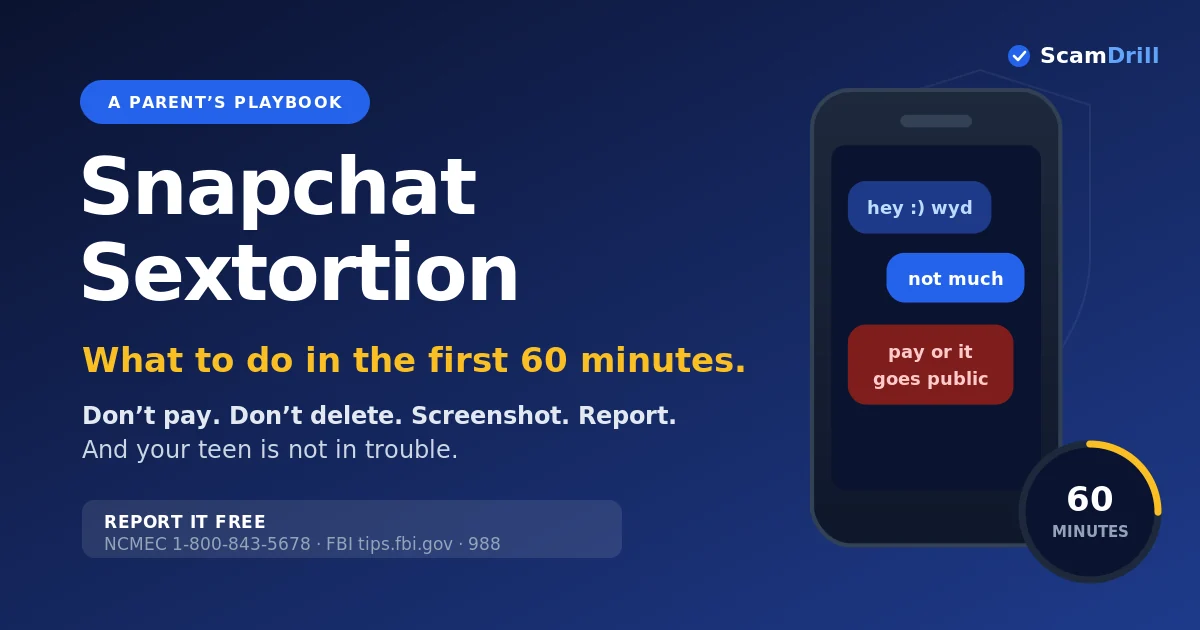
If your teen is being sextorted, the next hour matters more than the panic. Don’t pay, don’t delete anything, screenshot the evidence, block the account, and report it to NCMEC (1-800-843-5678) and the FBI (tips.fbi.gov). Paying almost never makes it stop. And the single most protective thing you can say to your child is that they are not in trouble. If your child is in crisis, call or text 988.
Most parents meet this scam at the worst possible hour, usually late, usually because a kid finally came to them shaking, or because a message popped up on a phone left on the counter. The fear is real and the clock feels like it’s against you. It isn’t, quite. Sextortion runs on speed and shame, and you can take both away from it by staying calm and moving in a clear order. This page is built to be read in that moment, by a parent who needs to know exactly what to do first, and then to be read again later, slowly, when the worst has passed.
What to do in the first 60 minutes
Work through these in order. If you only get through the first four before you can breathe again, that’s fine, those four are the ones that stop the bleeding.
- Tell your child they are not in trouble, and mean it. Before anything tactical, say it out loud: “I’m glad you told me. You’re not in trouble. We’ll handle this together.” The FBI is blunt that the young person being exploited is the victim of a crime, not the one who did something wrong. Shame is the lever the offender is pulling, so take it off the table immediately.
- Stop paying and stop replying. If money has already gone out, stop now, no matter what they threaten. Don’t send more, don’t negotiate, don’t send a “last” payment. Paying does not buy safety; in case after case, the demands simply continued.
- Don’t delete anything. The instinct is to wipe the chat and make it disappear. Don’t. Those messages are evidence, and they help investigators and the platforms act.
- Screenshot everything first. Capture the offender’s username and profile, the messages, the threats, and any payment requests or handles (Cash App, Apple Pay, a gift-card code). Note the date and time. Then, and only then, block the account.
- Report inside the app and block. Snapchat and Instagram both have built-in tools for reporting sextortion and threats to share images. Use the in-app report, then block the account so the pressure stops landing on your child’s screen.
- Get the images stopped through NCMEC. Use Take It Down (takeitdown.ncmec.org) to help remove explicit images of a minor from participating platforms, and file a report with the National Center for Missing & Exploited Children’s CyberTipline at report.cybertip.org or 1-800-843-5678. Both are free.
- Report to the FBI. File at tips.fbi.gov or call 1-800-CALL-FBI (1-800-225-5324). You do not need to know who the offender is to report.
- Stay with your child, and watch for crisis. Don’t leave them alone to sit in it. Keep them company, keep talking, and take any mention of hopelessness or self-harm seriously. If you’re worried about their safety, call or text 988, the Suicide & Crisis Lifeline, or 911.
Figure 01 · The first 60 minutes

Steps consolidated from FBI and NCMEC sextortion guidance, 2023–2026.
What is financial sextortion?
Financial sextortion is a crime where an offender, usually posing as a peer online, persuades a teen to send a nude or sexual image, then threatens to send it to friends, classmates, and family unless the teen pays. Unlike older forms of sextortion, the goal is money, fast, not more images.
How the scam actually works on Snapchat
It rarely looks like a threat at the start. It looks like a girl. A new follow request or a DM comes in from an attractive teen who seems to already know a little about your son, maybe a mutual follower, maybe a school or a team in common. The conversation is warm and fast. Within a single evening, sometimes within an hour, it moves from flirty to “send me one and I’ll send one back.” The photo your son thinks he’s sending to a peer is going to an organized crew, often on the other side of the world, working from a script.
The flip is instant. The moment they have the image, the warmth vanishes and the threat lands: pay, or this goes to everyone you know. They’ll often paste a list of your son’s followers to prove they can do it. They want money in minutes, by the channels that are hardest to claw back, gift cards, Cash App, Apple Pay, sometimes crypto. They’ll set a countdown. And here’s the part that matters most for a parent: paying doesn’t end it. The FBI warns that handing over money or gift cards does not stop the offender from releasing the material, and in many cases they keep demanding more after a payment.
The profile that hooked your son almost certainly wasn’t real. The photos are stolen or generated, the “girl” is a front, and the same script runs against dozens of kids at once. A federal case out of California shows the scale a single operator can reach. In May 2026, prosecutors in the Central District of California unsealed a 22-count indictment against a 28-year-old Norwalk man who, they allege, posed as a teenager on Snapchat using several aliases and pressured nine children, ages 9 to 16, across nine states to send sexually explicit images between June and October 2024. (The charges are allegations; he has pleaded not guilty, and a trial is set for July.) One person, nine kids, nine states, all from a phone. That is what your son is actually up against, and it’s exactly why this is not something he could have simply been smart enough to avoid.
Figure 02 · Anatomy of a Snapchat sextortion
Pattern per FBI sextortion guidance and 2024–2026 federal cases.
If you want to understand the persuasion mechanics underneath this, the same fast-rapport, false-urgency playbook shows up across modern fraud. We break it down in our guide to QR-code “quishing” scams aimed at teens, and the broader habit of building skepticism is the whole point of teaching kids about online scams before one finds them.
Why teen boys are the ones being hunted
This scam has a type, and it’s your son. Research that Snap Inc. itself published found that about two out of every three teens had been targeted by sextortion or knew a friend who had, and the company noted that the schemes disproportionately go after young men for money. When Thorn and NCMEC dug into the CyberTipline reports, the pattern got sharper still: roughly 90% of financial-sextortion targets were boys, most of them 14 to 17.
Why boys? Partly because the crews have learned that a teenage boy is likelier to act fast, send the image, and then panic quietly rather than tell anyone. The shame is engineered. And the operations themselves are largely organized and overseas; the same NCMEC and Thorn analysis tied close to half of the reports with a known location to groups working out of Nigeria and Côte d’Ivoire. This is not a creepy individual in your town. It’s a business, with scripts and shifts, and your son was a name on a list, not a personal failing.
The part no parent wants to read, and why we’re telling you anyway
There is a reason this scam is treated as a public-safety emergency and not just a fraud problem. The pressure is engineered to feel like the end of the world to a teenager, and for some kids it has been fatal. NCMEC has said it is aware of at least 36 boys who died by suicide after being caught in financial sextortion. We’re telling you that once, plainly, because you deserve to understand the stakes, and then we want to move straight to the thing that actually helps: the danger drops the moment a child stops feeling alone with it.
That’s the whole reason step one of the playbook is a sentence, not an action. When a kid believes an adult is now on their side and they are not about to be punished or humiliated, the trap loses its grip. The FBI says the same thing in its guidance for families, that children stay silent because they’re afraid of getting in trouble, and that it’s critical they know they are not the one who did something wrong. Your calm is not a small thing here. It may be the most important variable in the room.
If your child may be in crisis
Stay with them. Take any talk of hopelessness, “everyone will find out,” or self-harm seriously and treat it as urgent, not as teenage drama. Call or text 988 (the Suicide & Crisis Lifeline, free and 24/7 in the U.S.), or call 911 if they are in immediate danger. You can contact 988 yourself, as a parent, for guidance on what to say.
How to talk to a teen who hasn’t told you yet
Sometimes you don’t get a confession. You get a feeling that something is very wrong. Because sextortion moves in hours, the warning signs tend to show up as a fast, sharp change rather than a slow drift. Watch for a kid who panics or goes pale at a notification, who suddenly guards their phone or deletes an app, who asks out of nowhere to borrow money or for gift cards, who goes quiet and withdrawn after being online, or who says things that sound like shame and dread out of proportion to anything you can see.
If you suspect it, the goal of the first conversation is not to extract the whole story. It’s to make it safe to tell you. Don’t lead with the phone or with questions that sound like an investigation. The FBI’s family materials suggest opening sideways, with something like, “I read about kids being pressured online to send pictures and then getting threatened, scary stuff, have you ever seen anything like that happen to anyone?” It lets your child answer about “a friend” if that’s easier, and it signals that you already know this happens and you’re not going to come apart.
Then say the line that does the heavy lifting: “If anything like that ever happened to you, you would not be in trouble with me. My only job would be to help you.” Say it when nothing is wrong, too, at a calm moment in the car. The kids who get out of this fastest are usually the ones who already knew, before it happened, that home was a safe place to bring a problem. For the longer view on building that kind of openness, our tween and teen internet-safety guide for parents covers the habits and conversations that make the difference.
Make a plan before you need it: the family agreement
The best time to handle this is months before it happens, at the dinner table, with no crisis in the room. A short family agreement does two things at once: it sets a few plain rules about images and strangers, and, more importantly, it pre-writes the “come to me” promise so your kid doesn’t have to wonder how you’ll react when they’re terrified.
The piece that earns its keep is a code word. Agree on a single, ordinary-sounding word your kid can text you, from anywhere, that means “I’m in trouble and I need you to help me without a lecture right now.” No questions in the moment, no phone confiscation as the opening move, just help. A kid who has a no-blame exit ramp is far likelier to use it before sending a second payment or spiraling in silence.
Knowing the steps and being able to do them under pressure are two different things, which is exactly why drills work. A family that has talked through “what would we do” once, calmly, reacts faster and with less panic when something real lands on a phone. We make the broader case for that in our guide to phishing simulations for families, the same low-stakes-practice idea that workplaces have used for years, brought home.
Turn “we should talk about this” into a reflex.
ScamDrill sends safe, realistic scam simulations to the people you love, with an instant, gentle teachable moment the second someone bites, so the pause is already built before a real predator tests for it.
See how it works for families →Where to report, and where to get help
Every channel below is free, and you do not need to identify the offender to use any of them. Save these numbers in your phone now, today, while nothing is wrong.
Report it
- NCMEC CyberTipline — report.cybertip.org or 1-800-843-5678. The national clearinghouse; it routes cases to investigators and the platforms.
- NCMEC Take It Down — takeitdown.ncmec.org. Helps remove explicit images of anyone who was under 18, without the image leaving your child’s device.
- FBI — tips.fbi.gov or 1-800-CALL-FBI (1-800-225-5324).
- In-app — use Snapchat’s and Instagram’s built-in sextortion and threat reporting, then block.
Get support
988 Suicide & Crisis Lifeline — call or text 988, free and confidential, 24/7. For your own footing as a parent, NCMEC’s Get Help Now resources and the FBI’s sextortion page walk through next steps and what to expect.
One more thing, because it tends to get lost in the fear: this ends. The threats feel infinite at 11 p.m., but these crews are running a volume business, and a target who stops paying, locks down their accounts, and gets reported quickly stops being worth their time. Helping your parents or other adults in your life build the same instincts matters too; if you’re the one people lean on, our guide to protecting your parents from scams applies the same calm, report-it-fast approach across the family.
If you read this in a panic, go back to the first 60 minutes and work the list. If you’re reading it on a calm afternoon, do the better thing: print the one-page plan, agree on a code word tonight, and put the numbers in your phone. Our rundown of the four scams that show up in teen DMs covers the three that usually arrive before this one does. The goal isn’t to scare your kid off the internet. It’s to make sure that on the worst night, the first call they think of is you.