Crypto Courier Scams: When Fraud Sends Someone to Your Door for Cash
Bottom line up front
Scammers running fake cryptocurrency investments have added a chilling step: once your bank starts blocking the wire transfers, they send a courier to your home or a parking lot to collect cash in person. No real investment, bank, or government agency ever sends someone to pick up cash, gold, or gift cards. The friendly investment advisor, the profits on your screen, and the courier with a password are all one crew. If a pickup is ever arranged, don't meet anyone, don't open the door, and call your bank and the FBI.
Here is the part that makes this one land so hard: by the time a courier is on the way, the victim usually thinks the scam is the thing protecting them. They have been told their account was flagged, or that a transfer looked suspicious, and that moving cash by hand is the safe way to keep their money working. The person they trust most in the world, at that moment, is the one stealing from them.
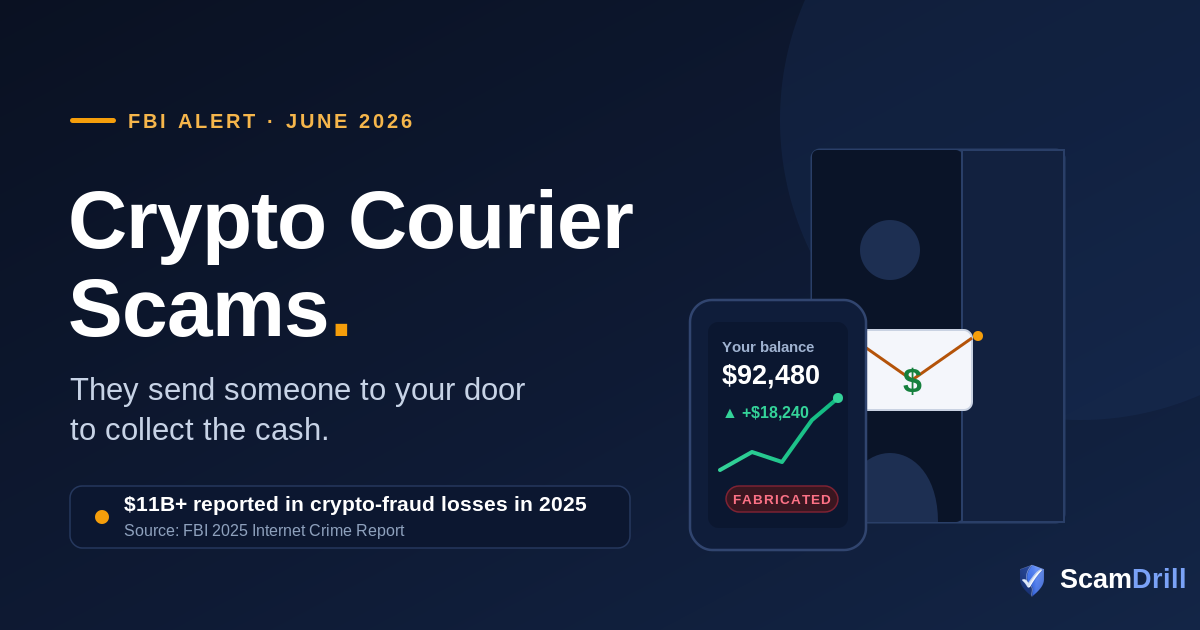
The FBI's Internet Crime Complaint Center put out a fresh warning about this on June 15, 2026, aimed squarely at a tactic it is seeing more of: couriers collecting cash for fraudulent crypto platforms, most often from older adults (IC3 alert I-061526-PSA). Cash pickups aren't new to fraud. What's new is bolting them onto the long-con investment scams that have already drained billions, as a workaround for banks that finally started saying no.
What is a crypto courier scam?
A crypto courier scam is an investment-fraud tactic where a scammer, after building trust online, convinces the victim to withdraw cash and hand it to an in-person courier — claiming it protects money on a fake cryptocurrency platform. The cash is stolen, and the gains shown on screen are fake.
Five signs a cash-courier request is a scam
You don't need to understand cryptocurrency to catch this. If any one of these shows up, stop and treat it as fraud:
- Someone tells you to pull out cash to "protect" or "free up" an investment. Real accounts don't get safer by converting them to bills in a bag.
- A person will meet you to collect the money. At your door, a coffee shop, a parking lot — anywhere. Legitimate firms move money electronically, never by hand.
- You're given a password or a dollar-bill serial number to confirm you've got the right courier. That ritual exists to make theft feel official.
- Your app shows gains, but every withdrawal needs another payment first — a tax, a fee, an "unflagging" charge. Real exchanges don't bill you to release your own money.
- You're told to keep it secret and stop talking to your bank. Isolation is the tool that keeps the scheme alive.
You will usually see several of these at once, stacked so fast they don't leave room to think. That speed is deliberate — it’s the urgency tactic doing its job.
Why this matters: the courier step usually arrives late in the con, after weeks or months of grooming, when the victim is already emotionally and financially committed. By then the warning that would have worked on day one — "this is a scam" — sounds to them like the accusation, not the rescue. Knowing the shape of it in advance is what gives a person a chance to see it from the inside.
Why the courier is a new twist on an old con
For years the front end of this scheme has had a name: pig butchering. A stranger strikes up a warm conversation — a wrong-number text that turns friendly, a dating-app match, a LinkedIn message about a "can't-lose" opportunity. Over weeks they earn trust, then introduce a crypto trading app that shows steady, thrilling returns. We wrote about that opening move in detail in our guide to pig-butchering warning signs, and it is worth reading if any of this sounds familiar.
The money used to leave by wire. The victim would send transfer after transfer to accounts they believed belonged to the investment platform. But banks and credit unions have gotten sharper about spotting these transfers and slowing or blocking them — sometimes the one thing standing between a victim and their savings. So the scammers adapted. The FBI's June alert spells out the pivot plainly: when a financial institution denies a suspicious transfer, the scammer tells the victim that an in-person cash pickup is now required to keep investing, or to pay a "fee" to withdraw.
In-person collection itself isn't a crypto invention. The FBI flagged couriers picking up cash and gold from tech-support and government-impersonation victims back in a January 2024 alert, which tallied more than $55 million in losses in just seven months of 2023. What is happening now is those two playbooks merging: the patient, relationship-driven investment con up front, and the cash-courier collection on the back end, once the digital rails get cut off.

How the scam actually plays out
It runs on a schedule, even if the victim never sees the clock. Here is the sequence the FBI describes, translated into what it feels like from the inside.
The relationship comes first. Someone reaches out. Maybe it's a text that opens with "Hi David, are we still on for lunch?" — wrong number, no harm, and they're so pleasant that the conversation just keeps going. Maybe it's a match who's easy to talk to and never asks for anything, at first. The FBI's own tips name the technique: love bombing, where a target is flooded with attention and warmth until their guard drops. If you want to understand why this works on careful, intelligent people, we pulled apart the machinery in how scammers persuade you.
Not sure about a text you just got?
A friendly message from a stranger is where a lot of these cons begin. Paste the text into our free checker and it flags the patterns behind openers like these in seconds — nothing to install, and nothing leaves your phone.
Check a suspicious text → Check an email →Then the investment. The new friend mentions how well they're doing in crypto, offers to show you, walks you through downloading an app and funding an account. The early numbers are good. You might even be allowed to withdraw a small amount at the start — a deliberate move that turns skepticism into confidence. You put in more.
Then the wall. You try to send a larger transfer and your bank flags it, or a teller asks pointed questions, or the wire just doesn't go through. To the scammer this is a problem to route around, and they have the script ready. Your account is "flagged." A "compliance fee" is due. The exchange needs a cash deposit to "verify" you. Whatever the wording, the destination is the same: get the money out of the traceable banking system and into cash.
The handoff ritual
This is the detail that makes the whole thing feel legitimate, and it's worth sitting with for a second. The scammer tells you a courier will come to collect the cash, and gives you a way to know it's really "their" person: a code word, or the serial number of a specific U.S. dollar bill. When the courier shows up and recites it, the exchange feels secure. Verified. Professional.
It's theater. A shared password only proves the courier is working with the same voice on your phone — the voice that has been lying to you for weeks. It tells you nothing about whether the investment is real. The ritual is engineered to borrow the feeling of a secure transaction and staple it onto a robbery.
The tell you can't argue with
There is no version of a real financial transaction that involves a stranger coming to your home to collect an envelope of cash. Not for taxes, not for verification, not for "protecting" your account. If a person is being sent to pick up money, the decision is already made: it's a scam, and the answer is to stop, not to complete the handoff.
Then the loop closes. After the pickup, your account balance jumps. The profits look bigger than ever. And when you try to cash out, there's a new obstacle — a tax, a penalty, an anti-money-laundering "hold" that only clears if you pay. Every payment feeds the next demand. This is the same trap that snaps shut on victims who think the worst is behind them, and it's why the recovery stage is so dangerous; we covered that second wave in recovery scams, the second scam.
Who's being targeted — and why it works
The FBI is blunt about who's in the crosshairs: victims are "usually senior citizens." That isn't because older adults are gullible. It's because they're more likely to have retirement savings within reach, more likely to be home when a courier can come by, and part of a generation raised to be polite to someone standing on the porch. The losses reflect the targeting. People 60 and older reported about $7.7 billion in fraud losses in 2025, up 37% in a single year.
There's a second reason it works, and it has nothing to do with age. The whole con is built to convert doubt into loyalty. By the time cash enters the picture, the victim has a relationship with the scammer, a running story about their investment, and often a small "successful" withdrawal in the past that proved it was real. Warning them feels like attacking the one person who's been on their side. The anatomy of a modern scam is less about a single trick and more about this slow inversion, where the mark ends up defending the fraud.
The FTC's latest numbers put the scale of the broader problem in view. People reported losing $3.5 billion to imposter scams in 2025, nearly one in three fraud reports, with many of the costliest starting as a fake security alert that convinces someone to move money to "protect" it. That's the same emotional lever the courier scam pulls, just with a person sent to finish the job.
Why your bank can’t be the last line of defense
This tactic exists because the banking system got better at its job. Wire transfers to sketchy accounts get flagged; card networks claw back fraud; a teller who senses something wrong can slow a transaction down. So the scammers routed around all of it. Cash is legal, ordinary, and once it's in an envelope, the paper trail a wire leaves behind is gone. The courier is, in effect, a way to launder the last mile of a digital scam into an untraceable, in-person handoff.
Banks and some states have added friction — holds on large or unusual withdrawals, mandatory scam warnings, "trusted contact" alerts — and those genuinely help. But a coached victim can defeat most of them. The FBI describes scammers who tell people to withdraw smaller amounts across several branches, keep a cover story ready ("a home renovation," "buying a car"), and never mention an investment. A teller's question only works if the person answering it already suspects the answer.
Which is why the safeguard that actually holds isn't at the counter. It's a decision made ahead of time: no investment, and no "account protection," is ever worth handing cash to a stranger. The FTC built a 2026 public campaign around exactly this instinct, called Never Ever — a short list of things government and legitimate businesses will never do, including telling you to move money to keep it safe. It's a good phrase to keep in a back pocket. Never ever.
If a courier is scheduled — or already came
If you or someone you love is mid-scheme, the goal is to stop the next handoff and cut the scammer's access, in that order. Move calmly and fast.
- Don't complete any pickup. Don't meet the courier, don't open the door, don't leave cash anywhere. There's no penalty for standing someone up who was coming to rob you.
- Stop paying and stop talking. No more "taxes," fees, or verification deposits. Every extra dollar is gone the moment it changes hands.
- Call the bank. Report the withdrawals and any earlier wires so they can watch the accounts, flag the recipients, and try to halt anything still in flight.
- Write down everything. Names, numbers, the app, wallet addresses, courier descriptions, vehicles, times. It matters for reporting and for any investigation.
- Report it. File with the FBI and the FTC (details below), and call local police, especially if a courier came to a home.
Where to report
FBI Internet Crime Complaint Center: ic3.gov — include bank accounts and crypto wallets you were told to use.
FTC: ReportFraud.ftc.gov.
DOJ Elder Justice Hotline: 1-833-372-8311 — for victims 60 or older, or family members helping them file.
Local police: file a report, particularly if a pickup happened at a residence.
How to talk to a parent who's in the middle of it
The hardest cases aren't the ones where you spot a scam email. They're the ones where someone you love is weeks deep and certain they're fine. Leading with "you're being scammed" tends to backfire, because it lines you up against the scammer for their trust — and the scammer has had more practice. Ask to see the app and the messages without judgment. Get curious instead of alarmed: how do withdrawals work, who set this up, what happens if they try to take it all out today. Let the loop reveal itself.
If you have parents or grandparents who fit the profile, it's worth having the conversation before there's a courier on the way. Our playbook for protecting elderly parents and the guide to reviewing their financial statements both help you spot the early money movements — the first unusual withdrawals — while there's still time to step in. And if you think money has already gone out, our "I've been scammed, what now?" tool walks through the next steps for the specific situation.
Make "no real investment sends a courier" an automatic reflex.
ScamDrill runs your family through realistic practice scenarios — including investment and cash-pickup cons — so the red flags fire on their own before a real one arrives. Setup takes under 10 minutes.
Start your family plan →The one line worth sending today
If someone in your life is the type to help a stranger who seems friendly, send them a single sentence: “If any investment or 'account protection' ever asks you to take out cash and give it to a person — at the door, a store, anywhere — it's a scam. Don't do it, and call me first.”
It takes thirty seconds. It might be the thing they remember when a calm voice on the phone tells them a courier is on the way and everything is fine. Send it while it's in front of you.