The Influence Stack: How Scammers Use Persuasion Psychology Against You
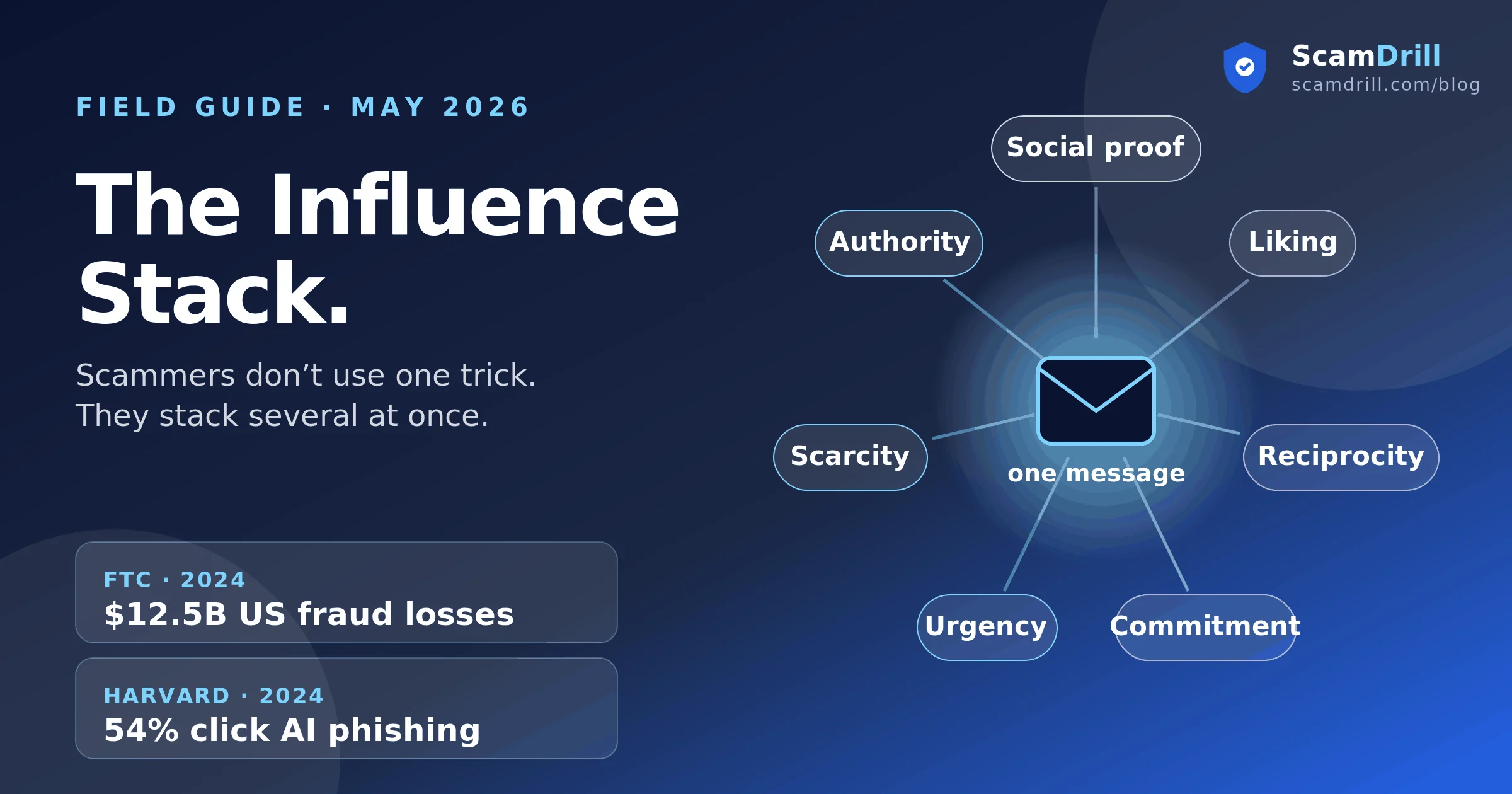
There is a comforting story we tell about scam victims, and it goes like this: they were careless, or greedy, or simply not paying attention. It is comforting because it implies the rest of us are safe. It is also wrong. The people who lost a combined $12.5 billion to fraud in 2024, according to the US Federal Trade Commission, were not unusually foolish. They were busy, distracted, hopeful, or under pressure — ordinary human states — at the exact moment a message arrived that was engineered to exploit them.
What makes a scam work is not a clever lie. It is a precise understanding of how human decisions get made, and which mental shortcuts can be triggered on demand. The psychologist Robert Cialdini spent decades cataloguing these shortcuts, and his principles of influence — authority, scarcity, social proof, liking, reciprocity, commitment, and unity — have since become required reading on both sides of the fight. Marketers use them to sell. Scammers use them to steal. The difference is not the toolkit; it is the intent.
Influence isn’t a trick. It’s a shortcut you can’t turn off
Your brain handles thousands of micro-decisions a day, and it cannot afford to deliberate over each one. So it leans on rules of thumb. If a message comes from someone in authority, comply. If something is scarce, want it more. If everyone else is doing it, it is probably safe. These shortcuts are not defects. They are what let a person function in a world too complex to analyze from scratch every morning. Cialdini’s insight was that because the shortcuts are automatic, they can be tripped by anyone who knows the trigger — including someone who has manufactured a fake version of the cue.
That is the uncomfortable core of the whole subject. You cannot simply decide to stop responding to authority or urgency, any more than you can decide to stop flinching at a loud noise. Recent academic work bears this out. A 2024 study at Harvard Kennedy School found that phishing emails written entirely by AI achieved a 54 percent click-through rate — statistically on par with messages crafted by human social-engineering experts, and roughly 350 percent more effective than a generic control message. The participants were not unintelligent. The persuasion was just well-built.
Content analyses of real phishing campaigns published between 2023 and 2025 point in the same direction. When researchers code which of Cialdini’s principles appear in a message, authority and scarcity show up most often, and liking and authority turn out to be the strongest predictors of whether a target actually takes the bait. None of this is intuitive from inside the moment. That is the point.
The real weapon is the stack, not the single trick
Most explanations of scam psychology stop at the list above, as if a scammer picks one principle off the shelf and runs with it. The list is useful, but it is also the part everyone already half-knows. Here is the part that matters more and gets discussed less: real scams almost never use one principle. They use four or five at once, layered into a single message so the cues reinforce each other. Researchers coding live phishing campaigns routinely find multiple principles co-occurring in the same email, and the reason is simple — pressure compounds. Authority on its own can be questioned. Authority plus a deadline plus the sense that everyone else has already complied is much harder to step outside of. You can watch all of it compound in the jury duty “arrest warrant” scam, where a “court officer,” a signed-looking warrant, and a same-day deadline arrive in one breathless call.
Consider an ordinary bank-impersonation text, the kind that topped the FTC’s list of reported text scams in 2024, and read it the way a scammer designed it:
The genius of that message is not any single line. It is the layering. The sender name borrows authority. The precise dollar amount and the phrase “new device” supply plausibility and a jolt of fear. The countdown manufactures urgency. And “reply 1” extracts a tiny commitment — once you have answered, you are in a conversation, and consistency pressure makes the next request feel like a natural continuation rather than a fresh decision you could refuse. By the time a real person is on the line, three or four shortcuts are firing simultaneously, which is exactly what they were chosen to do. This is the same architecture behind the AI-driven impersonation covered in our neo-phishing guide, the cloned-voice calls in our AI voice-cloning guide, and the confident fake recruiters in our remote job-scam playbook.
The traits being exploited are the ones you’d want in a colleague
Here is the perspective that tends to land hardest. The instincts a scam preys on are not weaknesses you should feel embarrassed about. They are, in most contexts, virtues. Deference to authority is what keeps an organization functioning; nobody wants the employee who treats every instruction from the finance director as a potential trap. A bias toward helping is what makes someone a good neighbor and a decent coworker. Consistency — following through on what you have started — is the backbone of trustworthiness. Scammers do not target the worst in us. They target the parts of us that the rest of life rewards.
That reframing matters for two reasons. First, it dissolves the shame that keeps victims silent, and silence is the scammer’s most reliable ally; the FTC and FBI both estimate that the large majority of fraud goes unreported. Second, it explains why “just be more skeptical” is such weak advice. You cannot run your whole life in interrogation mode without becoming impossible to work or live with. The realistic goal is not permanent suspicion. It is learning to recognize the specific texture of a stacked influence attempt — and to install one reliable circuit-breaker. Our breakdown of the wider anatomy of a modern scam shows where this persuasion sits inside the broader criminal supply chain, and our look at social engineering against small businesses covers the workplace version up close.
Slow scams stack the same levers — just over months
Fast scams compress the stack into thirty words. Slow scams stretch it across a relationship. Romance and so-called “pig-butchering” investment scams are the clearest example, and they lean overwhelmingly on liking, reciprocity, and commitment. Research published in 2025 in the Journal of Cybersecurity describes the playbook in clinical detail: weeks of warmth and constant contact build genuine attachment (liking), small confided secrets and gifts create a sense of mutual obligation (reciprocity), and then a first tiny investment is allowed to “pay out” a fake profit. That first small step is the hinge. Once a victim has put in a little and seen it grow, the sunk-cost fallacy takes over, and every subsequent transfer feels consistent with a decision they have already made. Pulling out would mean admitting the earlier steps were a mistake — so they keep going.
The mechanics are identical to the bank text; only the clock is different. If you are worried about someone in this situation, the warning signs and the conversation to have are in our romance-scam guide for families and the deeper pig-butchering breakdown.
How to break the stack
You do not defeat a stacked influence attempt by being smarter than it. You defeat it by changing the conditions it needs to work. Every principle in the stack depends on you staying inside the conversation the scammer controls, on a clock the scammer sets. Remove either of those and the whole structure loses its footing.
The circuit-breaker
When a message makes you feel you must act right now, treat the urgency itself as the red flag — not a detail to act on. Then verify through a separate channel you choose: hang up and call the bank on the number printed on your card, or text the relative on the number already in your phone. Naming the pressure out loud (“this is using a deadline on me”) is enough to switch the analytical part of your brain back on. Legitimate organizations do not lose anything if you take ten minutes to call them back. Scammers lose everything.
The single most useful habit is the out-of-band check, because it neutralizes the entire stack at once rather than each principle in turn. The authority cue cannot survive you dialing the real number. The urgency cannot survive a deliberate pause. The commitment pressure cannot survive a second opinion from someone who is not inside the scammer’s frame. This is also why practice beats theory: in the moment, you will not run down a checklist of seven principles, but you can train the reflex to slow down when something feels engineered to speed you up.
Recognizing the levers is the first half. The second half is rehearsing the response often enough that it fires automatically — the same way the scam does. For a sense of which specific lures are circulating right now, our May 2026 scam-trends roundup tracks what the influence stack is being wrapped around this month.
You can’t un-know a tactic you’ve felt.
ScamDrill sends safe, realistic fake texts, voicemails, and emails — built on the exact persuasion tactics in this article — to your family or team on a rotating schedule. When someone reacts to one, they get a teachable moment instead of a real loss.
Start free →