The Second Scam: How “Recovery” Cons Hunt People Who Were Already Scammed
Bottom line up front
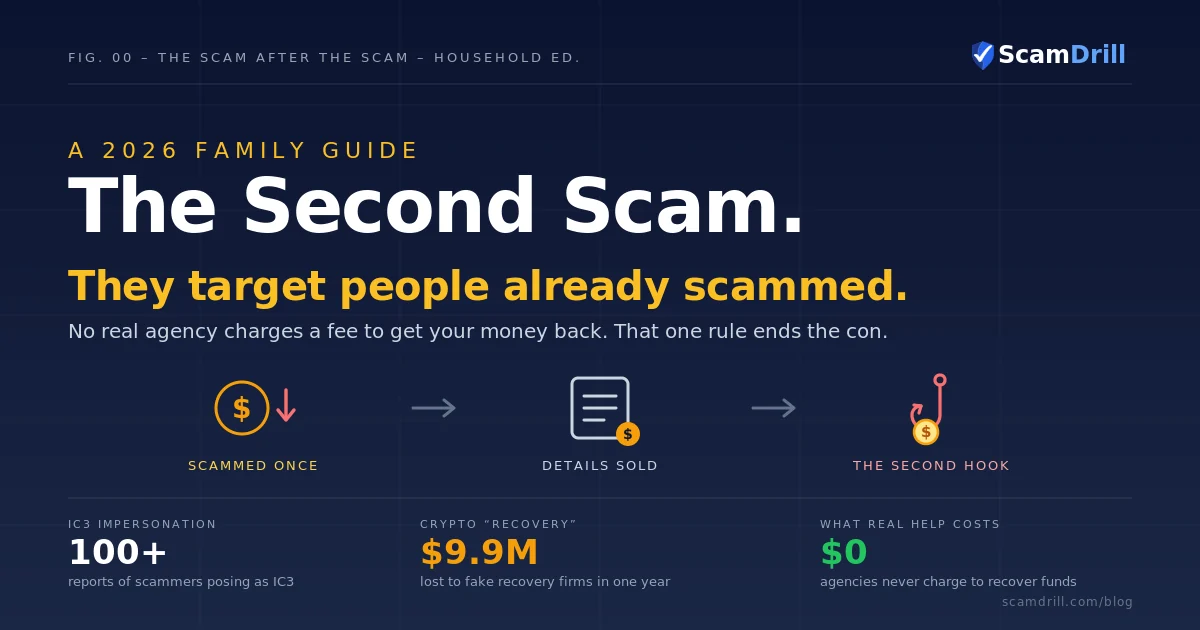
A recovery scam is the second con aimed at people who already lost money to fraud: a stranger posing as the FBI, a lawyer, or a “fund recovery” firm offers to get your money back for a fee. No legitimate agency ever charges to recover stolen funds, so the moment anyone asks you to pay, you are being scammed again. Here is how to spot it and where to report fraud for free.
Been scammed and trying to get your money back?
Report it for free — the FTC at reportfraud.ftc.gov and the FBI at ic3.gov. No legitimate agency or firm charges a fee to recover funds, so treat anyone who does as a second scam. Then close the door on the next attempt: run a suspicious message through our free email scam checker or SMS scam checker, and read our first-hour-after-a-scam guide.
The first message arrives a few weeks after the worst day of the year. The wire is long gone, the bank has said what banks say, and a stranger in a Facebook group for fraud victims sends a kind, knowing note. They were scammed too. They know how it feels. And they know a person who got their money back.
That is the opening move of a recovery scam, and it is one of the cruelest things in the entire fraud economy. It does not target the unwary. It targets people who have already paid, already grieved, and are desperate enough to believe that the money might still be out there. The FTC has a blunt name for these schemes. It calls them “the worst of the worst: scams that target people who have already lost money to a scam.”
If you have read our companion piece on what to do in the first hour after a scam, this is the sequel nobody warns you about: the second con, built specifically for the freshly burned.
Why they found you specifically
Recovery scams are not random. The people behind them work from lists. The FTC explains the mechanism in plain language: “Scammers buy lists of people who’ve paid scammers. They call it a ‘sucker list,’ with information about people, like your name, address, and phone number, the kind of scam that tricked you, and how much money you paid.” Those lists get bought, sold, and traded, on the simple logic that someone scammed once is a softer target the second time. People coming off a fake remote job or recruiter scam are squarely on that list, and are routinely re-approached with a bogus offer to recover what they lost.
There is a second supply line, too, and it is more personal. Recovery scammers go where victims gather to heal. The FBI reported in April 2025 that fraudsters create fake profiles, often posing as a fellow victim, join online groups for fraud survivors, and earn trust before steering people toward a supposed recovery agent. In one documented pattern, the contact handed victims off to a character calling himself the “Chief Director” of the FBI’s own Internet Crime Complaint Center over an encrypted chat app. He claimed he had recovered their funds. He had not. He was collecting their banking details to rob them again. The FBI sharpened that warning in July 2026: the impersonators now add AI deepfake videos of senior officials and spoofed IC3 websites, a shift we break down in the fake FBI and IC3 impersonation scam.
Figure 01 · Anatomy of the second scam

Pattern per FTC “Refund and Recovery Scams” and FBI IC3 advisories, 2023–2025.
Who they pretend to be
The costume changes, but the goal never does. Across the FTC’s guidance and a string of FBI alerts, recovery scammers impersonate four kinds of authority. Sometimes they pose as a government agency or the FBI’s IC3 itself. Sometimes they are a law firm claiming to work with the FBI or the Consumer Financial Protection Bureau. Sometimes they are a private “fund recovery” or “asset tracing” company that found you online. And sometimes they are the original scam company circling back, now offering refunds to the customers it just burned.
The impersonation has gotten more elaborate. In an August 2025 alert, the FBI described fake law firms that combine multiple tricks at once: forged letterhead, invented regulators with official-sounding names like the “International Financial Trading Commission,” and claims of being an authorized partner of a US government agency. The Bureau’s response is a single clean sentence worth memorizing: “There are no law firms which are officially authorized partners of US Government agencies.”
The reason this works has nothing to do with how smart you are. The FBI named it directly, describing schemes that succeed by “exploiting victims’ emotional state and financial need to recover funds from a previous scam.” That is the engine. We unpack the broader machinery in our piece on the persuasion psychology scammers use, but recovery scams run on one feeling above all others: hope.
The one tell that never changes
You can skip the entire detective exercise if you remember a single rule. A real agency never asks you to pay to get your money back. Law enforcement does not charge victims a fee to investigate a crime. The FBI’s IC3 stated it flatly in 2025: it “will not ask for payment to recover lost funds, nor will they refer a victim to a company requesting payment for recovering funds.”
So the moment money is requested, in any form and under any label, you are talking to the second scammer. The labels are designed to sound bureaucratic and harmless. The FTC lists the usual ones: a “retainer fee,” a “processing fee,” an “administrative charge,” a “tax,” or a “shipment and handling charge.” Newer versions demand cryptocurrency or prepaid gift cards, which are nearly impossible to claw back, and that demand alone is a screaming red flag.
Figure 02 · A real agency vs. a recovery scammer
Behaviors per FBI IC3 alerts I-041825, I-062424, I-081325 and FTC consumer guidance.
How to verify a recovery offer in five minutes
If a contact has you wondering, slow everything down. Urgency is the scammer’s only real weapon, and it evaporates under a few deliberate minutes. Here is the whole check.
- Assume it is a scam until proven otherwise. An unsolicited offer to recover your money is a scam in the overwhelming majority of cases. Start from there and make them earn your trust, not the other way around.
- Never use the number or link they gave you. If they claim to be a bank, an agency, or a firm, hang up and look up the real contact independently. Type ic3.gov straight into your browser. The FBI warned in September 2025 that scammers buy search ads to impersonate IC3, so do not click a sponsored result.
- Watch for the fee. Any request for an upfront payment, a tax, a release fee, more banking details, crypto, or gift cards ends the conversation. That is the line a real agency will never cross.
- Remember IC3 has no social media and never DMs you. The FBI has said plainly that the IC3 “does not maintain any social media presence” and will never reach out to you directly.
If it involves cryptocurrency
Crypto recovery is where these scams cluster hardest. Services that advertise the ability to trace and return lost cryptocurrency for a fee are, almost without exception, scams, and the FBI has issued repeated warnings about fake “crypto recovery” firms. If your original loss was a crypto investment con, the recovery pitch is part two of the same script. Our guide to pig-butchering crypto scams walks through how the first stage hooks people, which makes the follow-up easier to see coming.
Where to actually report, all of it free
Real recovery, when it is possible at all, runs through your bank, the courts, and law enforcement, never through a stranger who found you in a comment thread. Every legitimate channel below is free. None of them will ever ask you for a fee.
Figure 03 · The only places worth your time
Channels verified active via FBI IC3, FTC, and AARP, June 2026.
If you think you are mid-conversation with a recovery scammer
- Stop sending money and stop sharing information. Not one more dollar, not one more account number, no matter what stage they say the recovery is at.
- Do not act on the urgency. “The funds will be released today” is a script, not a deadline.
- Save everything. Screenshot the messages, the profiles, the phone numbers, and any payment receipts, then report it at ic3.gov.
- Tell someone in your family today. The second scam thrives on the silence that shame creates.
The part that actually protects you
Older adults carry the heaviest losses in fraud overall. The FBI’s 2024 report counted reported losses topping $16 billion across the year, with people over 60 losing nearly $5 billion of it, and the 2025 report pushed that older-adult figure to roughly $7.7 billion. Recovery scammers concentrate on exactly that group, not because older people are gullible, but because they are more likely to be sitting on a painful first loss worth chasing. If you are helping a parent, our 2026 playbook for protecting elderly parents covers the conversations that come after a first incident, the ones where a recovery call is most likely to land.
Here is the uncomfortable truth that ties it together. Almost everyone who falls for a recovery scam already knew, in the abstract, that you cannot pay to get scammed money back. They knew it the way you know to look both ways. The knowledge did not save them, because the call arrived on a bad day wearing a badge and offering the one thing they wanted most. Information is not the same as a reflex.
That gap is exactly what a drill closes. Workplaces figured this out years ago: people learn to spot a phish only after they have safely failed for one in a low-stakes setting. The same logic works at the kitchen table. A few realistic, gentle simulations a month, including the “we can recover your funds” pitch, build the pause that no article can. We make the full case in our family simulation guide.
Practice the pause before a scammer tests it.
ScamDrill sends safe, realistic scam simulations to the people you love, from smishing texts to recovery-scam follow-ups, with an instant teachable moment the second someone bites. It turns “I know better” into “I caught it.”
Start free →The whole thing in one line
If anyone contacts you out of the blue and offers to recover money you lost to a scam, especially for a fee, it is the second scam, every time. Real agencies do not charge to give you your money back, and they do not slide into your DMs to say so. Save that one rule, share this with the person in your life most likely to need it, and the recovery con loses the only thing it runs on.