Fake Remote Jobs Are Up 1,000%: The 2026 Recruiter-Scam Playbook (and How to Verify a Real Offer)
Bottom line up front
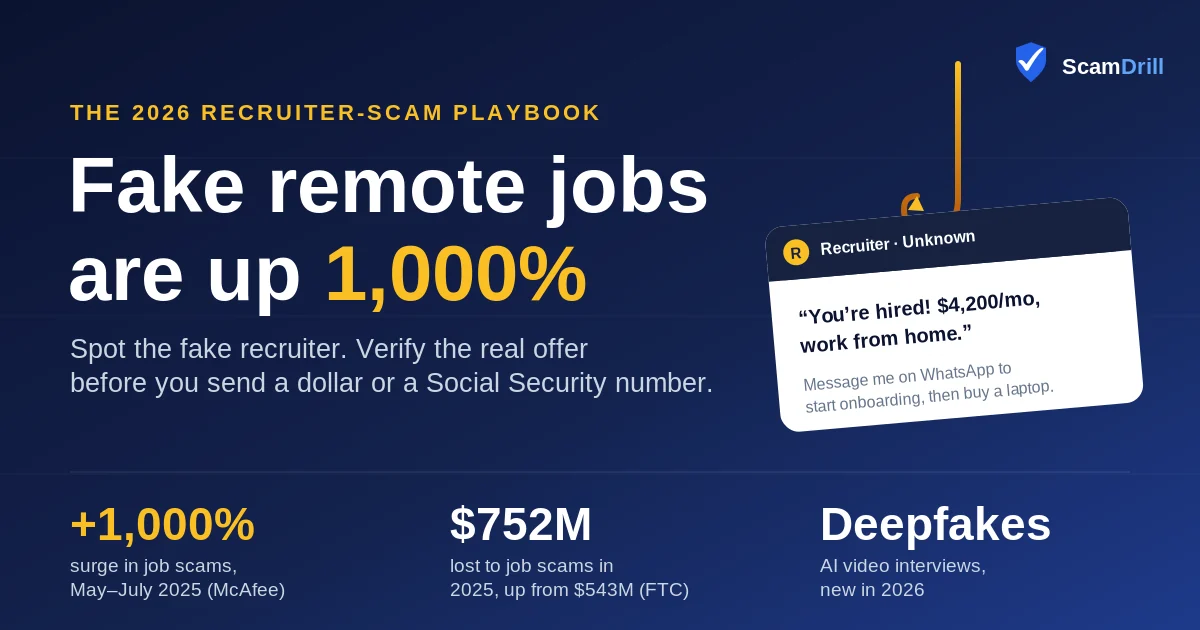
Fake remote job offers are everywhere right now, and the people running them are good. A real employer never asks you to pay for equipment, never sends a check you have to partially send back, and never hires you over a chat app with no real interview. If money has to move from you to a “new job” in any direction, it is a scam. Below: the seven red flags, the four schemes in the wild, and a 90-second way to verify a recruiter before you give them anything.
The message lands at a good moment, which is the whole point. You have been applying for weeks, or you just got laid off, or you are trying to find something flexible you can do from home. The note is friendly and specific. The pay is better than you expected. The interview, if there even was one, felt easy. And somewhere underneath the relief, a small part of you notices that something is slightly off, and tells you not to be paranoid.
Listen to that part. Job scams have exploded into one of the fastest-growing frauds in the country, and they are engineered to slip past exactly the careful, hopeful person reading this. This is the playbook: how the current scams work, who they are hitting hardest, and how to check whether an offer is real before you send a dollar or a Social Security number.
7 red flags this “job” is a scam
If you only read one section, read this one. Any single item below is enough to walk away. Two or more, and you are almost certainly being scammed.
The seven red flags
- The conversation jumps off the platform. A recruiter contacts you on LinkedIn or a job board, then quickly pushes you to keep talking on WhatsApp, Telegram, or personal text. Real hiring stays on email and the company’s own systems.
- You’re “hired” with no real interview — or a chat-only one. No phone call, no video, no one who can answer detailed questions about the role. An offer that arrives entirely over text is a scam tell.
- You’re asked to buy equipment and “get reimbursed.” Real employers ship you a laptop or buy gear directly. Being told to pay first, from a specific vendor, and wait for a refund is the setup for a theft.
- A check arrives for more than you’re owed. You’re told to deposit it and send back the difference, or forward part of it to a “vendor.” This is a fake check scam, every time.
- The recruiter’s profile is brand new. A days-old account with a handful of connections, no work history, and a stock-looking photo is not a person who has been recruiting for a decade.
- The company email is a free address. Mail from gmail.com or outlook.com instead of a real company domain (like @company.com) means there is no company behind it.
- They want your SSN or bank details before you’ve signed. Social Security number, bank account, or a photo of your ID requested early, before a real, verified offer, is how identity theft starts.
The FTC put out a plain-language version of several of these in an April 2026 alert, “That job offer text is probably a scam,” warning about fake recruiters claiming to hire for vague “remote position” or “online assessor” roles. Many of these now arrive the same way fake delivery notices do, as a text out of nowhere — the same channel we cover in our guide to USPS and delivery text scams.
Got a recruiter message or “offer” that feels off?
Before you reply, run it through our free checker. Paste the email or text and it flags the tells behind fake-job scams — the upfront “equipment” fee, the check to deposit, the rush onto WhatsApp — in seconds.
Check an email → Check a text →What is a remote job scam?
Definition
A remote job scam is a fraud in which criminals pose as recruiters or employers and offer work-from-home jobs that don’t exist. They use the fake offer to steal money — through bad-check deposits, equipment “reimbursements,” or upfront fees — or to harvest personal data like your Social Security or bank account number before you ever start work.
The mechanics vary, but the shape is constant. Someone manufactures trust quickly, manufactures urgency right behind it, and then introduces a reason that money or personal information has to move. The job is the costume. The payment request is the crime.
The four scams in market right now
Most fake job offers in 2026 are a version of one of these four. Knowing the shape of each makes the next one easy to spot.
1. The fake check and equipment “reimbursement” scam
This is the most common version, and the most expensive. After a quick “hire,” the company says it will set you up to work from home. They mail or email you a check — often for more than your supposed first paycheck — and tell you to use part of it to buy a laptop, software licenses, or a “home office package” from a specific vendor. Sometimes you’re told to deposit the check and wire back the extra. Either way, the check is fake.
Here is the part that traps careful people: when you deposit a check, your bank often makes the funds available within a day or two, before the check has actually cleared. It looks like real money in your account. So you send the “vendor” payment or wire back the difference in good faith. Days later, the check bounces, the bank pulls the full amount back out, and the money you forwarded is gone — to the scammer. You are left owing your own bank. The FTC is blunt about the rule that defeats this: never use money from a check to send a payment to someone, and never accept a job that asks you to.
Figure 01 · How the fake-check job scam takes your money

Pattern per FTC “How to Spot, Avoid, and Report Fake Check Scams” and FTC job-scam guidance, 2025–2026.
2. The recruiter impersonation scam
Here the scammer doesn’t invent a fake company — they borrow a real one. They build a profile claiming to be a recruiter or HR manager at a company you recognize, sometimes copying a real employee’s name and headshot. The listing looks legitimate because the company is legitimate. The person contacting you is not.
This is why the platforms themselves keep flagging the problem. Reporting on LinkedIn and ZipRecruiter has documented fraudsters exploiting real job boards and posting fake listings under real company names, and security analysts tracking LinkedIn job scams in 2026 describe networks of polished but fraudulent recruiter accounts. The platforms are not the villains here; they are the venue, the same way a parking lot is not at fault for a car break-in. The fix is to verify the person against the company, not the company against the person. And the same broken hiring pipeline gets attacked from the other side too: for the employer’s view — fraudulent applicants using deepfakes and stolen identities to get hired — the red flags run in reverse.
The check takes 90 seconds: go to the company’s actual website, find the role on its real careers page, and confirm the recruiter through the company’s published contacts — not the phone number or email the recruiter gave you. If the “recruiter from Acme” emails you from a Gmail address and the job isn’t listed anywhere on Acme’s site, you have your answer.
Figure 02 · A real recruiter vs. a scam account
Tells per FTC job-scam guidance, NBC News, and Skrapp LinkedIn job-scam research, 2025–2026.
3. The “online assessor” and pay-to-train gig scam
Some scams don’t bother with a fake employer at all — they sell you a job. You’re recruited for easy remote work like rating products, “optimizing” apps, or being an “online assessor.” You complete a few small tasks and even see a small balance build up in a dashboard. Then comes the catch: to unlock your earnings, hit the next tier, or get “certified,” you have to deposit your own money first. The FTC calls these task scams, and the early payouts exist only to convince you the later deposits are safe. They are not.
This overlaps heavily with the gig and “earn from your phone” cons that target younger workers, which we break down in our guide to micro-task scams aimed at teens and young adults. The rule is the same across all of them: a real job pays you. You never pay it.
4. The deepfake video interview — new in 2026
The newest twist closes the one gap that used to give scams away: the lack of a live, on-camera person. In 2026, fraudsters began running interviews using real-time AI face-swap and voice tools, appearing on Zoom or Teams as a convincing “recruiter” or “hiring manager.” McAfee, which tracked the surge in job scams, notes that scammers now build polished profiles, clone company websites, and use AI-generated interviews to appear credible, with many scams completed in under an hour.
A video call is no longer proof of anything. The defense doesn’t change: a deepfake can fake a face, but it can’t put a real job on the company’s real careers page or send mail from a real company domain. If you want to see how AI is reshaping this whole category, our breakdown of the persuasion psychology scammers use explains why a confident face on a screen lowers your guard so effectively — and why authority and urgency are the levers being pulled.
Build the pause before a scammer tests it.
ScamDrill sends safe, realistic scam simulations — including fake recruiter texts and job offers — to you or the people you care about, with an instant teachable moment the second someone bites. It turns “I know better” into “I caught it.”
Start free →Who is being targeted most right now
These scams find people at the moment they have the least room to be skeptical. That isn’t an accident. Scammers go where need is highest, because need is what they sell against.
Recent grads are a prime target. They are new to hiring, unsure what a normal process looks like, and eager to land a first role. McAfee found that scam victims under 35 are more likely than older adults to be targeted again, and that nearly 3 in 10 people ages 18 to 24 report getting conversational scams that open with friendly, low-pressure messages — the exact tone a fake recruiter uses.
Laid-off tech workers are targeted precisely because they are qualified and looking. After a round of layoffs, scammers flood professional networks with fake openings that match real job titles, knowing that someone three months into a search will give a promising message the benefit of the doubt. There is no shame in that. A long search wears down anyone’s skepticism, and the scam is built to arrive on the day it’s lowest.
Military spouses are hit hard enough to deserve their own section, below.
If you are deep in a job search and one of these got close, that is not a verdict on your judgment. The whole design is to defeat smart, careful people who are under pressure. The same forces show up in other life-transition scams — we cover the version aimed at people who already lost money once in our piece on recovery scams, the second con, which job-scam victims are specifically targeted for afterward.
How to verify a real recruiter in 90 seconds
You don’t need to become an investigator. Four quick checks will clear the overwhelming majority of fake offers, and you can run them before you reply to anything.
- Check the profile’s age and network. Open the recruiter’s profile and look for history: years of activity, a real work record, mutual connections, past posts. A brand-new account with a dozen connections and no past is the single most common scam signature. Resources like guides on spotting remote job scams and 2026 analyses of AI-driven LinkedIn scams put profile age near the top of every list.
- Find the role on the company’s own careers page. Go to the company website directly — type the address yourself, don’t click a link the recruiter sent — and look for the exact job. If it isn’t there, that is a strong signal. Real openings are almost always posted on the employer’s own site.
- Check the email domain. A real recruiter at a real company uses that company’s domain (name@company.com). Gmail, Outlook, or a look-alike domain (company-careers.com, company.hr-team.com) is a red flag on its own.
- Call the company and ask. Look up the main number on the company’s website and call HR or the front desk. Ask whether the recruiter works there and whether the role is real. Thirty seconds on the phone ends most of these.
Two questions a scammer can’t answer well
If you want a fast pressure test, ask: “Can you send the offer from your company email and point me to the listing on your careers page?” and “Can we do a short video call so I can ask about the team?” A real recruiter says yes without friction. A scammer stalls, makes excuses, or gets pushy about time — which is its own answer.
What to do if you already sent money or info
If you’re reading this after the fact, take a breath. You are not the first and the speed of your next few moves matters more than anything that already happened. Work down this list in order.
- Call your bank now. Tell them you believe you deposited a fraudulent check or were tricked into a payment. Ask whether the wire or transfer can be stopped, recalled, or reversed. With wires especially, the first hours are when a recall is most likely to work. If you paid by gift card, contact the card’s issuer right away and ask them to freeze the funds.
- Report it to the FBI at ic3.gov. The Internet Crime Complaint Center is the federal channel for this. Include every detail: messages, names, profiles, account numbers, amounts, and dates.
- Report it to the FTC at reportfraud.ftc.gov. This feeds the database law enforcement uses and helps build cases against the networks running these scams.
- Freeze your credit at all three bureaus. If you shared your Social Security number, place a free freeze at Equifax, Experian, and TransUnion so no one can open accounts in your name. If your identity was exposed, identitytheft.gov builds you a step-by-step recovery plan.
- Change your passwords. Start with any account you reused a password on or shared during the “onboarding,” especially email and banking, and turn on two-factor authentication.
Do not trust anyone who offers to “recover” your money
Within days or weeks of a job scam, many victims get a second contact — a “fund recovery” service, a “cyber investigator,” or someone posing as a government agency — promising to get the lost money back for a fee. This is a second scam aimed squarely at people who were just hit. No legitimate agency charges a fee to recover stolen funds, and the moment anyone asks you to pay, you are being scammed again. We walk through exactly how this follow-on con works in The Second Scam: when a stranger offers to get your money back.
Here is the honest part. Money sent to scammers is hard to recover, and often it doesn’t come back at all, especially with wires, crypto, and gift cards. Anyone who promises you a guaranteed recovery is lying. What the steps above actually do is stop the bleeding: halt a still-pending transfer, limit identity damage, and put your case on the record. That is worth doing fast and completely, even when the odds on the original money are bad.
For military spouses and remote-first households
Military spouses get targeted out of proportion, and it’s easy to see why: frequent moves with a servicemember make portable, work-from-anywhere jobs a real need, not a luxury, so “remote, flexible, start immediately” lands harder. Scammers tailor fake listings to military-friendly job boards and spouse employment groups, sometimes wrapping them in patriotic language or fake “military spouse preference” programs. None of that changes the checks: confirm the role on the company’s real careers page, verify the recruiter’s email domain, and never pay for equipment, training, or a background check. If your household is navigating a PCS or a new-duty-station job hunt, our guide to scams targeting the military community and our PCS rental-scam playbook cover the adjacent cons that hit during a move.
The thing that actually protects you
Information isn’t the same as a reflex. Almost everyone who falls for a fake job offer already knew, in the abstract, that you shouldn’t pay to work or send back part of a check. They knew it the way you know to check your mirrors. The knowledge didn’t fire in the moment, because the moment arrived wearing a job title they wanted, on a day the search had worn them down.
That gap — between knowing and catching — is what practice closes. Workplaces learned this years ago with phishing drills: people get good at spotting a fake only after they’ve safely failed for one in a setting where nothing is at stake. The same logic works for job scams. A few realistic, low-stakes simulations build the half-second pause that an article alone can’t. You can test your own instincts right now with our free Scam IQ quiz, brush up on the broader signals in our guide to spotting common scams, or see how household-wide practice works on a quick tour of ScamDrill for families.
The whole thing in one line
Real employers pay you; they never need you to pay them, float them a check, or hand over your SSN before a verified offer. If money or sensitive information has to move from you to a “job” in any direction, stop and verify the company directly — careers page, email domain, a real phone call — before you do anything else. Save that rule, send this to the person in your life who’s job hunting, and the recruiter scam loses the only thing it runs on.