The “Easy Online Job” Scam Aimed at Your Teen: How Task Scams Work
Bottom line up front
The ‘get paid to like videos or complete simple tasks’ job is a scam. It shows small fake ‘earnings,’ then asks you to deposit your own money to unlock a bigger payout — and that deposit is the theft. No real job ever asks you to pay to get paid. If an app shows a rising balance you can’t withdraw without adding funds first, stop, add nothing more, and block the contact.
The message lands like a tap on the shoulder. “Hi! I’m a recruiter hiring for flexible online work — rate products from your phone, $150–$400 a day, no experience needed. Interested?” No interview, no résumé, no company you’ve heard of. Just a friendly stranger on WhatsApp who somehow has your number, or a DM under a TikTok you barely remember posting.
Most parents picture a scam victim as someone elderly and alone at a kitchen table. The data says almost the opposite. In its 2025 figures, the Federal Trade Commission found the youngest consumers were more than twice as likely as the oldest to report actually losing money to a scam — 51% of fraud reports from people 19 and under involved a real financial loss, against 21% from people 80 and over. Older victims lose far more per scam, but younger people get caught more often. And one of the fastest-growing traps reeling them in barely existed five years ago.
It’s called a task scam, and it is engineered — almost surgically — for the way young people already use their phones.
What a task scam actually is
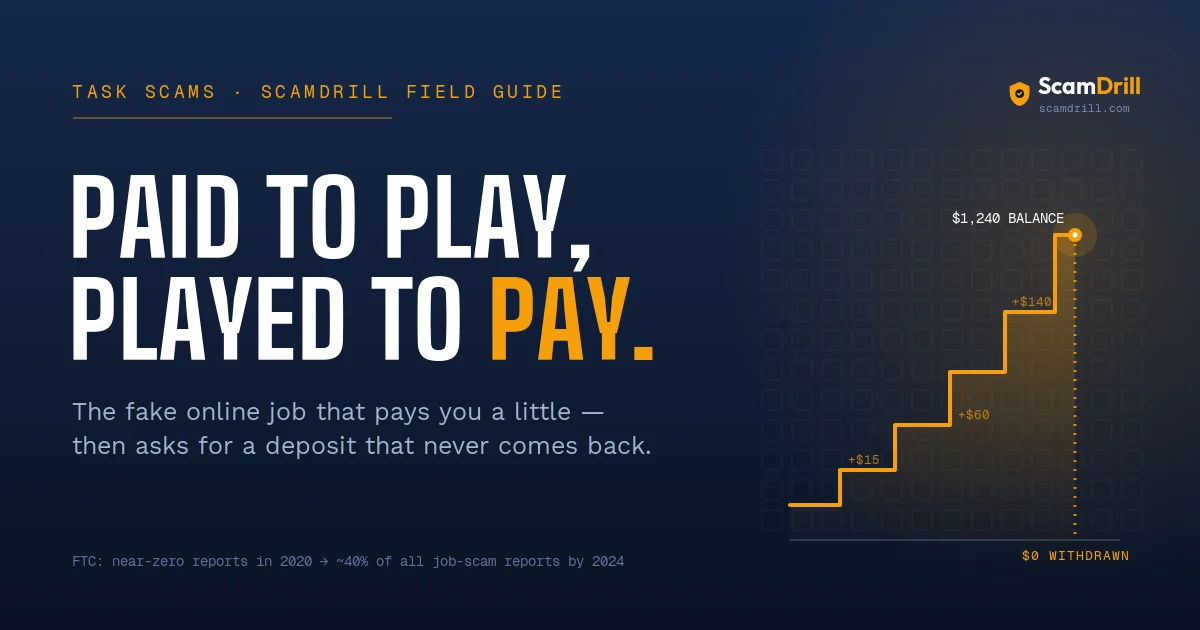
A task scam — the FTC calls it a gamified job scam — is a fake job built to look like a mobile game. It opens with that unexpected message offering “online work” with no real details, usually wrapped in buzzwords like “product boosting” or “app optimization.” You’re sent to a slick app or website and handed simple, repetitive jobs: like a batch of videos, rate product photos, “submit” orders. The tasks come in sets — often forty at a time — and a running balance ticks upward with every tap.
Then comes the part that disarms even careful people: they actually pay you. A small, real withdrawal — usually somewhere between $5 and $20 — lands in your account. It’s not a pitch anymore; it feels like proof. That little payout is the most expensive $10 in the whole scheme, because it quietly converts a skeptic into a believer.
Eventually a “combination task” or a “double task” appears, worth far more than the rest. But to unlock it — or to pull out the balance glowing on your screen — the app says you first have to deposit your own money, almost always in cryptocurrency. Charge up the account, finish the set, and you’ll supposedly get it all back plus commission. Except you won’t. The earnings were a number on a screen the whole time, and crypto sent to a stranger doesn’t come back. The FTC reports crypto is the payment of choice here, with reported crypto losses to job scams roughly doubling to $41 million in just the first half of 2024.
A task scam is a loop, not a job. The small real payout in step 3 exists only to set up the deposit in step 4.
Got a text offering easy paid tasks?
“Just finish a few tasks and get paid” is the opener for a scam that ends with you depositing your own money to “unlock” earnings. Paste the message into our free SMS Scam Checker to see the tells before you reply.
Check a suspicious text →It’s not a job. It’s a slot machine wearing a lanyard.
Look at the mechanics and you stop seeing a workplace and start seeing a casino floor: a balance that climbs, levels to clear, streaks to protect, a progress bar that’s almost full, and a buzzing group chat where “mentors” cheer you toward the next deposit. None of that is decoration. It’s the same variable-reward loop the most addictive apps and games use, pointed at the generation that grew up fluent in exactly those loops.
That’s also why it lands on teens and twenty-somethings in particular. They’re the most comfortable group alive with side hustles, gig work, and getting paid through an app, so “flexible online job” reads as normal rather than alarming. They’re often the most financially stretched, so a few hundred dollars a day from the couch is genuinely tempting. And “get paid to scroll and tap” sounds, to someone who already does that for free all day, completely believable.
How to check whether a task app or job offer is legitimate
Task scams rename themselves constantly, so searching an app’s name often turns up nothing either way — and a clean search result proves nothing. These checks work no matter what the app is called:
- Pin down exactly what it is. Write down the app or site’s full name, its web address, and who publishes it. Copycats use near-identical names, so a good review of a similar-sounding app tells you nothing about this one.
- Find the employer yourself. Look up the company behind the offer on your own, then contact it through its official website or a phone number you found independently — not through the recruiter, the group chat, or the link that reached you.
- Get the pay terms before you do any work. A real job tells you what you’ll be paid, how, and when, in writing.
- Ask the one question that settles it. Will you ever have to pay or deposit money — to unlock tasks, reach a new level, or withdraw what you’ve earned? If the answer is yes, it’s a scam. That deposit-to-continue step is the pattern the FTC describes in gamified job scams.
- Don’t count an early payout as proof. Small real withdrawals at the start are part of the script, not a sign of legitimacy. Neither is a polished app, a business registration, or a friendly “mentor.”
If the offer arrived as a message, you can check the message itself: check a suspicious job-offer email or check a recruitment text. Both run in your browser.
What it actually looks like
The brand-ambassador DM. An Instagram or TikTok account — sometimes using a real influencer’s stolen photos — messages your teen to “get paid to like and comment” or to become a “part-time brand ambassador.” The first few tasks pay out. The momentum does the rest.
The WhatsApp “remote gig.” A recruiter pitches data entry, hotel reviewing, or app testing, then moves the chat into a polished portal where the tasks and the fake balance live. This is the exact pattern the FTC describes: an unexpected message, vague work, and an app that makes pretend earnings feel real. The grown-up cousin of this con — fake remote jobs and fake recruiters aimed at adult job seekers — runs on the same playbook, which we break down in the 2026 recruiter-scam guide.
The success-story group chat. If you hesitate before depositing, you’re dropped into a group where “experienced workers” post screenshots of $480 days and thank the boss for changing their lives. They’re all fake — props in a play staged just for you. The FTC specifically warns about these manufactured chats.
The teen-sized version. Younger kids get a smaller-scale lure: “I’ll pay you to like my videos,” or offers of free Robux, V-Bucks, or game skins “just for completing a few tasks.” Same machine, lower stakes — and excellent practice for the scammer’s next, bigger ask.
Five questions, opposite answers. If the right-hand column sounds like the “job” in your DMs, stop before you deposit anything.
The part nobody puts on the recruiting flyer
Here is the perspective that changes how this whole thing feels. The person messaging your teen about an easy online job may not be a willing scammer at all — they may be a prisoner. The UN Office on Drugs and Crime reports that hundreds of thousands of people have been trafficked into guarded compounds across Cambodia, Myanmar, Laos, the Philippines, and Malaysia, where their passports are confiscated and they’re forced to run online scams under daily quotas and the threat of violence. In May 2025, UN human-rights experts called it a humanitarian and human-rights crisis.
And how were most of those workers recruited? With a fake job ad promising flexible, well-paid work abroad — the same lie, pointed the other way. So one scam template runs in both directions at once: it’s used to enslave the worker who sends the message, and to rob the young person who answers it. That’s worth telling your teen plainly, because it dissolves the shame that keeps victims silent. Falling for this isn’t a sign someone is gullible — it’s a sign they ran into an industrial machine built by organized crime. For the bigger picture of how these operations run like a business, see our breakdown of the anatomy of a modern scam.
How to shut it down
Nobody needs to memorize scam types. One sentence defuses nearly every version of this, and it’s worth saying out loud at dinner this week. If you would rather hand them something, the fake job offer sits alongside three others on our page of warning signs worth showing a teenager once.
The line that ends every task scam
No legitimate job ever asks you to pay money in order to get paid. Real employers don’t hire through surprise texts or WhatsApp messages, they don’t pay you up front to build “trust,” and nobody can legally pay you to like or rate things online. The moment a “job” asks for a deposit, a top-up, or a fee to unlock your earnings, it’s a scam — full stop, no exceptions.
And if you’re the young adult reading this directly: the small payout is the tell, not the reassurance. A real employer doesn’t need to hand you $15 to prove it’s real before you’ve done anything that matters. If the entire “job” lives inside an app you’d never heard of yesterday, pays you a little, and then needs money from you to keep going — that’s not a slow start. That’s the whole scam, and right now you’re standing at the only exit you’ll get for free.
If money already changed hands
Stop paying first, then move fast — and lead with reassurance
Don’t send another cent to “unlock” or “withdraw” anything; that promise is the trap closing again. If the payment went by bank transfer or card, call the bank or card issuer immediately to try to reverse or flag it. Crypto is usually unrecoverable, but still report it — patterns help investigators. Save the messages, app screenshots, and any wallet addresses, then report it at reportfraud.ftc.gov and to the FBI at ic3.gov. One thing before any of that, though: if it was your teen, don’t open with anger. Young people who expect to be blamed are the ones who hide the next scam until it’s much worse.
Task scams rarely travel alone. The crypto “deposit to withdraw” mechanic is a close cousin of pig-butchering investment scams; the trust-building and manufactured urgency are textbook examples of the psychology scammers use to persuade you; and the surprise-message delivery is the same engine behind QR-code “quishing” and USPS text scams. If you’re raising kids, our 2026 internet-safety guide for tweens and teens folds all of it into one household game plan.
Make “pay to get paid” an instant red flag.
ScamDrill sends safe, realistic practice scams — including fake job offers and task-scam lures — to your household on a rotating schedule. When someone takes the bait, they get a friendly teachable moment instead of an emptied account.
Start your family plan →