The ShinyHunters Canvas Hack: What Every Business Should Take From the Largest Education Breach on Record
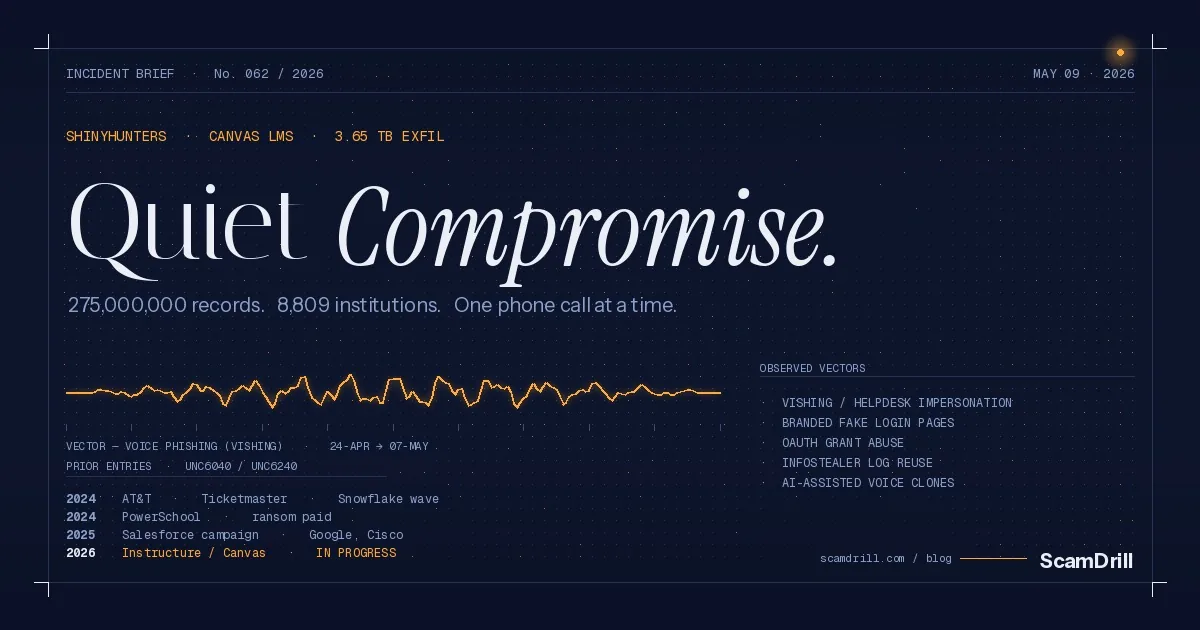
If you have a kid in college or a teacher in the family, you have probably already heard about the Canvas outage — the “security patch” banners since May 1, finals rescheduled at Penn, Harvard, and Duke, the “PAY OR LEAK” message that briefly replaced the Instructure splash screen. The reason that page went sideways is a name anyone in security has been hearing for five years now: ShinyHunters.
The headline numbers are staggering. ShinyHunters claim to have stolen 3.65 terabytes of data covering roughly 275 million users across 8,809 institutions — universities, K–12 districts, and entire national education ministries that route through Canvas. Wikipedia’s running summary calls it the largest education-sector breach on record. The deadline posted on the Canvas login page gives affected schools until May 12, 2026 to negotiate via Tox.
The story matters far beyond education. The way ShinyHunters got in is the same playbook that hit AT&T, Ticketmaster, Snowflake customers, PowerSchool, Google, and a long tail of Salesforce tenants. It is mostly a phone call. And almost every business now lives downstream of a SaaS vendor that could get the same call next week.
What we know about the Canvas incident
Here is what is publicly confirmed. Instructure detected unauthorized activity on April 29, 2026 and pulled parts of Canvas offline on May 1. The company notified affected schools May 5. ShinyHunters publicly claimed responsibility on May 7, and that day the Canvas login page was changed to read “PAY OR LEAK” with negotiation instructions. CNN, TIME, and Inside Higher Ed all carried the same outline within hours of each other.
The exact entry point is still moving in the public reporting. Early Instructure statements pointed to a vulnerability tied to the platform’s Free-For-Teacher account tier. Mandiant’s commentary on the same window adds the part that is more useful to the rest of us: the attackers used voice-phishing calls and company-branded fake login pages to harvest employee credentials before pivoting to SaaS data. Times Higher Education flagged the secondary risk this week: stolen private messages between students and teachers are perfect raw material for personalized follow-on phishing.
Who ShinyHunters actually are
If the name conjures up a shadowy state-sponsored APT, recalibrate. ShinyHunters have been around since roughly 2020 and have always read more like a forum-grown extortion crew than a government operation. Emsisoft threat-intel analyst Luke Connolly described them this week as “a loose group of teenagers and young adults based in the US and the United Kingdom.” Mandiant tracks the cluster behind the 2025–2026 SaaS campaigns as UNC6040 and UNC6240.
Two arrests in 2024 are worth knowing about. Connor Riley Moucka, then 25, was arrested in Kitchener, Ontario in October 2024 and faces US charges including conspiracy, computer fraud, extortion, and identity theft. John Erin Binns, 24, was arrested in Turkey in May 2024 and is fighting extradition tied to the 2021 T-Mobile breach. Even with those two off the board, the brand keeps operating — ShinyHunters is less a fixed roster than a logo anyone with the right contacts can run a campaign under.
Update, September 2026: the same group claimed a breach of the FBI’s own jobs portal. What an HR-system breach like that means for employees and applicants is written up separately, and so is what it means for the employers who hold that data.
A Five-Year ShinyHunters Trail
The tactics: why a phone call is the new zero-day
The thing that surprises most non-security people about ShinyHunters is how little of their playbook is technical. They are not, generally, finding new vulnerabilities in widely deployed software. They are calling the helpdesk.
1. Vishing as the front door. The signature ShinyHunters move is a phone call from someone claiming to be IT support — sometimes the company’s actual IT support, sometimes a SaaS vendor like Salesforce or Okta. Varonis’s analysis of UNC6040 and Google’s Threat Intelligence team both describe the same script: caller has the employee’s name, role, and a plausible reason to be calling, then walks them through approving an OAuth app, entering credentials on a real-looking Salesforce or Okta page, or installing what they say is the “official” Data Loader tool. The branded login page is the trick — it uses your company logo, your colors, your subdomain pattern. By the time the employee notices the extra URL character, the OAuth token has already been issued.
2. AI-assisted helpdesk impersonation. Google’s 2026 follow-up describes the group layering legitimate AI voice platforms on top of vishing — automated agents that handle the early script before handing off to a human if the target hesitates. Three seconds of voice training is enough to clone a vendor’s real account manager, which is the same dynamic we’ve been writing about in neo-phishing and AI voice cloning. The crew that used to be a human reading from a script is now a human plus a voice clone plus a translation model.
3. Stolen credentials from infostealer logs. The 2024 Snowflake wave that hit AT&T and Ticketmaster did not involve a Snowflake vulnerability. The attackers bought infostealer logs — bundles of credentials harvested from random employees’ personal devices by malware like Lumma, Vidar, and Redline — and reused them against corporate Snowflake tenants that had no MFA enforcement. The sheer cheapness of the input (a few dollars per log) is what made 160 organizations possible.
4. Branded extortion sites and dark-web pressure. Once data is out, ShinyHunters do not just email the CISO. They post samples on a leak site, alert reporters, and increasingly, as in the Canvas case, deface the victim’s own product so that customers see the ransom note before the legal team does. That is a deliberately public threat model, and it is hard to stay quiet through.
What this means by company size
The Canvas incident is dominating the headlines because of who got hit. The lesson, though, has very little to do with education. It has to do with the dependency graph almost every business now runs on top of.
Small businesses (under ~50 employees)
You do not have a CISO. You probably do not have an IT team large enough to staff a real helpdesk. That is fine, and it is also exactly what ShinyHunters operators count on. The two changes that are worth the time this week are an honest SaaS inventory — literally a Google Sheet listing every tool that holds customer or employee data, who owns it, and whether MFA is on — and a callback rule for any password reset, MFA reset, or banking-detail change. Anyone, internal or external, who calls and asks for one of those gets a callback to a number you already have. Our social engineering guide for SMBs walks through both in detail; the 30-day phishing-simulation plan is a good follow-up if you want to make this a habit, not a memo.
Mid-size businesses (50–1,000 employees)
This is where the ShinyHunters pattern stings the most. Mid-market companies have enough SaaS tools to be interesting (Salesforce, Workday, NetSuite, Zendesk, a couple of CRMs nobody is sure who owns) and not enough security headcount to police OAuth grants and conditional-access policies in any of them. Two non-negotiables for this segment: review every OAuth app connected to your major SaaS tenants, and add conditional-access rules that block logins from unmanaged devices or anomalous geographies. Add a tabletop exercise in which a “Salesforce support” vishing call is the kickoff event, and watch how quickly the gaps surface. The 2026 AI cybersecurity landscape post has more on what is realistic for a team of five to actually defend.
Large enterprises (1,000+ employees)
You already have an OAuth policy. The Canvas incident, like the Salesforce wave before it, is the case that the policy you have is not enough. Treat third-party SaaS like you treat employees: just-in-time access, not standing OAuth grants; phishing-resistant MFA (FIDO2, hardware keys) for any account that can extract data; helpdesk verification scripts that explicitly assume the caller is lying about who they are; and a shared-services-style detection feed for OAuth grant anomalies across tenants. The Arup deepfake CFO case from 2024 and the Canvas vishing chain in 2026 are the same shape of attack, scaled differently. The defense is also the same shape: change the channel any time money, access, or confidentiality is on the line.
Anatomy of a ShinyHunters Vishing Attack
If you are downstream of the Canvas breach
If your school, district, or company uses Canvas, treat this as an active campaign — not a finished incident. The data ShinyHunters claim to have (names, emails, student IDs, full message threads) is the perfect input for a follow-on personalized phishing wave. Times Higher Education flagged the same risk this week: expect emails that quote a real conversation a student had with a real professor, sent from a domain that looks identical to your registrar’s.
This week’s checklist
- Tell every Canvas user — staff and students — not to trust password-reset emails or “urgent action required” messages, even if they reference real coursework.
- Reset passwords on any account that reused the same password as Canvas.
- Turn on MFA everywhere it isn’t already, ideally with a hardware key or passkey for staff with admin privileges.
- Watch for phone calls claiming to be from “Instructure support” or your IT helpdesk asking for credentials. Hang up and call back on a known number.
The bigger picture
The thing that should keep founders and CISOs up at night is not the size of the Canvas number. It’s the unit economics. A loose collective of teenagers and twenty-somethings, with no zero-days, has now stitched together at least four nine-figure breaches over five years, almost entirely on the back of phone calls and infostealer logs. The Salesforce Data Loader trick alone has hit Google. The Snowflake credential reuse has hit AT&T. The ed-tech vendor pattern has now hit PowerSchool and Instructure within 18 months of each other.
If you run a business of any size, the practical takeaway is the same one we have been writing about all spring: the attack surface is no longer your perimeter. It is your people, your vendors, and the trust between them. Hardening the helpdesk — both yours and the ones your SaaS vendors run on your behalf — is the highest-leverage thing you can do this quarter. Everything else is downstream of that.
Drill the moment of doubt before it costs you a quarter.
ScamDrill sends realistic mock vishing calls, BEC emails, and OAuth-style phishing prompts to your team on a rotating schedule — with a friendly teachable moment when someone hands over credentials they shouldn’t have. Build the “hang up and call back” reflex.
Start free →