Ghost Students: How Strangers Take Out College Aid in Your Name
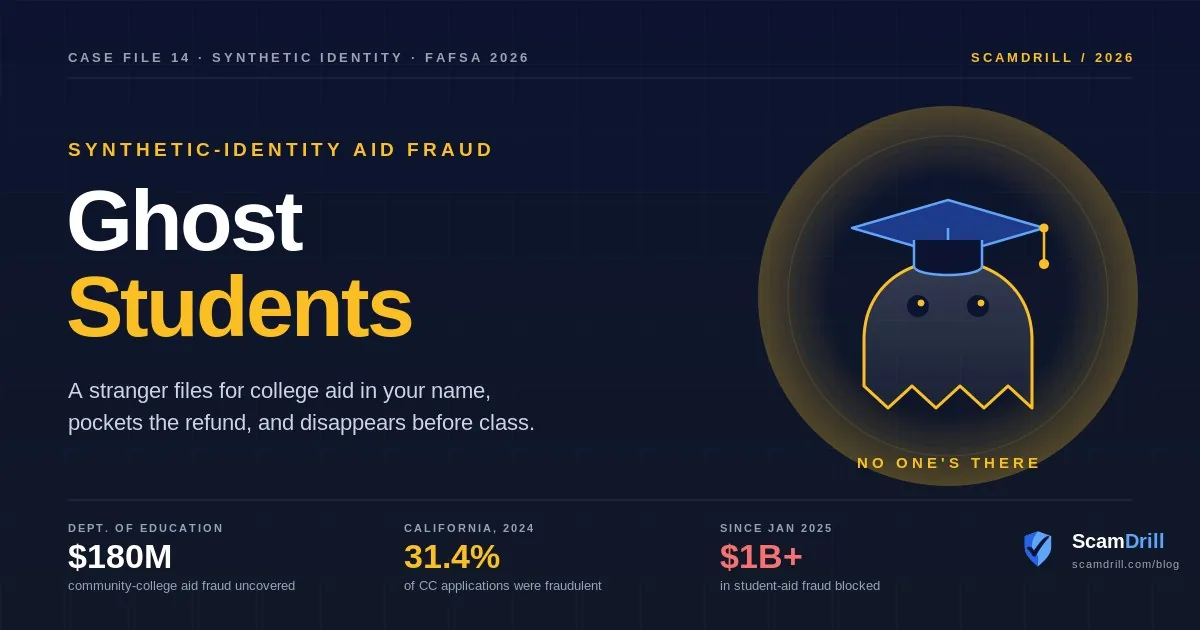
Somewhere there is a community college you have never set foot in, in a state you may have never lived in, and you are on its roster. A financial aid office has your name, your birthdate, and your Social Security number in a file. A Pell Grant was approved. A refund went out the door. None of it reached you, because the person enrolled under your name was never going to attend a single class. They were a ghost student, and you were the costume.
It sounds like a one-off horror story. It is closer to an industry. Over the past two years, organized fraud rings, some domestic and some run from overseas, have turned federal student aid into a payout machine, feeding it stolen identities and collecting the change. In April 2026 the Department of Education finally bolted a fraud detector onto the front door. Here is what these rings are actually doing with your name, what changed last month, and the handful of moves that put your identity, and your transcript, out of reach.
What a ghost student actually is
Strip away the spooky nickname and a ghost student is a refund scheme wearing a backpack. A ring takes a real or stitched-together identity, enrolls it at a school, claims financial aid in that name, and walks away before anyone notices the seat is empty. No lone hacker in a hoodie. These are operations run like small businesses, increasingly with AI bots filling out applications and “attending” just enough of an online class to stay enrolled.
Community colleges take the brunt of it for reasons that are almost insultingly simple. Enrollment is open, so nobody is screening for SAT scores or a high school transcript. Tuition is low. Classes are online, which means a bot can log in, post a sentence in a discussion board, and pass for a human. And the prize sitting at the end is the Pell Grant, the federal grant for lower-income students that, unlike a loan, never has to be repaid. When the grant is bigger than the cheap tuition it is supposed to cover, the school refunds the difference to the “student.” That refund, wired to an account the ring controls, is the whole point.
And the rings are patient. A single operation can run hundreds of identities at once across a dozen states, each one enrolled in a different online section, each drawing a few thousand dollars. The volume is the model. It carries a quieter cost too: when fake students fill the seats in a popular online class, real ones get waitlisted out of a section they actually needed, which is part of why colleges have turned so aggressive about screening.

Sources: U.S. Department of Education; Protiviti; Identity Theft Resource Center, 2025–2026.
Why your name, and not an invented one
A fully made-up identity tends to trip verification checks. A real one does not, which is why the rings want yours. The most valuable raw material is a Social Security number that nobody is watching: a young child who will not apply for credit for a decade, a retiree who is not enrolling in school, or someone who has died. The Department of Education found roughly $30 million in aid that had been paid out using the identities of deceased people. Those numbers do not get flagged by a human, because the human they belonged to is gone.
The supply of usable identities is the part that should worry every parent. The pipes feeding these rings are the same breaches filling the headlines. Student records have been hemorrhaging for two years, from the PowerSchool breach that exposed tens of millions of K-12 students to this spring’s ShinyHunters attack on Instructure’s Canvas platform, which we broke down in our Canvas hack post. A breach in a school district’s servers in 2024 becomes a fraudulent Pell Grant application in 2026, which is exactly why student data is now the hottest item on the criminal market. The kids whose data leaked are not old enough to apply for aid yet, but their identities are already in inventory.
This is not a fringe problem at a few unlucky campuses. In 2024, 31.4 percent of all applications to California’s 116 community colleges were fraudulent. Nearly a third. Admissions staff now spend part of every week deciding which of their new “students” are people.
Sources: U.S. Department of Education; California Community Colleges; Minnesota Office of Higher Education; 6abc/CCP, 2024–2025.
How you find out, usually too late
The cruel part is that almost no one gets a warning. The aid goes out, the ring disappears, and the paperwork lands on the real person months later. Murat Mayor and his teenage son learned they were ghosts only when they sat down to apply for the son’s actual financial aid. Someone had already enrolled both of them at community colleges scattered across the country and taken loans and grants in their names. They were not protecting against a future theft. They were cleaning up one that had been running for a while.
You do not need to wait for that moment. The fraud leaves a paper trail, and a few of those papers tend to reach the victim. If you see any of the following, treat it as a flare, not a clerical error.
Signs you might be someone’s ghost
- A 1098-T tuition tax form arrives from a school you never attended.
- A financial aid award letter or a loan servicer notice shows up in your name for a college you did not apply to.
- Your real FAFSA gets rejected because one was already filed under your Social Security number.
- A hold or balance appears on a student account you never opened, or collection letters reference an unfamiliar school.
- You are a parent and your child’s name turns up enrolled somewhere, years before they would apply.
What changed in April 2026
For years the front door was wide open. During the pandemic, identity verification was scaled back so far that fewer than one percent of applicants were ever asked to prove who they were, which is roughly how you end up with a third of California’s applications coming from nobody. That changed on April 26, 2026, when the Department of Education switched on real-time fraud detection built directly into the FAFSA. Now every application is screened as it is submitted, and anyone the system flags as high-risk has to present a government-issued ID, captured on a phone camera, before a dollar moves. The Department also went back and re-screened applications already sitting in the 2026-27 pile, and it estimates the whole effort will keep more than $1 billion away from fraudsters this cycle, on top of the billion-plus it says it has blocked since January 2025.
Then, on June 10, 2026, the House passed the No Aid for Ghost Students Act by a vote of 249 to 172. If it clears the Senate and becomes law, the screening stops being a policy the department can switch off and becomes a requirement: starting October 1, 2026, every FAFSA gets checked, and no aid goes to a flagged application unless the school confirms the person is real, either in person or over live video.
Sources: U.S. Department of Education press releases; Congress.gov (H.R. 7892), 2025–2026.
A detector on the front door is a real improvement, and it is overdue. It is also not a force field. Screening at the point of application does nothing to recall the identity that is already circulating in someone’s spreadsheet, and it cuts both ways: tighten the filter and some share of legitimate students, disproportionately the low-income and first-generation applicants the aid exists for, get flagged and told to prove themselves before their money arrives. The system can ask “is this person real,” but it cannot ask “is this person the one whose name is on the form.” That gap is yours to close.
Lock down your name, and your transcript
You cannot patch the Department of Education’s database, but you can make your own identity a dead end for a fraud ring. None of this takes money, and most of it takes an afternoon.
Five moves that close the door
- Claim your StudentAid.gov account before a stranger does. Create your FSA ID at studentaid.gov and check the Aid Dashboard for any loans, grants, or schools you do not recognize. An account you control is one a ring cannot open in your name. Never share the login, not even with a school.
- Freeze your credit at all three bureaus. Equifax, Experian, and TransUnion, free, and it blocks new accounts opened with your number. Freeze your kids’ credit too; a 9-year-old’s Social Security number is prime material precisely because nobody is watching it.
- Get an IRS Identity Protection PIN. A six-digit code from the IRS that stops anyone from filing a tax return under your number, which is the other half of how a stolen 1098-T becomes your problem.
- Read the mail you would normally toss. A 1098-T, an award letter, or a servicer notice from a school you never attended is the earliest warning you will get. Treat it as one.
- Review your statements like you mean it. The same habit that catches a fraudulent loan catches a fraudulent charge; our guide on reading a statement line by line works just as well on your own.
How to actually “lock” a transcript
Here is the move most people have never heard of. If you have ever attended a college, you can put the equivalent of a freeze on your education records. Send each registrar a written request to place a directory-information block on your file, the right granted to you under FERPA, the federal student-privacy law. The school flags your record, and that flag carries through to the National Student Clearinghouse, the service that answers “is this person enrolled?” and “did they graduate?” for schools, lenders, and employers across the country. With the block on, anyone trying to verify or trade on your student record, a fraud ring included, comes back empty. It is the closest thing that exists to a credit freeze for your academic identity, and almost nobody uses it.
If you discover you are already a victim, move in this order: call Federal Student Aid at 1-800-433-3243, tell the financial aid office at the school where the fraud happened, file a report at IdentityTheft.gov to generate a recovery plan, and add a police report for the paper trail. Then keep every document. You may need it to peel a fraudulent loan or tax form off your name later. If the whole thing has your head spinning, our first-hour guide to being scammed walks through it calmly.
The best ID check is a person who pauses.
ScamDrill runs realistic phishing, smishing, and voice-scam drills for your family or your staff, with a friendly teachable moment the instant someone clicks. It is how the people you care about learn to spot the message that hands over the data these rings run on. Your first drills are free.
Start your free drills →Ghost students worked because the system trusted a name without ever checking for a face behind it. That is finally changing at the federal level, slowly and imperfectly. Your part is smaller and more durable: claim your accounts, freeze what can be frozen, block your records, and read the strange mail. A name that leads nowhere is not worth a fraud ring’s time, and that is the whole game.