Midterm Election Scams 2026: The Four the FBI Flagged
Bottom line up front
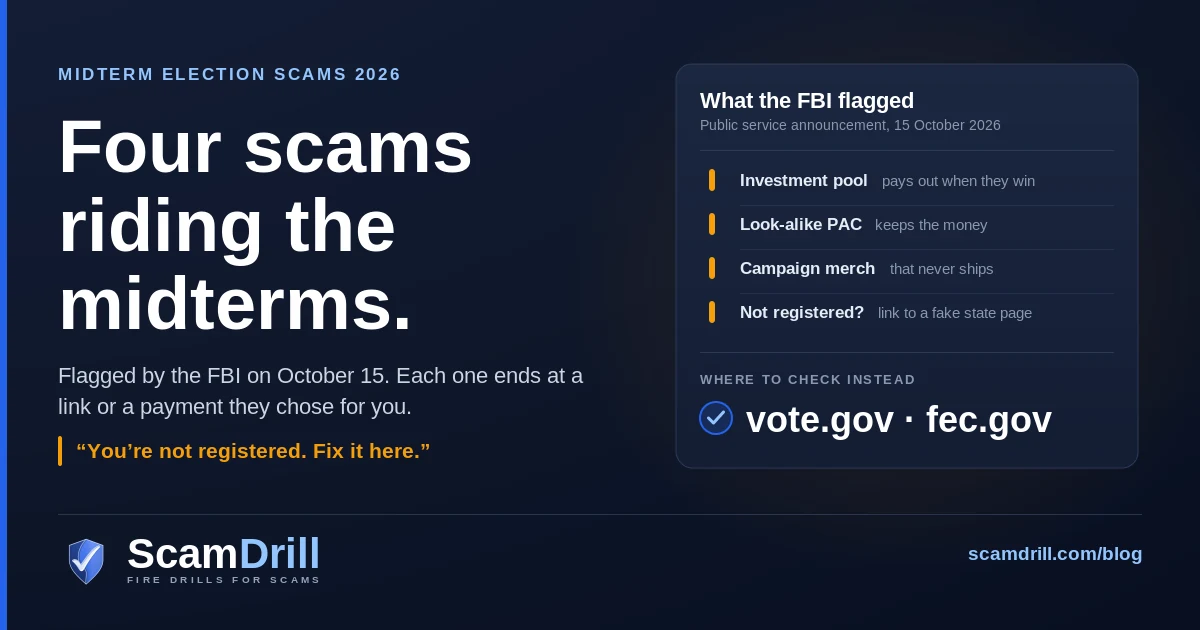
On October 15 the FBI warned that scammers are using the 2026 midterms to run four schemes: a fake “campaign investment pool,” donations to PACs that don’t exist, campaign merchandise that never ships, and texts claiming you aren’t registered to vote. All four end at a link or a payment someone else chose for you. The fix is the same each time: go to the source yourself. Check your registration at vote.gov, look up a committee at fec.gov, and give through a campaign site you typed in.
Election season fills phones with political messages. Most of them are real. Campaigns are allowed to text you, and plenty of them do, often several times a day by the first week of November. That’s exactly why it’s good cover. When a fake donation appeal or a fake registration alert lands in the middle of thirty real ones, it doesn’t stand out.
The FBI’s Internet Crime Complaint Center put out a public service announcement on October 15 (alert I-101526-3-PSA) naming four schemes it expects around the November 3 midterms. It’s an update to a warning the Bureau issued before the 2024 election, under almost the same title, which tells you something by itself: these plays come back every cycle, because they keep working.
This guide is not about who to vote for, and none of it depends on your party. Scammers borrow candidates from every side. What follows is how each of the four works, the red flags that give them away, what the robocall and text rules actually allow, and what to do if you already gave money or details.
Seven red flags in election-season messages
If you only read one section, make it this one. Any one of these is a reason to stop, close the message, and go check through a route you found yourself.
- A donation that promises a return. “Contribute now, collect when we win” is not how campaigns work. The FBI is blunt about it: “Campaign donations are not an investment and will not increase in value nor be returned.”
- A request to recruit friends into the pool. The FBI says victims of the campaign investment scheme are encouraged to bring in others to grow their payout. That’s the shape of a pyramid, not a campaign.
- “You are not registered to vote” with a link. Your registration status lives on your state’s election website. You can reach it from vote.gov without touching the link.
- A committee you can’t find on the FEC’s website, or one that sounds almost like a group you know. Federal political committees file with the Federal Election Commission, and the filings are public.
- Pressure to give right now, by a deadline that seems to reset every few hours, especially on a phone call.
- A payment method you wouldn’t use with a real campaign: gift cards, a wire, crypto, or a payment app sent to a person. The FTC’s guidance on giving says a group that only takes those is likely a scam.
- Merch from a store an ad found for you, at a price that beats the campaign’s own shop, with a checkout that nudges you away from a credit card.
Notice that none of these depend on spotting a typo or a strange accent. Those tells are mostly gone. As Cofense’s Max Gannon told Help Net Security, “AI has erased the clumsy mistakes that once gave these scams away.” The red flags that still work are about what the message asks you to do.
Definition
An election scam is a fraud that borrows the look of a candidate, a campaign, a political committee or an election office to take your money or your personal details. Common forms include fake donation appeals, phony PACs, campaign merchandise that never ships, and texts claiming you aren’t registered to vote.
What the FBI warned about on October 15
The PSA is short and worth reading in full. Its opening line says scammers “could exploit the 2026 US Midterm Election to perpetrate financial fraud schemes” and notes they have “previously exploited state and local elections” too. So this isn’t only about the races on national TV. A county commissioner’s name works just as well on a fake donation page, and it’s less likely anyone has warned you about it.
It describes the raw material the same way across all four schemes: scammers “use the names, images, logos, and slogans of candidates” to solicit contributions, sell merchandise, or collect personal information that can be used for more fraud. And it adds the 2026 twist. Scammers use AI tools “to generate highly realistic voices, images, and written messages that impersonate candidates, campaigns, government entities, and trusted contacts.”
Read that list closely. It isn’t only candidates. “Government entities” covers a fake county election office. “Trusted contacts” covers the friend whose account shares a fundraiser link, or the relative whose voice asks you to chip in. The FBI doesn’t give loss figures for election scams specifically, and it would be wrong to invent one. What it does give is the four patterns, which are below.

Schemes and checks per FBI IC3 PSA I-101526-3-PSA, 15 October 2026. Amber marks the attacker’s move, blue the check you make yourself.
The figure above is the whole post in one picture. Each scheme has its own story, and each has the same exit: a source you find yourself, not one the message hands you. The sections below take them one at a time.
The “campaign investment pool”
This is the strangest of the four, and in some ways the most revealing. In the FBI’s words, scammers “promise victims a guaranteed return on campaign contribution dollars by investing in a candidate campaign pool that supposedly pays out after the candidate wins.” Victims are then nudged to recruit others to grow their share.
Nothing about real political giving works that way. A contribution is money you give away. It doesn’t earn interest, it doesn’t pay a dividend when your candidate wins, and nobody will send it back to you with a bonus. The Register’s write-up of the PSA put it plainly: no genuine campaign donation appreciates over time.
So why would anyone fall for it? Because it mixes two things people feel strongly about at the same time, their politics and their money. A pitch that says “help our side win and come out ahead” lets the excitement about one cover for the doubt about the other. It also tends to arrive from someone you know, because the recruitment step means each victim becomes the next messenger. If a friend or a group chat is pitching a pool like this, they’re very likely a victim too, not the scammer.
Our piece on crypto investment scams covers the same mechanics with a different costume: early “payouts” to build trust, then a bigger ask, then a reason you can’t withdraw. If a political pool ever shows you a dashboard with your growing balance, assume that number is fiction.
ScamPACs and the donation that goes nowhere
The second scheme is the one most people will actually meet. The FBI describes scammers who “dupe victims into believing they are donating to a legitimate Political Action Committee (PAC), such as a Super PAC or candidate’s campaign committee but the scammers have no affiliation with the PAC and keep the funds.”
There are really two versions of this. One is outright impersonation: a text or a web page that copies a real committee’s name and look and takes your card number. The other is murkier, and the FBI’s own advice hints at it. It warns that “some scam PACs and SuperPACs may appear registered,” and that a committee reporting high spending on “fundraising, consulting, compliance, or other administrative costs” may be a scam. In other words, being on a list is not the same as being honest.
Here’s the check, and it takes about five minutes:
- Don’t give through the link in the message. Search for the candidate or committee yourself and find its official site.
- Look the committee up on the FEC’s committee search. You can filter by name, committee type and state, then open its filings.
- Skim where the money goes. If most of what it raises is spent on fundraising, consultants and “administrative” costs, rather than on the candidate or cause it names, take the FBI’s hint.
- Give by credit card on a site you typed in. That leaves you a dispute route if the charge turns out to be fraud.
One more wrinkle. The FTC’s guide Before Giving to a Charity warns that “some calls that sound like calls from a charity might actually be from a PAC,” and that donations to PACs aren’t tax-deductible. If a caller blurs the line between a cause and a committee, ask directly which one they are. A legitimate fundraiser can answer in a sentence. The same guide says that if the only way to pay is crypto, a wire through Western Union or MoneyGram, a payment app or a gift card, “it’s likely a scam,” and that a credit card or check is the safest way to give.
That payment check is the same one we hung our holiday scams guide on, and it carries over to political giving almost word for word. When the payment method is the one thing they won’t budge on, you have your answer.
Campaign merch that never ships
The third scheme is ordinary online shopping fraud with a political label. Scammers “claim to sell political merchandise but do not ship the purchase when ordered,” which the FBI calls “a classic ‘non-shipment scam’ or ‘non-delivery fraud’ scheme.”
Classic is right. In its 2025 Internet Crime Report, the IC3 logged 56,478 non-payment and non-delivery complaints, with reported losses of $503,373,587, making it the fifth most common complaint type of the year. That figure covers all online purchases, not just hats and yard signs, but the playbook is the same one. A social media ad shows a shirt or a flag you can’t find elsewhere, often tied to a moment in the news. The site looks fine. The order confirms. Nothing arrives, or a cheap knock-off does.
Election merch has two features that make it a good fit for this. It’s time-limited, so a seller can promise “ships before Election Day” and know you’ll stop chasing it by mid-November. And it’s emotional, so people buy fast. The checks are simple:
- Buy from the campaign’s own store, reached from its official site, not from an ad.
- Search the store’s name with “scam” or “reviews.” The FBI suggests checking reviews and complaints on BBB.org.
- Pay by credit card. If the checkout steers you to Zelle, a wire or crypto, close the tab.
- Be suspicious of a store that seems to have appeared this month with a large inventory and no history anywhere else.
“You’re not registered” texts
The fourth scheme is the one with the most reach, because it doesn’t need you to care about any particular race. Per the FBI, victims get a text or email “stating they are not registered to vote in their state” and are pushed to click through to “a fraudulent state voter registration page.” The page exists to collect personal information for identity theft, and the FBI notes it can also be used “to further target victims for additional fraud schemes.”
Think about what a registration form asks for: your full name, home address, date of birth, and usually an ID number. That’s most of an identity. It’s also a list of people who just showed they’ll act fast on an official-looking message, which is why the follow-ups come.
Per FBI IC3 PSA I-101526-3-PSA (voter registration scheme), 15 October 2026. Red marks the point of loss. Check your status at vote.gov.
The message works because of timing and fear. Two weeks from an election, “you’re not registered” feels urgent in a way few other texts do. Nobody wants to show up at the polls and be turned away. And it’s hard to second-guess, because most of us don’t remember exactly when we last checked.
The answer is to check, just not through the text. Vote.gov, run in partnership with the U.S. Election Assistance Commission, sends you to your own state’s official site to register or check your status. Type it into your browser yourself. If your state’s site says you’re registered, the text was a lie. If it says you aren’t, you’ve found out on the real site, where fixing it is safe.
This is the same move we recommend for fake delivery texts: the real service works fine when you go to it directly, so there’s never a reason to use the link. And it fits the wider numbers. Phishing and spoofing was the most reported complaint type in the IC3’s 2025 report, with 191,561 complaints, far ahead of anything else on the list. A fake registration page is phishing with a ballot sticker on it.
AI voices, robocalls and robotexts: what’s allowed
The FBI’s line about AI-generated “voices, images, and written messages” is the part of this year’s warning that will worry people most, so it helps to know what the rules actually say. That way you can tell an odd-but-legal message from one that should never have reached you.
From the FCC’s guide to political campaign calls and texts:
- Autodialed or prerecorded political calls to your cell phone need your prior consent. To a landline they’re generally allowed without it.
- Political texts sent with an autodialer need consent; texts sent manually don’t. That’s why you can get campaign texts you never signed up for, legally.
- You can revoke consent, for example by replying STOP to a text.
- Prerecorded messages must identify who is calling and give a phone number.
- Political calls are exempt from the Do Not Call Registry, so being on it won’t stop them.
And on AI specifically: in February 2024 the FCC ruled unanimously that calls made with AI-generated voices count as “artificial” under the Telephone Consumer Protection Act, which puts cloned-voice robocalls under the same consent rules as any other prerecorded call.
What this means in practice: a political text out of nowhere isn’t proof of a scam, and a law against AI robocalls doesn’t mean you won’t get one. Criminals don’t follow consent rules. So don’t try to judge a call by whether the voice sounds real. Judge it by what it asks. A candidate’s voice asking you for a card number over the phone, or to send money through an app, is a reason to hang up and give, if you still want to, through the campaign’s own website.
The same goes for a familiar voice that isn’t a candidate. The FBI’s list includes “trusted contacts,” and voice cloning works just as well on a nephew as on a senator. Our guide to AI voice cloning scams covers how those calls go, and a family safe word is the simplest defense anyone has come up with.
Older relatives and the donation calls
A lot of political fundraising still happens by phone and by mail. If your parents keep a landline, remember that it can legally get prerecorded political calls without their consent, so it’s the line a fake one is most likely to reach. And the wider numbers are hard to ignore: people over 60 reported $7.748 billion in losses to the IC3 in 2025 across 201,266 complaints, up 59% and 37% on 2024.
Most of that isn’t election fraud. But the habits that protect against one protect against the others. If a parent or grandparent gives regularly to political causes, a few minutes over the phone or at the kitchen table can help a lot:
- Agree that phone pledges get a callback. If they want to give after a call, they hang up and give on the campaign’s website, or with a check mailed to an address they looked up.
- No gift cards, wires or crypto for any political cause, ever.
- No “returns.” Any pitch that says their donation will grow or be paid back is a scam, full stop.
- Registration questions go to the county election office on a number from the official site, or through vote.gov.
If you want something to leave next to their phone, we keep a printable sheet of the calls worth hanging up on, made for exactly that spot.
If you already gave money or details
Act quickly and skip the self-blame. These schemes are built by people who do this all day, and election season gives them perfect cover. What you can do depends on what you handed over.
- Paid by credit or debit card: call the number on the back of the card, report the charge as fraud, and ask about a dispute. Do it today.
- Paid by bank transfer, Zelle or wire: call your bank immediately and ask them to try to recall it. Speed matters more here than anywhere else, and there’s no promise it can be pulled back.
- Entered details on a fake registration page: check your real status on your state’s site through vote.gov, and watch for follow-up messages using what you typed. If you gave your Social Security number, work through our guide to what to do after giving your SSN to a scammer, starting with a credit freeze.
- Joined an “investment pool”: stop paying in, including any “fee” to release your winnings, and don’t recruit anyone else.
- Report it. The FBI asks people to report election scams to their local field office or to the IC3 at ic3.gov, with as much detail as possible: who contacted you, phone numbers, email addresses and websites, how you paid, and what you were told.
Our first-60-minutes checklist puts all of this in order. Then be ready for the message that often follows a report: someone offering to get your money back for a fee, sometimes claiming to be from the FBI itself. That’s the second scam, and it goes after people who just reported the first.
What to do now
Two weeks out from Election Day is a good moment to agree on a few habits with the people you live with or look out for:
- We check registration at vote.gov, never through a link in a text or email.
- We give through a campaign or committee website we typed in ourselves, by card or check.
- We look up committees we don’t know on the FEC’s site before giving.
- Donations don’t pay out. Anyone who says ours will is lying.
- Phone pledges get a callback, and asking someone first is never embarrassing.
Rules help, but the real message never arrives labeled. ScamDrill sends realistic, harmless practice scams to the people you care about, including urgent texts and fake donation appeals, and shows them what they missed when they click. It’s a calmer way to learn the pattern than finding it in your voicemail on November 2.