The Utility Shutoff Scam: When “Pay in 45 Minutes or Lose Your Power” Isn’t Your Power Company
Bottom line up front
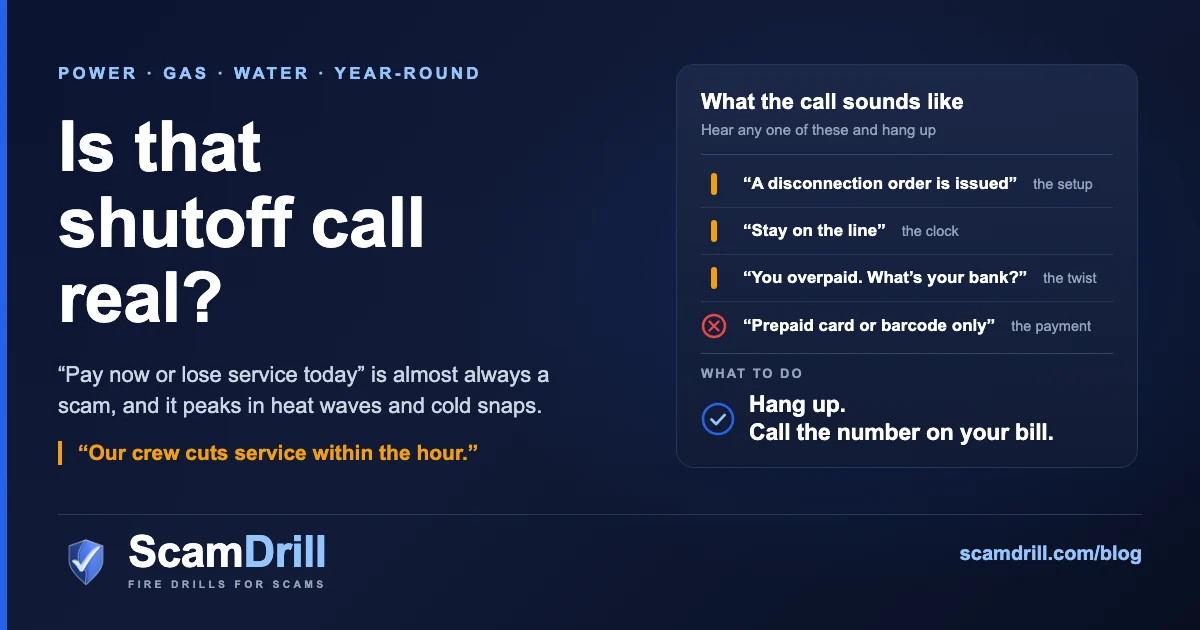
Is that shutoff call real? Almost certainly not. A call, text, or knock saying your power, gas, or water goes off today unless you pay right now — by gift card, prepaid card, crypto, a payment app, a barcode, or a link in a text — is a scam that runs year-round and peaks in heat waves and cold snaps. Real utilities send written notices first, take ordinary payments, and in most states face limits on extreme-weather shutoffs. Hang up and call the number printed on your bill.
It’s 3:40 on a Wednesday afternoon, the fourth day of a heat advisory, and the thermometer on the porch reads 98. The phone rings. Caller ID says the name of your electric company — the real one, the one on the magnet on your fridge. A recorded voice, then a live agent: your account is seriously past due, a disconnection order has already been issued, and the crew is scheduled for today. You can stop it, but only if the balance clears in the next 45 minutes.
You have never missed a bill in your life. But it’s 98 degrees, your mother-in-law is napping in the back room, and the person on the phone has an account number, a case number, and a calm voice that says this happens all the time and is very easy to fix.
Everything about the call is fake except the temperature. The heat is doing the persuading; the caller is just collecting.
Swap the heat advisory for a January freeze, and the air conditioner for the furnace, and the script doesn’t change a word. That’s the version arriving now, as heating season starts.
Six tells, any one of which ends the call
You don’t need to win an argument with someone who makes these calls for a living. You need to spot one of these, then hang up:
- A same-day disconnection threat. The FTC is blunt about this: real utility companies won’t demand immediate payment to avoid same-day disconnection. Shutoffs for non-payment come after multiple written notices, on paper, over weeks.
- A countdown measured in minutes. “The crew is already in your area” is theater. Utilities schedule disconnections through a regulated process, not a phone ultimatum. PG&E tells customers it will never send a single notification within one hour of a service interruption.
- One specific payment method. Prepaid debit card, gift card, wire transfer, cryptocurrency, Zelle, or a payment app. The FTC’s rule has no exceptions to memorize: only scammers say you can only pay one of those ways. Your utility takes checks, cards, bank drafts, and payments through its own website.
- A barcode or QR code to scan at a store. This is the newest wrinkle — more on it below. No utility in America collects bills through a barcode texted to your phone.
- A “refund” or “rebate” that needs your banking details. The flip side of the threat call. If they owe you money, they credit your account. They don’t need your routing number over the phone.
- Anyone at your door asking to see your bill. Utility field workers carry company ID and don’t need to look at your paperwork. PG&E’s guidance is one sentence long: if someone asks to see your bill, close the door.
What the call actually sounds like
Crews write their own scripts, but the same lines keep turning up, because they’re built on the tactics the FTC and the utilities themselves describe. Hearing any one of these is your cue to hang up:
- “A disconnection order has already been issued on your account.”
- “Our technician is in your area and will cut service within the hour.”
- “Stay on the line, or the order goes through automatically.”
- “Today we can only accept a prepaid card, Zelle, or this barcode.”
- “You overpaid last month. I just need your bank details to send the refund.”
- “Your meter has to be replaced, and there’s a fee to schedule it.”
Definition
Utility shutoff scam: an impersonation fraud in which a caller, texter, or door-knocker poses as your electric, gas, or water company and threatens same-day disconnection unless a fake past-due balance is paid immediately — by prepaid card, gift card, crypto, payment app, or a barcode scanned at a store. Losses cluster around heat waves and cold snaps.
Why this call works in a heat wave or a cold snap
The shutoff scam is a pressure con, and extreme weather is peak pressure. In summer it rides heat advisories, requests to conserve power, and news stories about strained grids; in winter it rides freeze warnings and storm outages. Scammers read the same forecasts. When losing service means losing air conditioning or heat — and for some households, losing the refrigerator that holds insulin or the machine that helps grandpa breathe at night — a disconnection threat stops being an annoyance and becomes an emergency.
That manufactured emergency is the same engine behind the jury-duty arrest-warrant call and the fake bank fraud-department callback: a trusted institution, a terrible consequence, a short clock, and a payment path that can’t be reversed. Only the costume changes. The utility version has a cruel edge the others lack — it deliberately hunts people during the exact weather that makes hanging up feel dangerous.
The supporting production is better than most people expect. Caller ID routinely shows the utility’s real name, because spoofing a display name costs a scammer nothing. PG&E warns that crews behind these calls now generate authentic-looking 800 numbers that match what customers expect to see — but that don’t connect back to the utility if you redial. Some operations run hold music and fake phone trees. The whole point is that nothing sounds off. Which is why the defense can’t be “it’ll sound fake.” It won’t.

What the payment method tells you
Strip away the script and the payment request is a confession. Utilities are boring about money on purpose: they take payments online, by phone, by mail, by automatic bank draft, and in person, and they don’t care which one you pick. A caller who cares intensely — who will accept exactly one method, and it happens to be one that moves money instantly and can’t be pulled back — has told you who they are. The FTC keeps a running list of the tells: gift cards are for gifts, not bill payments, and once a scammer has the numbers off the back of a prepaid card, that money is functionally gone.
The new wrinkle: barcodes and QR codes
The version that spread through summer 2026 swaps the gift-card errand for something that feels more official. After the disconnection threat, the “billing department” texts or emails you a barcode or QR code and directs you to a nearby convenience store or pharmacy, where a cashier scans it and takes your cash — a real payment network, moving your money into an account you can’t see. PG&E flagged the barcode variant in a June 2026 warning, with its lead scam investigator noting the con keeps evolving while the core demand — pay right now or lose service — never changes. The FTC had called the pattern out earlier: a barcode from “your utility company” is a scam, full stop. If the code arrives as a QR square, the same rules apply as with any QR-code scam: the pixels tell you nothing about where the money goes.
The doorstep version
Not every shutoff scam arrives by phone. In the in-person variant, someone in a polo shirt and a lanyard knocks, claims there’s a problem with your meter or your rate plan, and asks to see a copy of your bill — which hands them your account number, your name, and everything they need for a convincing follow-up call next week. Real field workers carry company identification, will show it without being asked twice, and have no reason to examine your paperwork. If you have any doubt, close the door and call the utility’s published number to ask whether anyone was dispatched to your address. A legitimate employee will wait; only an impostor argues with a closed door.
What your utility will actually do before disconnecting anyone
The scam works by hiding how slow and paper-heavy a real disconnection is. If your account genuinely fell behind, here’s what the real process looks like: a past-due notice on your regular bill. Then a separate written disconnection notice, typically mailed weeks before any shutoff date, as PG&E describes in its customer guidance. Offers of payment plans and hardship programs along the way. What never happens: a first-and-final warning by phone with a 45-minute fuse.
And in extreme weather, in much of the country, the shutoff can’t legally happen at all. Wisconsin’s Public Service Commission reminded residents during the June heat wave that state law prohibits disconnecting power to occupied homes during a National Weather Service heat advisory, warning, or emergency. Nationally, the federal LIHEAP Clearinghouse counts 21 states with hot-weather disconnection protections and 42 with cold-weather ones (more on winter below). Scammers invert this: they call because it’s 98 degrees, or 9, threatening the one thing the law specifically protects that day. The more extreme the weather, the more likely a disconnection threat is fake.
What a real utility will never do
- Threaten disconnection the same day as a call or text, with no prior written notice
- Demand a prepaid debit card, gift card, crypto, wire transfer, or payment app — or send you a barcode or QR code to pay through a store
- Refuse to let you hang up and call back through the number on your bill
- Ask for your banking details on a call they placed, whether for a “past-due balance” or a “refund”
- Send someone to your door who needs to look at your bill
Does the shutoff scam change in winter?
Only the props. Heat waves get the headlines, but heating season is this scam’s other peak, and it’s starting now. The threat moves from the air conditioner to the furnace, and “the crew is on its way” becomes “your gas goes off before tonight’s freeze.” After a major winter storm in late January 2026, the FTC warned that scammers know severe weather may have shut off your electricity, heat, or water, and are sending messages dressed up as your utility, with links built to steal your information. The same week, Duke Energy customers in the Carolinas got a fake text announcing “rolling outages” through the freeze, with a link for details. Duke’s answer: the message did not come from Duke Energy and it is a scam.
What winter shutoff protections actually exist
Most states have some. The federal LIHEAP Clearinghouse’s state-by-state disconnection guide counts 42 states with cold-weather protections and 44 with rules shielding vulnerable households. Some protect by calendar date, some by temperature, and some use both. Two caveats from the same guide are worth knowing before you lean on them:
- They pause shutoffs; they don’t erase the bill. The utility keeps billing during a protected period, and a disconnection can follow once the protection lifts if a past-due balance remains.
- They mostly cover state-regulated utilities. Municipal utilities, rural electric co-ops, and heating-oil or propane dealers generally aren’t regulated by the state commission, so the rules may not bind them. The guide lists every state’s commission and its phone number, so you can check which rules apply to yours.
That’s the useful part for spotting the scam. Where a real winter disconnection is allowed at all, it follows written notice and a published set of rules. A stranger promising to cut your heat tonight skips every one of them.
Gas and water companies get impersonated too
The FTC’s guidance covers all three: impostors threaten to shut off your gas, electric, or water service if you don’t pay them immediately. Gas is the winter favorite, for obvious reasons. Water impostors lean on the doorstep. In July 2025, the East Bay Municipal Utility District in California warned that people pretending to be its representatives were knocking on doors in Oakland and Richmond, saying they needed to test the tap water. Its rule is worth borrowing for any utility: inspections, audits, and water tests are always arranged in advance, and real employees carry ID showing their name, photo, and employee number. An unscheduled “tester” is a reason to keep the door shut and call the number on your bill.
The “you’re owed a refund” and “new meter” calls
Not every version threatens you. Some offer you something, or bill you for something that sounds routine. The top 10 impostor-scam list that Entergy published for Utility Scam Awareness Day in November 2024 includes two that don’t threaten anything at all:
- The overpayment trick. You overpaid, the caller says, and they need your bank or card details to send the refund. A real utility usually just applies an overpayment to your account as a credit. It doesn’t need your routing number on a call it placed.
- The equipment fee. Your meter needs repair or replacement, and there’s a charge to pay now, or a “contractor” at the door needs to reset it. Entergy says it contacts customers ahead of time about equipment work, schedules appointments in advance, has workers show ID, and puts any equipment charges on the regular monthly bill.
Fake heating-assistance offers
Winter also brings a kinder-sounding con: a call or message offering a government grant to cover your heating bill, for a small processing fee. The federal Low Income Home Energy Assistance Program is real, and it does help households with heating bills and with preventing shutoffs. But HHS is explicit that LIHEAP does not provide direct grants to individuals and does not charge a fee for a benefit. If someone offers you a LIHEAP grant or asks for a fee, HHS asks you to report it to its fraud hotline at 1-800-447-8477. To apply for real help, start at energyhelp.us or call the National Energy Assistance Referral line at 1-866-674-6327.
Small businesses get the same call — at the worst possible hour
This one isn’t only a household scam. PG&E notes that small and medium-sized businesses are a deliberate target, and the timing is engineered: the call hits a restaurant at 12:15 on a Friday, a salon with a full book, a dental office mid-procedure. The pitch writes itself — power goes off in an hour, walk-ins and refrigerated inventory be damned, unless someone runs a payment right now. A manager with a line out the door doesn’t pull last month’s bill to double-check; they pay, precisely because keeping the lights on is their job. PG&E’s customers alone have lost more than $211,000 to scams in the first half of 2026, on pace to exceed last year — and one utility’s reports are a fraction of the national picture.
The countermeasure costs nothing: decide today who at your business is allowed to pay a “utility emergency,” and make the rule that nobody else may, no matter the deadline on the phone. If your team has never practiced saying “I can’t make payments — you’ll need to send a written notice” to a convincing caller, that’s exactly the reflex a simulation program exists to build.
The two-step exit
Everything above compresses into one habit that beats every version of this scam — phone, text, email, and doorstep:
- Hang up. Or delete the text, or close the door. You owe a stranger with a deadline exactly nothing, and a real utility employee is not harmed by a dial tone.
- Call the number printed on your bill. Not the number that just called you, not the number the caller offers, and not the first result in a search — the FTC specifically warns that paid search ads impersonate utility payment sites, so scroll past the sponsored results or, better, use the paper bill or the utility’s app. If your account is genuinely behind, it will say so right there. If it isn’t — and it almost certainly isn’t — you just kept a few hundred dollars by doing nothing.
The industry’s own consortium — Utilities United Against Scams, more than 150 electric, water, and gas companies — compresses it even further: slow down, verify, stop the scam. Its members run Utility Scam Awareness Day every November (the tenth was Nov. 19, 2025), and many utilities post fresh scam warnings that week. Scammers don’t fear skepticism on the call; they’re trained for it. They fear the hang-up, because no script survives you independently dialing the real company. Got the threat by text instead? Paste it into our free SMS scam checker before you do anything else.
Have the five-minute conversation before the phone rings
Older adults living alone are this scam’s favorite audience — the health stakes of losing heat or air conditioning are real, and scammers know it. If you help a parent with their bills, tell them about the shutoff script this week, before the first hard freeze: people warned about a con in advance hang up on it at far higher rates. Our guides to protecting elderly parents from scams and ScamDrill for parents cover how to have that talk without condescension.
If money already moved
The people who pay these calls aren’t careless — they’re the ones who acted fastest to protect their homes and families in dangerous weather. If that’s you or someone you love, move quickly and sort feelings later. Our first-60-minutes checklist walks the full sequence; the utility-specific short version:
- If you paid by gift card or prepaid card, call the card issuer now. Tell them the card was used in a scam and ask if the funds can be frozen. Speed matters more than anything else here.
- If you paid through your bank, Zelle, or a payment app, call your bank immediately using the number on your card, say the word “scam,” and ask them to attempt a stop or recall.
- Call your real utility on the number from your bill. They track impersonation reports, and confirming your actual balance closes the loop the scammer opened.
- File the reports: ReportFraud.ftc.gov and your state attorney general. Reports are how the next family gets warned.
- Expect the second act. Paid victims get called again — sometimes as the “utility” claiming the payment failed, sometimes as a “refund department” offering to claw the money back for a fee. That follow-up is its own scam. Not sure what applies to your situation? Our “I’ve been scammed — what now?” tool builds a step-by-step plan.
Make the hang-up reflex automatic — before the next cold snap tests it.
ScamDrill sends your family realistic practice scenarios, including fake utility shutoff calls and texts, so the pause-verify-call-back habit exists before a professional tries it on someone you love. Setup takes under 10 minutes.
Start your family plan →The one sentence to send your group chat
Most people meet this scam for the first time with the phone already ringing and the thermostat already climbing, and the whole scheme dies on contact with one line of advance warning. Send this to the family thread today: “If the ‘power company’ ever calls threatening to shut you off today unless you pay by prepaid card, app, barcode, or a text link — hang up and call the number on your bill. Real utilities send written notices, and most states limit shutoffs in extreme cold or heat.”
Ten seconds to send, and it works in any weather.