Jury Duty Scams: Why the Arrest-Warrant Call Is Always Fake
Bottom line up front
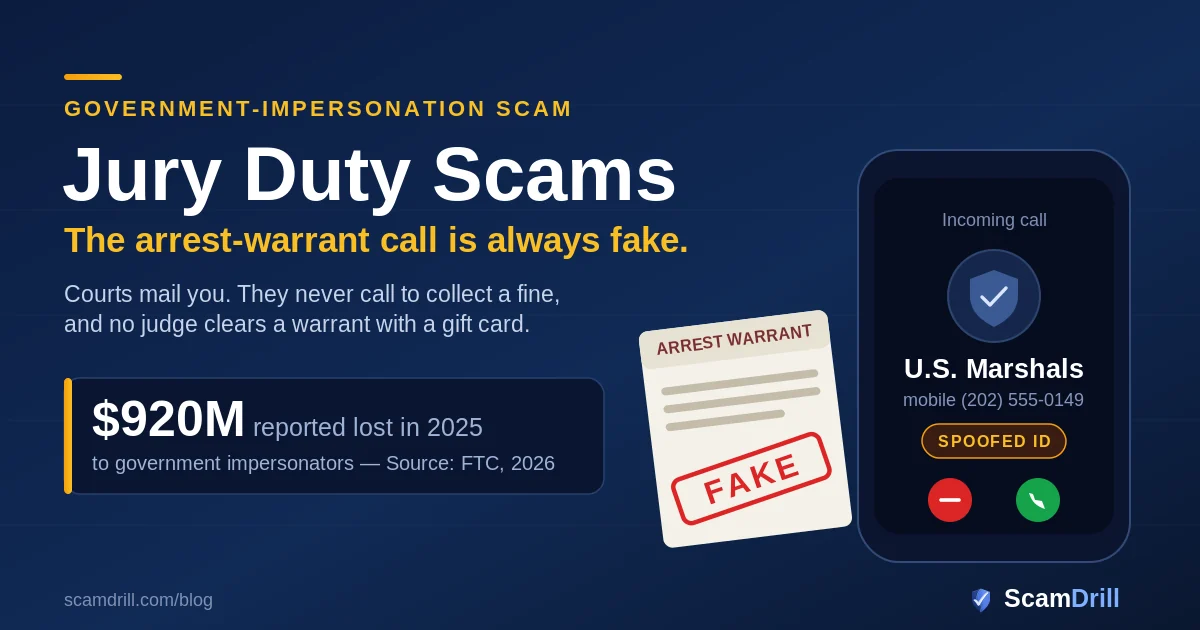
A jury duty scam starts with a phone call that says you missed jury service and a warrant is out for your arrest unless you pay a fine right now. It is always fake. Courts contact jurors by mail, never demand payment by phone, and no judge clears a warrant through a gift card, app, wire, or cryptocurrency. The spoofed caller ID, the names of real judges, and the warrant texted to your phone are all props. The safe move is the same every time: hang up, pay nothing, and call the court back on a number you look up yourself.
The call lands at a bad moment, because most calls like this do. A calm, official-sounding voice says it is calling from the U.S. Marshals Service or your county sheriff. It already knows your full name and your address. It tells you that you failed to appear for jury duty, that a judge has signed a warrant, and that an officer will come to your door unless you settle the fine in the next hour.
Your stomach drops. That reaction is the entire design. Fear plus authority plus a ticking clock is the oldest engine in fraud, and the jury duty version is one of the cleanest examples of it working. The Federal Trade Commission flagged a fresh wave of these calls in a June 2026 consumer alert, and it carries one twist that makes the new version more convincing than the old one.
Five signs the call is a scam
You do not need to be a lawyer to shut this down. If the contact does any of the following, it is a scam, every time, with no exceptions worth worrying about:
- It comes by phone, text, or email. Real courts summon jurors through the U.S. mail. They do not cold-call you about a missed date.
- It threatens arrest. Officers do not phone ahead to warn you they are about to arrest you, and they will not say you will be arrested if you hang up.
- It demands payment to "clear a warrant." No court collects fines by phone. A demand for a gift card, payment app, wire transfer, or cryptocurrency is the scam announcing itself.
- It keeps you on the line. "Stay on the phone, do not tell anyone, drive to the store now." Isolation and urgency are the tools, not the symptoms.
- It sends a "warrant" to your phone. A texted or emailed warrant, badge photo, or government ID is a prop. Real warrants are not delivered to your messages.
Any single one of these is enough. You will usually get several at once.
Definition
Jury duty scam: a government-impersonation con in which someone posing as a court officer, sheriff, or U.S. Marshal calls to claim you missed jury service and owe a fine, then threatens arrest to pressure immediate payment by gift card, payment app, wire transfer, or cryptocurrency.
Why this matters: the script works on people who have done nothing wrong. You do not have to have skipped a summons to be rattled by a stranger who knows your address and says a judge wants you arrested. That is the point. The con is built to make a careful person panic.
How the call actually unfolds
The scam has a rhythm, and once you have seen it laid out, you start to hear the gear changes in real time. It opens warm and official, turns frightening, then squeezes. Here is the sequence.

Source: ScamDrill analysis of FTC consumer alerts and U.S. Courts juror-scam guidance, 2026.
The first two steps are what make the rest land. When a caller already knows your name and the screen says "U.S. Marshals," the skeptical part of your brain quietly stands down. That is not an accident of the call; it is the foundation of it. The U.S. Courts system warns directly that scammers spoof real court phone numbers and recite the names of actual judges, real case numbers, and badge numbers to sound authentic.
The new twist: a warrant in your text messages
The classic version of this scam was voice-only. The 2026 version comes with attachments. After the call rattles you, a text or email arrives carrying an official-looking arrest warrant, complete with your name and the exact dollar amount you supposedly owe. The FTC describes this added document plainly: it makes the scam look more convincing, and it is all fake.
Some versions go further, sending photoshopped court letterhead, a photo of a "badge," or even a picture of a real deputy lifted from a sheriff's office website. None of it is real, and none of it changes the one fact that ends the whole thing: real law enforcement does not text or email arrest warrants. A warrant landing in your messages is not a reason to worry. It is a reason to be certain you are being scammed.
There is an audio version of the same upgrade. Scammers increasingly use AI voice tools to sound like a specific, commanding officer, and they pair it with a spoofed "County Sheriff" on your caller ID. We broke down how cheap and convincing that has become in our guide to AI voice cloning scams. The takeaway is the same: a voice that sounds official is not proof of anything anymore.
Treat these as automatic stop signs
- Any caller who says you missed jury duty and now owe a fine.
- A demand to pay by gift card, payment app, wire transfer, or cryptocurrency to avoid arrest.
- Pressure to stay on the line, keep it secret, or act before you can verify anything.
- A warrant, badge, or government ID sent to your phone or inbox.
- Caller ID that shows a court, sheriff, or the U.S. Marshals, which can be faked in seconds.
What the call sounds like
The menace is in the delivery. The voice stays calm and procedural at first, which is exactly what makes the turn frightening. Here is a composite of the script, assembled from the patterns described in FTC and court warnings rather than any single real call.
A reconstructed jury-duty call
“Good morning, this is Deputy [Name] with the U.S. Marshals Service, badge 4471. Am I speaking with [your full name], of [your street address]? I’m calling on a federal failure-to-appear. You were summoned for grand jury service on the 14th and did not show, so Judge [Real Judge] has issued a bench warrant.”
“I can offer you one chance to clear this before an officer is dispatched to your home. There is a $1,500 contempt bond. You’ll need to stay on the line with me and pay it through the courthouse kiosk today. Do not hang up, because the second you do, the warrant goes active and I can’t call off the arrest.”
Every sentence is doing a job. The badge number and the real judge’s name borrow authority. Your street address, read back to you, proves they “know” you. The contempt bond invents a fee out of thin air. And the order to stay on the line is the isolation move, built to keep you away from the one person, a spouse, an adult child, a bank teller, who would say the thing the scammer fears most: that doesn’t sound right, let’s hang up and call the court ourselves.
What a real court does, and what the scammer does
The cleanest way to hold the difference in your head is side by side. Genuine jury communication is slow, paper-based, and free. The scam is fast, electronic, and expensive. They behave like opposites on every line that matters.
Source: U.S. Courts and FTC guidance on jury and government-impersonation scams, 2026.
One line on that chart does the most work. According to the U.S. Courts system, in no instance will a court official, the U.S. Marshals Service, or any other government employee call to demand payment or personal information. If money or your Social Security number is being requested over the phone, the conversation is already a scam, regardless of how the call started or whose name is attached to it.
Why the script is so effective
This con is not successful because victims are gullible. It is successful because it borrows the two things humans are wired to obey: authority and urgency. A badge and a deadline can override careful judgment in seconds, and the scammer never gives you a quiet minute to think. That is the same psychological machinery behind romance scams, fake tech-support calls, and the "your account is compromised" bank impersonation, which we map out in the psychology of how scammers persuade you. The same deadline-driven pressure shows up wearing a hard hat in the utility shutoff scam, which spikes during heat waves. And the same badge-and-authority act now arrives with an AI-generated face in the fake FBI and IC3 recovery scam.
It also helps to see the jury duty call as one outfit on a body that never changes. Strip away the courtroom costume and you are left with the universal scam skeleton: a pretext that grabs your attention, a manufactured emergency, and an irreversible payment. We take that skeleton apart piece by piece in the anatomy of a modern scam. Once you can name the parts, the costume stops mattering.
The damage is real and it is concentrated. The FBI's Internet Crime Complaint Center reported that Americans lost a record $20.9 billion to fraud in 2025, a 26 percent jump in a single year, and people age 60 and older accounted for $7.7 billion of that, roughly a 37 percent increase over the prior year. Government-impersonation scripts like this one lean hardest on exactly the people who are home to answer the phone and most likely to take a "warrant" at its word.
If you get the call: four moves
You do not have to be clever in the moment. You have to be boring. The same four steps work whether the caller is a robocall, a live person, or an AI voice that sounds like a sheriff you would swear you recognized.
Sources: FTC, ReportFraud.ftc.gov; FBI Internet Crime Complaint Center, ic3.gov; U.S. Courts.
A word on verifying. The instinct to "just call them back and sort it out" is reasonable, but never use the number that called you or the one in the text. Both are controlled by the scammer. Look up your local federal or county court yourself and call the clerk of court's office. Real clerks field these questions constantly and will tell you in one sentence that no such warrant exists.
If the threat arrived as a text rather than a call, you can sanity-check the message before you do anything else. Paste it into our free SMS scam checker for an instant read on the tells. It will not replace calling the court, but it can settle your nerves enough to slow down.
The one sentence that ends it
Before you do anything the caller wants, say it out loud: “A real court would mail me, not call me, and would never ask me to pay over the phone.” Then hang up. The real court will still be reachable in an hour. The scammer is betting you will not take that hour, because the moment you do, the spell breaks.
If you already paid or shared information
First, set down the shame, because this was engineered by professionals to rush exactly the people who pride themselves on being responsible. Then move quickly. If you paid by debit or credit card or a bank transfer, call your bank now, report the fraud, and ask whether the payment can be stopped or recalled. Gift card, wire, and crypto payments are harder to claw back, but report them anyway, because patterns help investigators and occasionally funds are frozen in time.
Save everything: the number that called, screenshots of any texts, the fake warrant, and the time of the call. Report the scam to the FTC at reportfraud.ftc.gov and to the FBI's Internet Crime Complaint Center at ic3.gov, and tell your local court's clerk so they can warn others in the area. If you handed over your Social Security number or banking details, treat it as an identity-theft situation and follow the step-by-step plan in what to do after a scam.
One more caution. After someone is hit, a second wave often follows: a "recovery" service that promises to get the lost money back, for a fee. It is the same con aimed at the same wound, and no legitimate agency charges you to recover funds. We wrote a full breakdown of that follow-on trap in the second scam.
Protecting the people most likely to get this call
If you have an older parent or relative who answers every call, this is a conversation worth having before the phone rings, not after. The script is designed to isolate, so the single most protective habit you can give someone is a standing agreement: any call about a warrant, a fine, or jury duty, you hang up and call me first. That one rule turns the scammer's "do not tell anyone" into the exact thing the target does next.
Our playbook for protecting elderly parents from scams and the broader protect your parents guide both walk through how to set that up without being heavy-handed about it. The goal is not to make anyone feel watched. It is to make the scammer's pressure feel suspicious instead of urgent.
It is worth saying who is behind the curtain here: this is organized fraud, not a lone prankster. The FTC reported that Americans lost $3.5 billion to imposter scams in 2025, nearly triple the figure from five years earlier, and it has joined the Department of Justice and others in a public campaign built around a simple promise the government will never ever make, including demanding payment or threatening arrest by phone. When you hear those moves on a call, you are hearing a business model.
Why rehearsal beats a warning
Reading this helps. It will not, by itself, make you immune, because knowledge stored in a calm moment tends to evaporate in a frightening one. The jury duty call is engineered to arrive when you are distracted and to keep you too rattled to reach for what you know. What survives that pressure is not a fact you read once. It is a reflex you have run before.
That is the whole idea behind practicing on a safe version of the real thing. When a fake "warrant" call is something you have already seen and hung up on in a drill, the live one feels familiar instead of terrifying, and familiarity is what keeps your money in your account.
Turn “wait, is this real?” into an instant hang-up.
ScamDrill sends your family realistic practice scenarios, including government-impersonation and arrest-warrant calls, so the warning signs fire automatically before a real one lands. Setup takes under 10 minutes.
Start your family plan →The one message to send today
If anyone in your circle is the type to pick up an unknown number, send them a single line: “If someone ever calls saying you missed jury duty and have to pay a fine or face arrest, it is a scam. Hang up and call me. Courts mail you, they never call to collect.”
It takes thirty seconds and could save someone a very bad afternoon and a lot of money. Send it now, while it is in front of you.