The “Veterans Savings Program” Postcard Scam: What the Call Wants
Bottom line up front
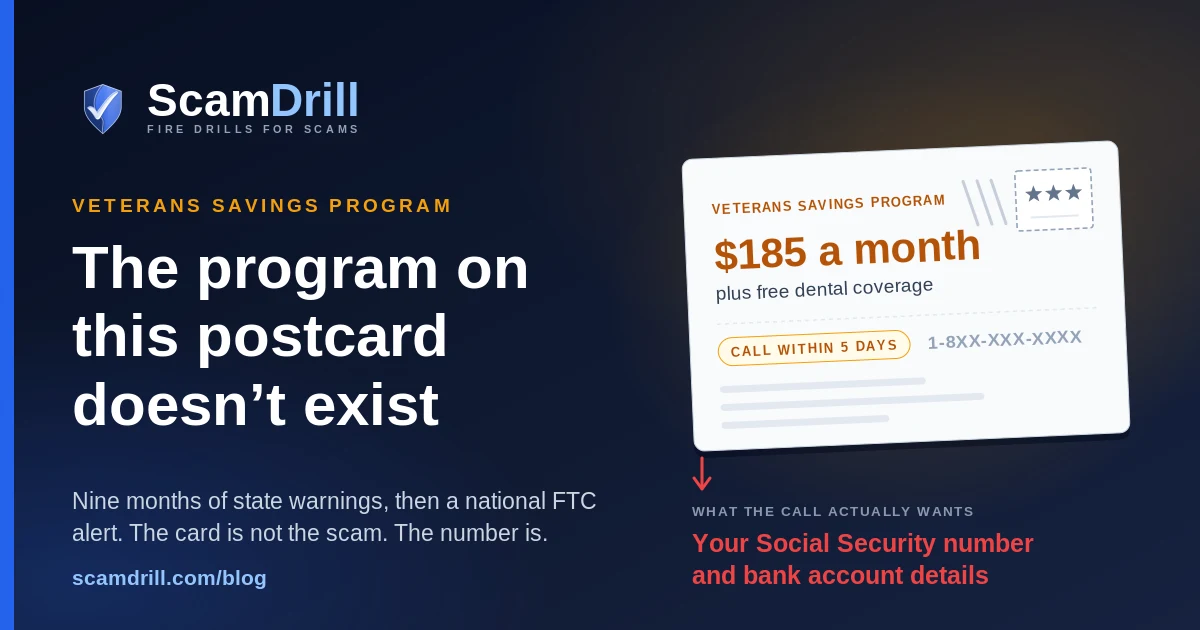
A postcard says you or your spouse qualify for extra monthly VA money, mentions CHAMPVA or TRICARE For Life, and tells you to call a toll-free number within five days. The FTC put out a national alert on August 24, 2026 saying plainly that the “Veterans Savings Program” does not exist. The card is not the scam. The phone number is. Throw the card away, and if you want to check on your benefits, call VA yourself at 1-800-827-1000.
It is a good-looking piece of mail. Clean layout, government-ish blue, your state printed on it, and real program names — CHAMPVA, TRICARE For Life — sitting next to a dollar figure. One version photographed by the North Carolina Department of Justice offered up to $185 a month plus free dental coverage, and asked you to call inside five days.
There is no program. There is a call center, and it wants your Social Security number.
What makes this one worth a full write-up rather than a one-line warning is how long it has been running and how little it has had to change. Warnings went out in Pennsylvania, Michigan and Iowa in late 2025. North Carolina's attorney general put out a release in March. VA's own benefits office wrote it up in June. The FTC went national on Monday. Same card, same five-day deadline, same number-harvesting on the other end, nine months later.
If the postcard is in your hand: six moves
None of this takes long, and most of it is free.
- Do not call the number on the card. Not to complain, not to opt out, not to find out who they are. The number is the entire product. Calling it confirms the address reached a real person, which is worth something to them even if you hang up.
- Bin it, or photograph it first. The North Carolina AG's advice was two words: throw the card away. If you want to report it, take a photo of both sides first — the number and any wording are what an investigator can actually use.
- Check your benefits the boring way. Sign in at VA.gov, or call VA on 1-800-827-1000, a number you look up rather than one you were handed. If there were a new entitlement, it would be there.
- Report it. ReportFraud.ftc.gov for the FTC and VSAFE.gov or 1-833-38V-SAFE for VA. If it came through the mail, the Postal Inspection Service takes it too.
- Say it out loud to one other veteran. Mailing lists are bought in bulk by ZIP code and by service status. If you got one, the people you served with probably did as well. The FTC's alert asks for exactly this, which tells you something about how these lists work.
- If you already called, skip ahead. There is a section further down on what to do depending on what you gave them. Short version: it depends entirely on whether a Social Security number or a bank account left your mouth.
The one that catches careful people
Plenty of readers will look at the card and think this is obviously junk — and then call anyway, because the spouse's name is on it, or because a parent already called and someone needs to find out what was said. That second call is the same call. If you need to know what an outfit is, search the number, don't dial it.
What the “Veterans Savings Program” scam is
Definition
The Veterans Savings Program scam is a mailed phishing attack. A postcard claims a veteran or spouse qualifies for extra VA money, name-drops real programs like CHAMPVA and TRICARE For Life, and pressures them to call a toll-free number within days. No such program exists; the call collects Social Security and bank details.
Mail is an unusual delivery channel for phishing, and that is precisely the appeal. Nothing filters your mailbox. There is no spam folder, no link preview, no carrier flagging the sender. A postcard arrives with the same authority as a jury summons or a tax notice, and it costs the sender well under a dollar to put in front of you.
It also solves a problem that email and text have made harder. Most people have been trained, roughly, not to click links from strangers. Very few have been trained to distrust a piece of paper. And the card asks for nothing on paper — no form to fill in, no reply envelope, no website. It asks only that you make a call, which feels like the cautious option.
VA's Benefits Delivery Protection office published its own fraud alert on this in June, and the description of what happens next is worth quoting closely: the caller will “often use flattery and praise regarding your military service to gain trust,” then work toward a Social Security number or bank account details. That is not a throwaway line. Thanking someone for their service is so ordinary that it reads as social lubricant rather than technique, and it buys the caller thirty seconds of goodwill at the exact point where a stranger asking for an SSN would otherwise sound alarming.
Nine months, four warnings, one unchanged card
The spread is the part I find most instructive, so it is worth laying out in order.

Timeline compiled from MOAA (March 30, 2026) on the late-2025 Pennsylvania, Michigan and Iowa warnings and the North Carolina DOJ card; VA News fraud alert (June 10, 2026); FTC consumer alert (August 24, 2026). Amber marks the campaign running throughout.
Look at what did not change across those nine months. Same fake program name. Same five-day deadline. Same real-program window dressing. Same request on the phone.
Scams get iterated when defenders start catching them. This one has not needed to iterate, which is a reasonable proxy for how well it is working. It is also a reminder that a national alert is not a fix — the FTC's Monday post will reach a fraction of the households that a bulk mail drop reaches, and the mail drop can be repeated next month for the cost of postage.
Six tells on the card itself
You do not need to memorise these. Any one of them is enough.
- A deadline measured in days. “Call within five days.” VA does not run limited-time offers. Entitlements do not expire because you were slow to a phone.
- No return address. The North Carolina card had none. Nothing legitimate that concerns your benefits arrives with nowhere to write back to.
- The only way to act is a phone number. No website you can type in yourself, no form number, no office. Every route leads through their call centre, which is the design.
- Real program names doing decorative work. CHAMPVA and TRICARE For Life are real; a “Veterans Savings Program” that bundles them is not. Borrowed nouns are cheap credibility.
- “Regardless of your disability rating.” VA's alert flags this phrasing specifically. It is aimed at veterans who have been told no before, which is a large group and a discouraged one.
- It arrived by postcard. Meaningful changes to service-connected benefits get communicated through VA.gov and TRICARE.mil, and through mail that identifies which office sent it. Not a card with a toll-free number and a countdown.
One more, less a tell than a habit: anything that pairs good news with urgency deserves the slow route. That covers this card, the “you have unclaimed benefits” voicemail, and about half of what lands in a veteran's inbox. VA's own pension-poaching FAQ reproduces a script in circulation — “Your VA profile was flagged for two potential benefits… These are time sensitive entitlements. Please call us back at your earliest convenience” — and you can hear the same two levers doing the work.
What the call is actually collecting
There is no program to explain, so the call has to do something else with its time. In practice it does one of two things, and which one you get seems to depend on who bought the list.
The first is straightforward identity theft. The caller runs an eligibility check that is really an intake form: full name, date of birth, Social Security number, branch and service dates, sometimes a bank account for “direct deposit of the benefit.” None of it is verified against anything, because there is nothing to verify against. Twenty minutes later they have a package worth more than most people assume — a veteran's SSN plus service history opens VA-adjacent accounts, credit lines, and later impersonation calls that sound extremely well informed.
If that is where you have landed, we wrote the full sequence out in what to do after giving a scammer your Social Security number. Freeze first, then work the list.
The second is a sales funnel, and it is the one people underestimate, because at the end of it somebody does file a real claim.
The other business model: claim sharks and pension poaching
A share of these calls are lead generation for outfits that charge veterans to do something VA does for free and that accredited service officers do for free.
The FTC has been warning about “claim sharks” alongside the postcards. In a July segment on the FTC's military-consumer data, a county veterans service officer in San Luis Obispo County, California put the fees he sees at between $15,000 and $30,000 for help filing a claim — help his office provides at no charge. His second point matters more than the first: many of these firms are not VA-accredited, and a badly filed claim can leave a veteran with a reduced rating, not just a bill.
Then there is the older, quieter version: pension poaching. VA has a standing FAQ on it, and the mechanics deserve a slow read, because the harm is not the fee.
The pitch targets wartime veterans and surviving spouses who might qualify for VA Pension with Aid and Attendance — typically older, often facing care costs. An adviser explains that the applicant has too many assets to qualify, and offers to fix that by moving money into a trust or an annuity. The application goes in. Sometimes it is even approved.
What the pitch tends to leave out is that VA reviews the terms of any assets transferred in the three years before the pension claim was filed. If VA later determines eligibility never existed, in VA's own words, “the claimant will be required to repay these benefits to the government.”
So the arithmetic can end up genuinely ugly: savings locked in an annuity that pays the adviser a commission and the claimant a penalty to exit, benefits already spent, and a debt to VA. VA's FAQ also names a variant worth knowing if you are the one arranging care for someone — a caregiver who asks that the veteran's benefits be deposited into the caregiver's account. Benefits go to the beneficiary. Not to whoever is helping.
Three rules that settle any VA benefits offer
You do not need to become an expert in accreditation law. Three facts cover essentially every version of this, and they come straight from VA.
Rules and quoted language from the VA Pension Poaching FAQ (April 2025). Fee range reported by a San Luis Obispo County veterans service officer via KSBY/Scripps News, July 24, 2026. Blue marks controls; amber marks the pitch.
The first: filing costs nothing. VA's language is blunt — “You should expect to pay nothing,” and “no one can charge a claimant for preparing or filing an application for benefits with VA without violating the law.”
The second: even legitimate paid help cannot charge on an initial claim. VA accredits three kinds of representative — VSO representatives, claims agents, and attorneys. VSOs are always free. Accredited agents and attorneys may charge a fee, but generally only after a VA regional office has already issued a decision, and only once a power of attorney and a fee agreement are on file with VA. Anyone quoting you a price to start is either not accredited or not following the rules.
The third: accreditation is a lookup, not a claim. VA's Office of General Counsel keeps a searchable list at va.gov/ogc/apps/accreditation. It takes under a minute. If a name is not on it, that is the end of the conversation — and if a caller discourages you from checking, that is your answer twice over.
California is trying to put teeth behind this: Senate Bill 694 was signed this year and takes effect January 1, 2027, giving veterans additional legal recourse against fraudulent claims companies. Useful, but state-by-state and not yet in force. The lookup works everywhere, today.
The tell is never the topic
Postcard, voicemail, spoofed caller ID — the shape is identical. Good news, a countdown, and a number they chose. ScamDrill sends your household realistic practice scams and coaches whoever bites, so the pause happens before the call does.
Start a free trialIf you already called the number
Most people who call give up less than they fear. Work down this list and stop where it matches.
You called, it sounded off, you hung up. Nothing to do beyond reporting it. Expect more calls — a live answer moves a number up a list — and do not answer numbers you do not recognise for a while.
You gave your name, address, or service dates. Low direct risk, real indirect risk. That combination is what makes the next call convincing. Tell whoever else is in the house: a caller knowing my service history is not evidence that the caller is real.
You gave a Social Security number. Freeze your credit at all three bureaus — free, reversible in minutes — then open IdentityTheft.gov for a recovery plan. Our SSN walkthrough has the order and the phone numbers.
You gave bank account or routing details. Call your bank on the number printed on your card or statement and tell them the account is exposed. Ask about a new account number rather than only new cards. If VA direct deposit runs into that account, update it through VA.gov or 1-800-827-1000 — and be aware that a fake “VA direct deposit” call is itself a common follow-up.
You paid someone a fee to file a claim. Look them up in the accreditation database, then complain to VA on 1-800-827-1000, to the FTC, to your state attorney general, and to the VA Office of Inspector General. Get a free accredited VSO to look at what was actually filed on your behalf.
And if the first hour after any of this feels like too many things at once, the first sixty minutes puts the steps in an order you can just follow.
Expect a second approach
People who lose money once get sold as a list to people who specialise in the second pass — the “recovery” call offering to get it back for a fee, or a fake FBI or IC3 contact. The FTC put out its own alert on refund and recovery scams on August 3. We covered the pattern in recovery scams: the second scam, and the rule is short: no legitimate agency charges to recover stolen money.
If this is arriving at a parent's house
Different problem, and one that goes wrong more often than the scam itself does.
An older veteran gets the card, calls, gives out a Social Security number, and then does not mention it — not because they did not notice, but because the version of the conversation they are anticipating is one where they get treated as someone who can no longer be trusted with the mail. That silence costs more than the call did. Whatever else you do, do not open with how obvious it was.
What tends to work better is removing the decision from the moment entirely. One line, agreed in advance, that does not require anyone to assess anything under pressure: anything about VA money, I call you before I call them. Rules that short survive; checklists do not.
If you are the one keeping an eye on an older parent's mail and money, the warning signs worth taping by their phone are on a single printable page — built for exactly this, a fridge or a hallway table rather than a browser tab nobody reopens. And our longer guide works through having the conversation without it turning into supervision.
Two numbers worth writing down while you are at it. The National Elder Fraud Hotline is 833-372-8311, staffed 10am–6pm Eastern on weekdays, and a person walks you through reporting. And VA's fraud line, VSAFE, is 1-833-38V-SAFE.
If the money side of this has become heavy
Financial exploitation lands hard, and it lands hardest on people who feel they should have caught it. The Veterans Crisis Line is available around the clock for veterans, service members and their families: dial 988 then press 1, text 838255, or chat at VeteransCrisisLine.net. You do not need to be in crisis to use it.
Where to report it
Reporting a postcard feels like shouting into a well. It is worth five minutes anyway, and the reason is visible in this specific story: the FTC's national alert exists because complaints from multiple states described the same card. Individually each report is noise. Collected, they are what moved this from a Pennsylvania curiosity in late 2025 to a federal alert nine months later.
- FTC — ReportFraud.ftc.gov
- VA — VSAFE.gov or 1-833-38V-SAFE; benefits questions to 1-800-827-1000
- Postal Inspection Service — uspis.gov/report, since this one arrives as mail
- TRICARE — its fraud and abuse form, if the card leaned on TRICARE branding
- Your state attorney general — directory here; state AGs are the ones who have actually published photos of these cards
- VA OIG — va.gov/oig, for anyone charging fees to file claims
What to take from this
The postcard is not sophisticated. It is a piece of card stock with a made-up program name and a phone number, and it has survived nine months of official warnings from four different directions.
It survives because it is aimed at a real gap rather than at gullibility. VA benefits are genuinely complicated, they genuinely change, plenty of veterans have genuinely been told no about something they suspect they were owed, and none of that is the reader's fault. A card that says there is money you did not know about, and here is a number is not absurd. It is the shape of every legitimate benefits notice anyone has ever received, minus the parts that would let you check it.
Which is why the durable defence is not recognising this particular card. It is the smaller habit underneath: when the good news arrives with a deadline, you get to use a number you found yourself. That single move breaks the postcard, the voicemail, the spoofed caller ID and the claim shark, and it costs about ninety seconds.
Related reading in this cluster: the fake “you owe the VA money” messages, which is this scam pointed the opposite direction, and the seven tactics that hit veterans hardest for the wider map.
Sources & citations
- Federal Trade Commission, “How to spot a postcard scam targeting veterans”, consumer alert, August 24, 2026.
- VA News, “Fraud alert: Beware the ‘Veterans Savings Program’ postcard scam”, June 10, 2026 (updated July 2, 2026), by Amy Kirby, Benefits Delivery Protection & Remediation.
- U.S. Department of Veterans Affairs, Pension Poaching FAQ (PDF), April 2025 — fee rules, the three-year asset review, repayment, and the accreditation lookup.
- MOAA, “‘Veteran Savings Program’ Postcard Scam Hits Multiple States”, March 30, 2026 — the $185 figure, the North Carolina DOJ postcard image, and the late-2025 Pennsylvania, Michigan and Iowa warnings.
- WRAL/WECT, “Attorney General warns of scam targeting veterans”, March 28, 2026 — North Carolina AG Jeff Jackson's warning.
- KSBY/Scripps News, “Military scam alerts, $684 million in losses in 2025”, July 24, 2026 — FTC loss figures, FTC guidance on claim sharks, and the $15,000–$30,000 fee range from a county veterans service officer.
- VA Office of General Counsel, accreditation search.
A note on one number: postcards in different states have quoted different monthly amounts. The $185 figure above comes from the specific North Carolina card photographed by that state's Department of Justice; other coverage of the same campaign has quoted higher figures. Treat the amount as variable and the program as fictional either way.