World Cup 2026 Scams: Fake FIFA Sites and the Safe Way to Buy Tickets
Bottom line up front
The 2026 World Cup is the richest ticket-scam opportunity in years, and the FBI has already flagged dozens of fake FIFA websites built to take your money and harvest your identity. There is exactly one official source for tickets, FIFA.com/tickets, and anyone selling outside it, especially through a social-media message or a peer-to-peer payment app, should be treated as a scam until proven otherwise. The safe move is boring on purpose: type the address yourself, pay with a credit card, and never let a “last seat left” message rush you.
For eleven years the United States, Canada, and Mexico have known this summer was coming. So have the scammers. The World Cup pulls in people who do not follow the resale market, do not know how official ticketing works, and have one shot at seeing their country play. That mix of high desire and low familiarity is the exact soil fraud grows in.
The tournament opened June 11 and runs through the final on July 19, which leaves several more weeks for a fan to find what looks like a miracle seat and lose a few hundred or a few thousand dollars buying it. The con is not subtle, and it is not new. What is new is the scale, the polish, and the fact that a federal agency felt the need to put out a public warning before kickoff.
Six signs a World Cup ticket deal is a scam
Before the deep dive, here is the whole article compressed into a checklist. If a ticket offer trips any of these, stop and walk away.
- The web address is not exactly fifa.com/tickets. Look-alikes like wvvw-fifa.com, odd endings like fifa.sale, or extra words like worldcup26ticket.com are not FIFA.
- You arrived through a sponsored ad or a search result instead of typing the address in yourself.
- The seller wants Zelle, Venmo, Cash App, a wire, or crypto rather than a credit card.
- There is a countdown or a “pay in the next ten minutes” push. Real ticketing does not work that way.
- The price is far below face value, or a seat is somehow available for a match that is officially sold out.
- A QR code or a screenshot is offered as “proof” the ticket is genuine. It proves nothing.
What is a World Cup ticket scam?
A World Cup ticket scam is any scheme that sells fake, invalid, or duplicate tickets, or harvests your personal and payment data, by impersonating FIFA or a legitimate reseller. It usually runs through a spoofed website, a social-media seller, or a peer-to-peer payment request, and the ticket either never arrives or fails at the gate.
Why the World Cup is a scammer's dream
This is the biggest World Cup ever staged: 48 teams, 104 matches, 16 host cities spread across three countries. More matches and more first-time host cities mean more fans chasing seats, including millions who have never bought from an official ticketing platform and do not know what one looks like.
Demand also runs far ahead of supply for the matches people actually want. When a fan finally finds an available seat for a sold-out game, the instinct is to grab it before someone else does, and that rush is the moment the scam needs. The same urgency and scarcity levers show up in nearly every con, which we take apart in our breakdown of how scammers persuade you. The World Cup just supplies a stronger dose of both.
There is one more accelerant worth naming. FIFA's own ticketing process is clunky, with CAPTCHA screens and virtual waiting rooms that can leave a buyer stuck and frustrated. When the legitimate path feels broken, a slick fake that promises instant tickets starts to look like the reasonable option. It is not.
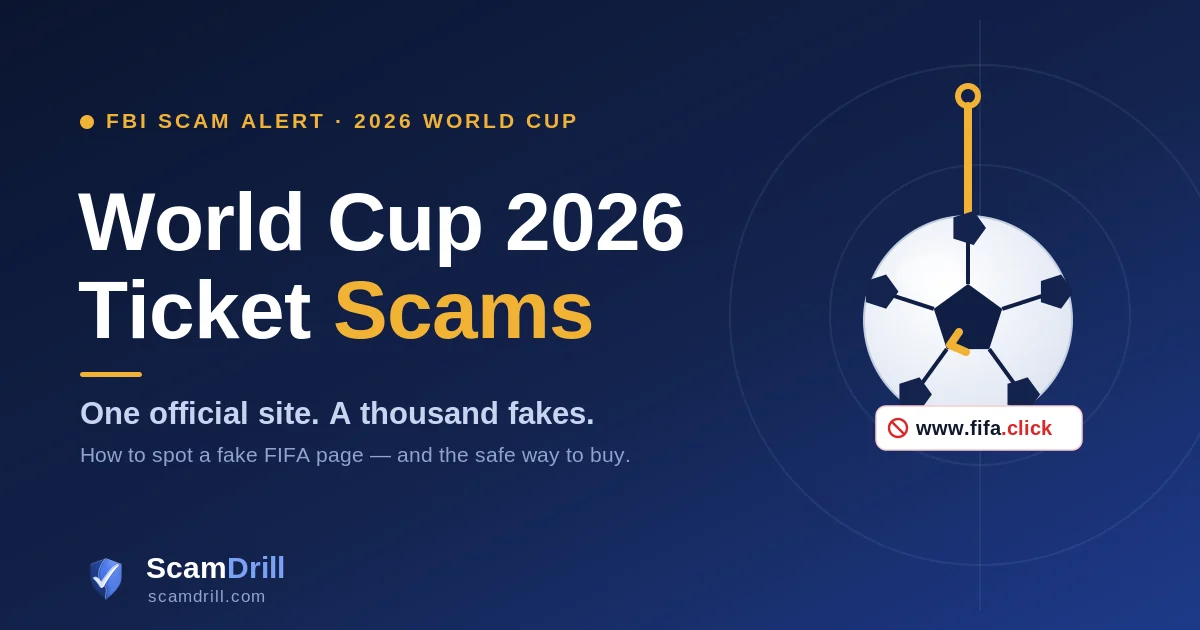
The crowd is unusually easy to fool, too. This tournament pulls in huge numbers of international visitors and first-time match-goers, people who do not know how American payment apps work, which resale sites are legitimate here, or what an official FIFA address even looks like. Scammers count on exactly that gap. A traveler comparing prices in an unfamiliar currency, jet-lagged and a day from kickoff, is not well positioned to notice that the web address reads fifa.click instead of fifa.com.
What the FBI is actually seeing
On May 27, before a single match was played, the FBI's Internet Crime Complaint Center put out a public service announcement warning that threat actors were spoofing FIFA's website ahead of the tournament. A spoofed site is a copy dressed up to pass as the real thing, built to do two jobs: sell fake tickets and hospitality packages, and vacuum up the personal and banking details you type in.
The trick that makes it work is typosquatting, registering web addresses that sit one keystroke away from the real one. The bureau listed dozens of live examples and said to expect more throughout the tournament. They fall into a few buckets: misspellings and look-alike letters such as fiffa.com, filfa.org, and wvvw-fifa.com; the same word with a different ending such as fifa.city, fifa.sale, or fifa.click; and longer strings with extra words bolted on such as worldcup26ticket.com and 2026fifaworldcuptickets.online. A whole separate cluster impersonated FIFA's hiring pages, with addresses like jobs-fifa.com and fifa-hiring.com.
Here is the part that catches careful people: you do not have to fall for a sales pitch to get hurt. If you only type your name, email, address, and card number into a spoofed checkout, the scammer already has enough to charge you, open accounts in your name, or sell the data on. The fake ticket is almost beside the point.

Source: FBI Internet Crime Complaint Center, Public Service Announcement I-052726-PSA, May 27, 2026.
The five ways the con comes at you
“World Cup scam” is really a family of scams sharing one engine: take your money or your data, give nothing real back. Here is how the family splits up.
1. Fake ticket sites and resellers
The headline act. A spoofed site or a social-media seller offers tickets to a match you want, takes payment, and either sends a worthless PDF or vanishes. AARP, reporting on the FBI alert, notes the usual ask is a peer-to-peer transfer through Zelle or Venmo, after which the “seller” disappears. A QR code or a photo of a ticket means nothing; both are trivial to fake or to sell to ten buyers at once.
2. Hospitality-package cons
One tier up from tickets sit hospitality packages, the premium seats with food, lounges, and hosting. They cost more, which makes them a richer target. The FBI's warning explicitly covers fake hospitality products alongside fake tickets. Genuine packages trace back to FIFA's official hospitality program, reachable from FIFA.com. An offer you cannot trace there, no matter how polished the brochure, deserves a hard no.
3. Accommodation and the “matchday relocation” trick
With host cities short on rooms, fake rentals and cloned booking and seller sites are thriving in parallel. Scammers list real homes they do not own, clone a hotel's booking page, or push you to pay outside a trusted platform. A newer move is the matchday relocation: a confirmed booking gets cancelled days before you travel, with a frantic message steering you to “rebook” through them.
This angle got more dangerous in April 2026, when Booking.com confirmed a breach that exposed guest names, dates, and reservation details. Criminals are now sending texts and WhatsApp messages that quote your real hotel, your real dates, and your real reservation number, then demand a new payment to “confirm” the room. Accurate details are not proof a message is real. They are the whole reason it is convincing. The same lesson runs through our guide to text-message scams: a personalized text is easier to trust and just as easy to fake.
4. Fake World Cup jobs
The tournament needs staff, and scammers know it. The FBI flagged a cluster of fake hiring domains, addresses like jobs-fifa.com, dangling event jobs that require you to hand over a passport scan, a Social Security number, and bank details for “payroll.” There is no job. There is only an identity-theft kit you assembled for them.
5. “You won tickets” and betting bait
Then come the unsolicited wins. A text, email, or social post says you have won World Cup tickets or a trip to a match, and you just need to pay a delivery fee or confirm your card to claim them. There is no prize. Around it swirl fake betting and prediction sites that take a deposit and never pay out. If you did not enter, you did not win.
The one safe way to buy
For all the variety in the cons, the defense collapses to a single sentence: buy only at FIFA.com/tickets, and get there by typing the address yourself. FIFA is the only authorized seller, and it runs the only official resale channel, the FIFA Resale and Exchange Marketplace, reachable from that same address. Tickets from anywhere else can be cancelled with no notice, even when the seller is sincere.
It helps to picture what the legitimate path looks like, so the fake stands out. On the official marketplace you buy and resell inside FIFA's own platform, prices move within FIFA's rules rather than by whatever a stranger can talk you into, and a ticket transfers to you through the official system instead of landing as a PDF in your inbox. That cuts two ways. A price far below face value is suspicious, and so is one far above it. Real seats for a sold-out match do not quietly surface on a site you have never heard of.
How you arrive matters as much as where you land. The FBI's guidance is to type fifa.com into the address bar rather than searching for it, and to be wary of sponsored results, which can be paid imposters sitting above the real link. Bookmark the official page once you reach it and use the bookmark next time. If you decide to use a large secondary marketplace anyway, know you are off the official path, type the address yourself, and lean on the protections below.
Pay with a credit card. It is the single most protective choice you can make, because a card gives you chargeback rights if the ticket turns out to be fake. Peer-to-peer apps and wires do not. That is the entire reason a scammer steers you toward them.
Source: ScamDrill, drawing on FBI/IC3 and AARP guidance on event-ticket payment safety, 2026.
Treat any of these as a stop sign
- A checkout or seller that will only take Zelle, Venmo, Cash App, wire, or crypto.
- A web address that is not exactly fifa.com, or that you reached through an ad.
- “Only two left,” a countdown timer, or pressure to pay this minute.
- A price well under face value, or a seat for a match listed as sold out.
- A “hotel” or “FIFA” message quoting real booking details and demanding a fresh payment.
The 30-second gut check
Before you pay, ask one question out loud: “Am I on fifa.com that I typed myself, paying with a card?” If the answer is no on either count, you are exposed. Close the tab, type the address by hand, and start over. If a real seat existed a minute ago, it will still be there once you are on the right site. Not sure about a text or email pushing tickets or a room? Paste it into our free SMS scam checker before you act on it.
If you already paid or handed over your details
First, breathe. These operations are engineered to fool sharp, careful people under time pressure, and being caught by one is not a verdict on your judgment. Then move fast, because speed is the one advantage you still hold.
Write down the web address and everything about the interaction: what you entered, when you paid, how much, and the account or wallet on the other end. If you paid by card, call your bank now and dispute the charge. If you used a peer-to-peer app or a wire, contact the provider immediately, though be realistic that those are hard to claw back. Report the scam to the FBI's Internet Crime Complaint Center at ic3.gov and to the FTC at reportfraud.ftc.gov. And if you typed personal details into a fake checkout, treat it as a possible identity-theft event: watch your statements, consider freezing your credit, and change any password you reused elsewhere. Our step-by-step guide for what to do after a scam walks through the full sequence.
One more warning, because it lands on people at their lowest. Once you have been hit, a second wave often follows: a “recovery” service that promises to get your money back for a fee. It is the same playbook aimed at the same wound, and the FBI has flagged scammers impersonating IC3 itself to run it. No legitimate agency charges you to recover funds. We unpack that follow-on con in The Second Scam.
Why rehearsal beats a warning
Reading this helps. It does not make you immune. The ticket scam works because it arrives at the worst moment, when your team is in and the only seat left is on a screen in front of you and a clock is ticking. In that moment, advice you read in a calm hour tends to evaporate.
What survives pressure is a trained reflex, the kind that fires before the excitement does. That is the difference between knowing about a scam and not falling for one, and it is the whole reason practice beats a pamphlet. If you want the broader travel picture for this summer, fake airfare, rental cons, and “your trip was cancelled” texts, our 2026 summer travel scams guide covers the ground around the stadium.
Turn “what a deal” into “that's a scam” before kickoff.
ScamDrill sends your family realistic practice scenarios, including fake ticket offers and look-alike-website cons, so the warning signs fire automatically when a real one lands. Setup takes under 10 minutes.
Start your family plan →The one message to send your group chat
If anyone you know is chasing a seat this summer, send a single line before they buy: “Only buy World Cup tickets at fifa.com/tickets that you typed in yourself, and pay with a credit card. If a seller wants Venmo or Zelle, it's a scam. Text me first.”
That message costs you thirty seconds and could save someone a few hundred dollars and a stolen identity. Send it now, while the group chat is still arguing about who's going.