The Grandkid Scam Call: The 10-Minute Setup to Do With Your Parents This Thanksgiving
Bottom line up front
The grandkid scam call is built to sound real, and in 2026 it often does. The FTC warned on November 18 that some scammers now clone voices and fake videos, so recognizing a voice at 2 a.m. is no longer a safe test. What stops the call is a plan your family agrees on before it comes: a code word, a callback rule (hang up and call the number you already have) and a money rule (never cash, never secret). Thanksgiving is a good time to set it up. It takes about ten minutes, including one gentle practice run.
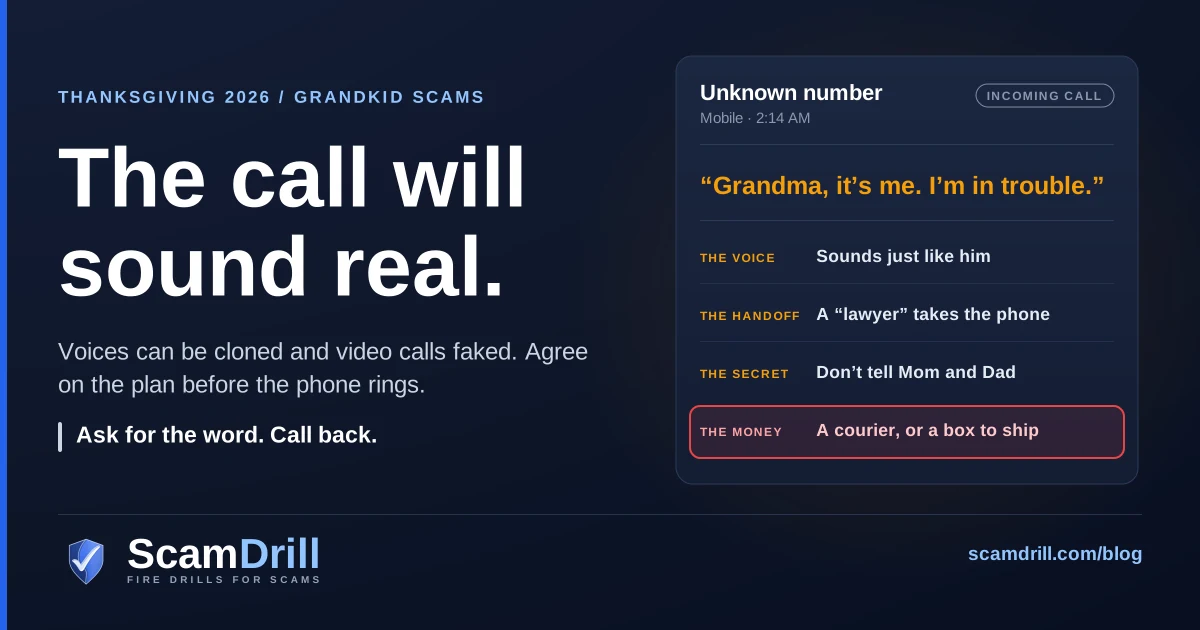
The call usually comes at a bad hour. Late at night, or early enough that nobody’s quite awake. A young voice, crying or hurt: Grandma, it’s me. I’m in trouble. There’s been an accident, or an arrest. Then someone else gets on the line, maybe a lawyer or a police officer, and explains what it will cost to fix this tonight. And one more thing. Please don’t tell Mom and Dad.
Three warnings in one week show how busy this scam is going into the holidays. On November 16, Pennsylvania State Police warned about callers who say a grandchild has been arrested, ask for the grandparent’s address, and send someone to the house to collect cash. On November 18 the Federal Trade Commission published a new consumer alert on grandkid scams. And on November 20 the Polk County Sheriff’s Office in Minnesota warned about a version where the “grandchild” wants thousands of dollars shipped in a package through a delivery service, with instructions to say the box holds Christmas ornaments or a birthday gift.
That last detail is worth passing along this week. It’s a cover story made for the season, and a box of ornaments in late November is about the least suspicious package there is.
Thanksgiving is one of the few days a lot of families are in the same room, grandparents and grandkids at the same table. That makes it the best chance all year to do the thing that actually stops this call. It isn’t a lecture about scams. It’s ten minutes of agreeing on what everyone will do if the phone rings like that, and then trying it once.
The 10-minute Thanksgiving setup
Do it after the meal, when nobody’s rushing to leave. Bring the grandkids into it. Theirs are the voices scammers copy, so the plan is partly theirs.
- Pick a family code word together. One word or short phrase that everyone knows and nobody posts, texts or emails. Make it odd. Skip pets, streets, schools and teams, since those turn up on social media. When a caller says they’re family and need money, the grandparent asks for it. Our guide to choosing a family safe word has ideas, and covers what to do when a caller says they forgot it. (About two minutes.)
- Agree on the callback rule, and check the numbers are saved. Any call about trouble and money ends the same way: I’m going to call you right back. Then the grandparent hangs up and calls the number already saved in their phone, never a number the caller offers. Before anyone leaves, sit down with your parent and make sure every grandchild’s current cell number is saved under their name. Numbers change more often than people remember. (Three minutes.)
- Name the second person to call. The FTC’s advice is to check the story with another family member or a friend. Make that one specific person: If you can’t reach Jake, you call me, any hour. Write the name and number on a card and leave it by the phone. (One minute.)
- Set the money rule: never cash, never secret. No emergency money leaves the house as cash, a package, a wire, a gift card, crypto or a payment app, and no money moves at all for an emergency that’s supposed to stay quiet. Real trouble can wait the ten minutes it takes to call someone. (One minute.)
- Ask the grandkids to tighten what they post. Scammers use social media to make the story fit, down to where you and your grandchild live, the FTC says. Post trip photos after you’re home, and set any account with videos of you talking to friends only. (A minute, plus some eye-rolling.)
- Do one gentle practice run, out loud. A grandchild plays the caller, and the grandparent practices asking for the word and saying they’ll call back. Everyone knows it’s practice. It takes two minutes and usually gets a laugh. There’s a simple script for it further down.
Definition
A grandparent scam, which the FTC calls a grandkid scam, is a call, text or video call from someone pretending to be a grandchild or other relative in sudden trouble, such as an arrest or an accident. The caller wants money fast, often in cash or gift cards, and asks you to keep it secret.
How the call unfolds, step by step
The details change from caller to caller, but the shape stays steady. Knowing the shape ahead of time is most of the defense, because every step has a way out.
1. The call: urgent, emotional, badly timed
It tends to come when you’re least able to think it through. The “grandchild” is crying, or says they’re hurt, or the line is bad. Pennsylvania troopers said callers may already know the relative’s name, and the FTC says they use details from social media to make the story believable.
One small habit helps a lot. Don’t say a name first. If the voice says it’s me, ask who is this? and let them answer. Then ask for the word.
2. Someone official takes over
Next comes a handoff. A second person gets on the line and says they’re a lawyer, a police officer or a bail bondsman. That does two jobs for the scammer. It lends the story some authority, and it means the “grandchild” never has to talk long enough to slip up. The second voice is usually the calm one, and it’s the one that names an amount.
3. The secret
Then comes the request to keep it quiet. Don’t tell Mom and Dad, they’ll be furious. Don’t tell anyone, it could make things worse in court. Pennsylvania State Police said callers try to keep the call secret by citing possible embarrassment to the family. We’ll come back to this one, because it’s the clearest warning sign in the whole call.
4. The payment, and how it reaches them
Bail and car repairs are the two stories the FTC names. The payment is where this year’s versions get inventive. The FTC tells people to refuse anyone who insists on a wire transfer through a company like Western Union or MoneyGram, cryptocurrency, a payment app, or gift cards, including reading the numbers off the back of a card over the phone. Gift cards come up a lot. The FTC’s new report on older adults found they were the payment method older people reported most often on scams impersonating friends and family. We wrote about why the way someone wants to be paid gives most holiday scams away, and it applies here too.
Two cash versions are worth describing to your parents in plain detail, because neither sounds like a scam until you’ve heard of it:
- The courier at the door. The caller asks for your address and says someone will come by to pick up the bail money. Pennsylvania State Police warned about exactly this on November 16, and told residents never to leave cash outside for pickup. Our post on scams that send a courier to your door covers the same move in a different costume.
- The box of ornaments. In the version Polk County warned about on November 20, the grandparent is told to pack thousands of dollars into a package, send it through a delivery service, and tell anyone who asks that it holds Christmas ornaments or a birthday gift. If someone on the phone is telling you what to say at the shipping counter, you’re being coached.
Courts and jails don’t take bail in gift cards, and they don’t send a stranger to your house or ask for cash in the mail.
What’s new: the voice, and now the face
For years the weak spot in this scam was the voice. A stranger couldn’t really sound like your grandson, so the script leaned on sobbing and a bad connection to cover the gap. That gap has mostly closed. The FTC’s November alert says some scammers use digital tools to clone a loved one’s voice or make fake videos. And it’s blunt about video calls: if the caller asks you to join one, know that “a person’s image can be faked, too.”
So two old instincts don’t protect anyone anymore. Trusting that you’d know your own grandson’s voice doesn’t hold up, and neither does asking to see him on video. That’s no failing on the grandparent’s part. The tools got good enough to fool parents, too. What still works doesn’t depend on anyone’s ears: a word only the family knows, and a callback to the number already in your phone. Our piece on AI voice cloning scams explains how the copying works.

Steps drawn from the FTC’s November 18, 2026 grandkid scam alert, Pennsylvania State Police (via FOX56, November 16) and the Polk County, Minnesota Sheriff’s Office (via KFGO, November 20). Ways out by ScamDrill, following FTC advice. Amber marks the scammer’s moves, red the point of loss, slate the way out.
“Don’t tell Mom and Dad” is the biggest red flag
If your parent remembers only one thing from this post, it should be this. A request to keep a money emergency secret is the scam announcing itself.
Think about what a real emergency looks like. A grandchild who has really been arrested might be embarrassed, but the family is going to find out within a day or two anyway, and a real lawyer has no reason to keep relatives from talking to each other. Secrecy helps exactly one person on that call: the one who needs the money to move before anybody compares notes. The FTC puts the goal plainly. Scammers want you to panic and send money before you can think it through or talk to someone you trust.
So turn the secret into a trigger. In your family, the rule can be that any call asking you to keep money quiet is the signal to call someone right away, starting with the person on the card by the phone. Say it at the table in those words. Then have the grandkids say their half out loud: If I ever ask you to keep it from Mom, that isn’t me.
What the numbers say, and what they miss
That figure comes from the FTC’s November 4 alert on its annual report to Congress about older adults. The full report has two details that bear directly on this call. One is the gift card finding above. The other is that in 2025, adults 60 and over were 15% more likely than younger people to report losing money to a scam impersonating a friend or family member, after adjusting for population size.
The report doesn’t give a dollar figure for grandkid scams on their own. The FBI comes closer. Its 2025 Internet Crime Report mentions grandparent scams, which it also calls distress scams, in a section on how criminals use AI, and says victims reported losses of more than $5 million to distress scams in 2025. Read that number narrowly. It reflects what people reported to the FBI’s Internet Crime Complaint Center under that heading, and the report files grandparent scams inside a much broader confidence and romance category. It isn’t a count of grandparent scams nationwide. It also shouldn’t be compared with the FBI’s far larger totals for all crime reported by older adults, as if the two measured the same thing.
The FTC is clear that reported losses undercount the real thing. Its report calls them the tip of the iceberg, and when it adjusts for people who never report, it estimates that fraud cost older adults somewhere between $13.3 billion and $119.5 billion in 2025, depending on the method. Our own read, and it’s only a read, is that many grandparent-scam losses never reach a federal database, because a grandparent who handed cash to a stranger is more likely to tell the local police, or nobody. That’s part of why this post spends more time on the plan than on the numbers.
How to bring it up at the table without talking down
This is the part adult children dread. You want to protect your mom without sounding like you think she’s slipping, and most parents can hear you’re getting old inside almost any sentence that begins with “Mom, about scams.”
What helps most is framing it as a family rule that covers everyone, you included, and making the grandkids part of it, so the conversation is about protecting them from having their voices used. Ask for your parent’s help rather than offering yours. Grandparents are usually the most willing people at the table to do something for the grandkids. Some lines that tend to land:
| The moment | Words you can use |
|---|---|
| Opening it up | I read about a scam this week where they copy a grandkid’s voice. I want all of us to set up a plan, me included. It takes ten minutes. |
| When a parent says they’d know their own grandchild | I know you would. The software is good enough now to fool parents, so let’s not make anybody rely on their ears. |
| Asking for the code word | Can we pick a word, just for us? If any of us ever calls in trouble and asks for money, ask for the word. No word, hang up and call us back. |
| From the grandchild | If I ever call you needing money, ask me our word. If I can’t say it, hang up and call my cell. I won’t be upset. I’ll be glad you did. |
| If a parent already got one of these calls | That call is designed to fool people who love their family. Lots of careful people have sent money. Let’s just make sure it can’t work twice. |
If your parent tells you they’ve already had one of these calls, maybe one they never mentioned, believe them and thank them for telling you. A grandparent who was fooled was not foolish. The call is run by people who do this all day, and it’s aimed at love and a quick protective reflex, which are exactly the instincts you’d want a grandparent to have. Shame is what stops people from reporting, and from mentioning the second call when it comes. Our playbook for protecting elderly parents covers the rest of that conversation, from bank alerts to a trusted contact.
If someone forwarded this to you
If one of your kids or grandkids sent you this post, they sent it because these calls now sound real enough to fool anyone, and they would rather agree on a plan with you than ask you to judge a voice in the middle of the night. What you need to remember is short. Ask for the word. Say you’ll call back, then call the number you already have. And if anyone asks you to keep it secret, that’s your cue to tell someone.
The two-minute practice run
A plan you’ve said out loud once is a lot easier to use with your heart pounding. So practice it, gently, with everyone in on it.
- A grandchild plays the caller and gives it some drama: Grandpa, it’s me, I’m in trouble. Please don’t tell Mom.
- The grandparent practices three short lines: Who is this? Then What’s our word? Then I’m going to call you right back.
- Someone else plays the lawyer and pushes hard. There’s no time, the hearing is in an hour, calling anyone will make it worse. The grandparent sticks to the callback.
- The grandparent really does hang up and calls the grandchild’s saved number, right there at the table, which also confirms it’s the right number.
- Swap roles, and let the grandparent play the scammer. Some of them are suspiciously good at it.
One firm rule: don’t test a parent with a surprise fake emergency call. It can genuinely frighten someone, and it teaches them that a panicked call from family might be a test, which is the last thing you want in their head when a real one comes. Practice in the open, at the table, or on a day you’ve agreed on in advance. If you’re curious why rehearsal sticks better than a warning, we wrote about practice drills for families and the research behind them.
What the grandkids can change
The grandchildren are the part of this scam nobody thinks to include, and they can make it noticeably harder to pull off. The FTC says scammers use social media details, such as where you and your loved one live, to make the story convincing. Its older Pass It On guidance on grandkid scams adds that they may hack a loved one’s email for the same reason. A few small changes help:
- Post the trip after the trip. A “stuck abroad, lost my wallet” story works best when the whole family can see you’re abroad. Share the photos once you’re home.
- Lock down the videos where you talk. Set those accounts to friends only. Your voice may already be out there, which is why the code word matters more than any privacy setting, but there’s no reason to make the copying easy.
- Don’t tag your grandparents by name and town. Together those are two of the facts that make a caller’s story fit.
- Tell your grandparents when your number changes. Then a call or text that opens with a new number and a broken-phone story falls flat, because the real new number is already saved in Grandma’s phone.
- Turn on two-step login for your email. A hacked inbox tells a scammer who your grandparents are and how you write to them.
If money already went out
Move fast, and skip the blame. What happens in the next hour matters far more than how it happened. Some money can be stopped or pulled back if the right company hears about it quickly. A lot can’t, and nobody can promise you a refund. The FTC’s guidance is to contact whoever you used to send the money right away, say it was a scam, and ask whether it can be reversed. Its advice by payment type, plus what to do about a courier:
The first hour
- Gift cards: call the company that issued the card, using the number on the back. Say the card was used in a scam, ask for a refund, and keep the card and the receipt.
- Wire transfer, bank transfer or payment app: call the wire company, your bank or the app immediately and ask them to stop or reverse the payment.
- Crypto: contact the exchange or the crypto ATM operator right away and report the transaction as fraud.
- Cash mailed through the Postal Service: call the U.S. Postal Inspection Service at 1-877-876-2455. The FTC says it may be able to intercept a domestic package that hasn’t been delivered yet, for a fee.
- Cash shipped with FedEx or UPS: call the carrier as soon as you can, and have the tracking number ready.
- Cash handed to a courier, or a courier on the way: call your local police, and don’t hand over anything more. If anyone is in danger, call 911.
Then report it, even if the money is gone and it feels pointless. Use ReportFraud.ftc.gov, the FBI’s ic3.gov, and your local police department. The FTC says reports help investigators find and stop scammers. If you’d like a person to talk it through with, the AARP Fraud Watch Network Helpline is toll-free at 877-908-3360, weekdays from 8 a.m. to 8 p.m. Eastern. AARP says it offers guidance and support, not investigation or case recovery. The Justice Department also runs the National Elder Fraud Hotline at 833-FRAUD-11 (833-372-8311).
Our first-hour plan after a scam walks through the order of calls in more detail, and the free “I’ve been scammed” tool builds a checklist for your situation.
After that, watch for a second call. The same “lawyer” may come back with a new problem and a bigger number, which is the same scam again. Or a stranger may offer to recover the money for a fee, sometimes claiming to work with the FBI. The FBI’s complaint center says it will never contact you directly for information or money, and that it doesn’t work with law firms or crypto services to recover lost funds. Anyone who wants a fee to recover a loss is very likely running a second scam.
None of this has to be heavy. Pick a word, save the numbers, agree on who to call, say the money rule out loud, and run the practice once before the pie comes out. Then bring it up again at the next family gathering. A plan that gets mentioned twice a year is one people actually remember when the phone rings.
Keep the habit going after the holidays
The phone plan is something you practice together at the table. ScamDrill doesn’t place fake calls to your parents. What it does is send them safe, realistic practice scams by email, such as fake account alerts and payment requests, and show you how their instincts improve over time. It’s practice, so nobody can fail it, and nobody gets in trouble for clicking. The family tour shows what a drill looks like.
See how family drills work