Scam Trends, June 2026: New Federal Numbers and the Scams Moving Now
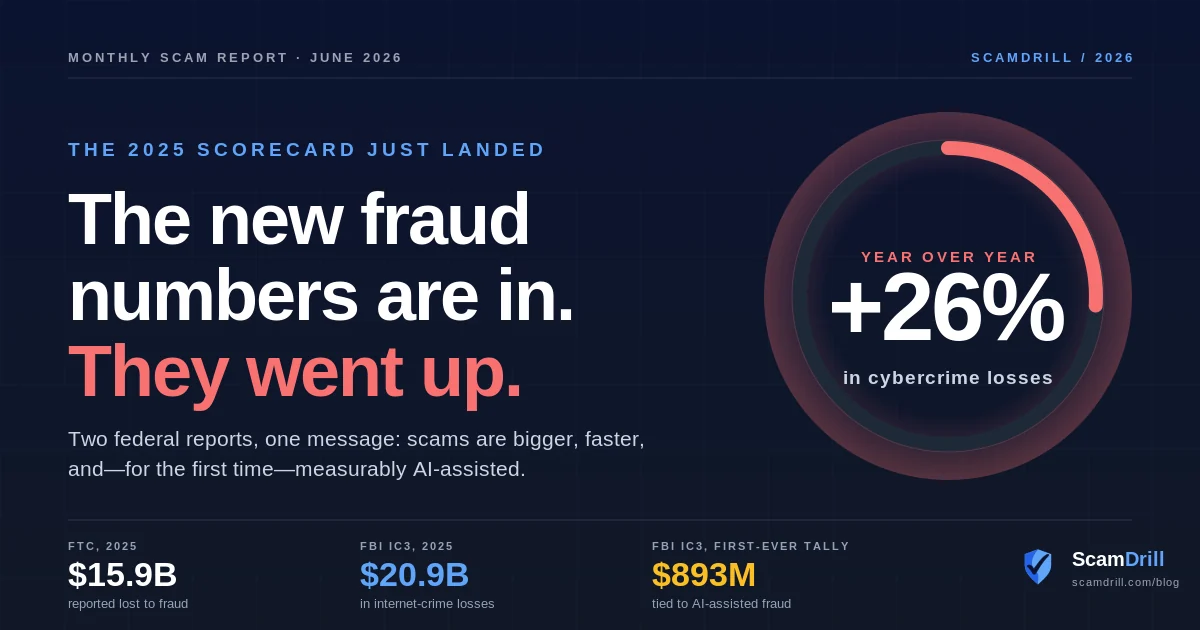
U.S. scam losses hit new records in 2025, with the FTC counting $15.9B and the FBI $20.9B, up 26%. The threats moving fastest this June are toll and job texts, romance cons that pivot to crypto, AI voice clones, and vendor-invoice fraud aimed at businesses, and the defense against every one of them is the same: slow down and verify on a channel you chose yourself.
Two of the year’s biggest fraud reports landed this spring, and they point the same direction. The FTC says Americans reported losing $15.9 billion to fraud in 2025, up from $12.5 billion the year before. The FBI’s Internet Crime Complaint Center (IC3) put total internet-crime losses at $20.9 billion, a 26% jump. Different agencies, different counting methods, one story: the money lost to scams keeps climbing, and the people running these schemes have better tools than they did a year ago.
If you read our May trends roundup, some of this will feel familiar. What changed over the past few weeks is the detail. We now have full-year figures, the first federal tally of AI-assisted fraud, and a fresh round of June scam alerts that show where attention is shifting right now. Here is what stands out, for households and for the businesses many of us run.
Investment fraud takes the money; imposters take the volume
The split at the top has been steady for a while, and 2025 made it sharper. Investment scams were the costliest category by a wide margin at $7.9 billion, with a median individual loss above $10,000. Most of that is cryptocurrency. The FBI logged 181,565 crypto-related complaints and more than $11 billion in losses, and a large share traces back to the slow-build “pig butchering” playbook we broke down in our guide to crypto investment-fraud warning signs.
Imposter scams were the most-reported fraud for the ninth year running, with over a million reports and $3.5 billion lost. These are the calls and texts from someone pretending to be your bank, the IRS, Social Security, a local sheriff, or a relative in trouble. They rarely cost as much per victim as an investment con, but they reach far more people, which is exactly why they keep working.
Older adults still carry the heaviest dollar losses. People 50 and older reported $4.3 billion lost in 2025, nearly double the $2.3 billion reported by younger adults. If that describes someone in your life, our playbook for protecting elderly parents from scams walks through a practical, non-patronizing way to help.
Social media is now the costliest front door
Here is the data point worth sitting with. Nearly 30% of people who reported losing money in 2025 said the scam started on social media, and those losses added up to $2.1 billion. That is more than any other way a scammer reaches you, and an eightfold jump since 2020.
People reported losing more money to scams that began on Facebook than on any other platform, with WhatsApp and Instagram trailing. The forms vary: investment pitches accounted for over half the dollars, shopping scams drove the most complaints, and roughly 60% of romance-scam victims first met the scammer on a social platform. The fix is unglamorous but real. Lock down who can see your posts and contacts, never let someone you met online steer your money, and search any unfamiliar seller’s name plus the word “scam” before you buy.
Three scams moving fastest right now
Government-impersonator texts jumped 40%, driven largely by fake unpaid-toll and DMV messages spoofing real programs like E-ZPass, SunPass, FasTrak, and TxTag. The script is always the same: a small overdue balance, a threat to suspend your registration, and a link. No toll authority or DMV collects money by text. If you want to check, type the agency’s real web address into your browser yourself. Our smishing guide shows the full pattern.
Romance-scam losses rose 22%, to roughly $2,020 per victim, and they increasingly blur into investment fraud. The connection builds for weeks, then the conversation turns to a “can’t-miss” crypto opportunity. If a new online relationship moves toward your money, that is the red flag, no matter how warm it feels. Our guide to helping a family member caught in a romance scam covers how to raise it without pushing them away.
Job and “task” text scams are the fastest riser. The FTC counted around 31,000 reports of job or employment text scams in the first quarter of 2026 alone, and job-scam losses tripled between 2020 and 2024. Two tells cover almost every version: a real employer never asks you to pay for equipment, training, or a background check up front, and no legitimate job pays you to “like,” rate, or boost things from your phone. We unpack the version aimed at teens and young adults in our piece on micro-task scams.
The AI line item is now official
For the first time in its history, the FBI’s IC3 report broke out AI-assisted fraud as its own category: 22,364 complaints and about $893 million in reported losses, with investment fraud the largest slice. The tools showing up in real cases are voice clones built from a few seconds of public audio, deepfake video on calls, fabricated ID documents, and synthetic social profiles.
That is the encouraging part. A cloned voice on an “emergency” call still falls apart the moment you hang up and dial the person back directly, and a family codeword stops it cold. Our AI voice-cloning guide walks through setting both up in about ten minutes.
For businesses: the invoice you trust is the attack
The same playbook scaled up is now the most expensive problem in business fraud. Business email compromise (BEC) costs U.S. organizations roughly $3 billion a year, but the crude version, a stranger emailing “wire me money,” is mostly gone. Direct wire requests are now a small fraction of how this money actually leaves. The growth is in vendor email compromise: a scammer quietly sits inside a real supplier’s email thread, waits for a genuine invoice, then slips in “updated” bank details at exactly the right moment.
The deepfake angle is no longer hypothetical. In a widely reported 2024 case, an employee at the engineering firm Arup paid out about $25 million after a video call with what looked and sounded like the company’s CFO and colleagues. Every face on that call was synthetic. We cover this attack class in detail in business video compromise, explained.
The defense costs nothing and breaks the whole chain: verify any change to payment details out of band, by calling a number you already had for that vendor, and require a second person to approve payments over a set threshold. That single habit is also the heart of the new NACHA ACH fraud-monitoring rule that took effect this month, and it pairs with the broader patterns in our guide to social engineering aimed at small businesses.
What June’s alerts are telling us
Beyond the annual numbers, a few fresh alerts in the past two weeks show where scammers are pointing next.
- Fake “recovery” help, now impersonating the FTC. On June 3 the FTC warned that scammers are posing as its own employees, offering to recover money you already lost, and even texting photos of fake employee IDs to seem legitimate. No real agency charges a fee to get your money back. This is the same cruel pattern we documented in the second scam, which preys on people who were already hit once.
- Childcare overpayment checks. Scammers posing as parents send childcare providers a check “in advance,” then ask for part of it back before the check bounces. It is the classic fake-check overpayment con aimed at a new target.
- Hurricane and summer-season fraud. Hurricane season opened June 1, and charity and home-repair scams reliably follow severe weather. Summer travel brings its own wave of fake rentals and booking sites, which we break down in summer travel scams 2026.
The thread that ties all of it together
Strip away the labels and these scams share a skeleton. Each one starts with contact you did not ask for, manufactures urgency, and pushes you toward a payment you cannot reverse: a gift card, a wire, crypto, or a “new” bank account. When you see two of those three together, you are almost certainly looking at a scam. We mapped this structure in the anatomy of a modern scam, and it holds up across every trend above.
The defense is the same whether it is a teenager getting a job text, a grandparent getting an “emergency” call, or an accounts-payable clerk getting an updated invoice. Slow down. Verify on a channel you chose, not the one that contacted you. Never pay to get paid, and never send money to confirm a windfall. It is boring advice, and it is the advice that keeps working while the technology around it keeps changing.
Practice beats panic.
ScamDrill sends safe, realistic fake texts, voicemails, and emails to your family or your team on a rotating schedule, tuned to the scams trending right now. When someone clicks, they get a teachable moment instead of a real loss.
Start a free drill →Pick one scam from this list and run it past someone this week. Forward a parent a fake toll text. Ask your finance team how they would handle a vendor’s “new” bank details. Walk a teenager through a too-good job offer. The people who say “I can’t believe I almost fell for that” are almost never the ones who practiced first.