Scam Trends, August 2026: Back-to-School Cons, Loan-Forgiveness Traps, and Storm-Season Impostors
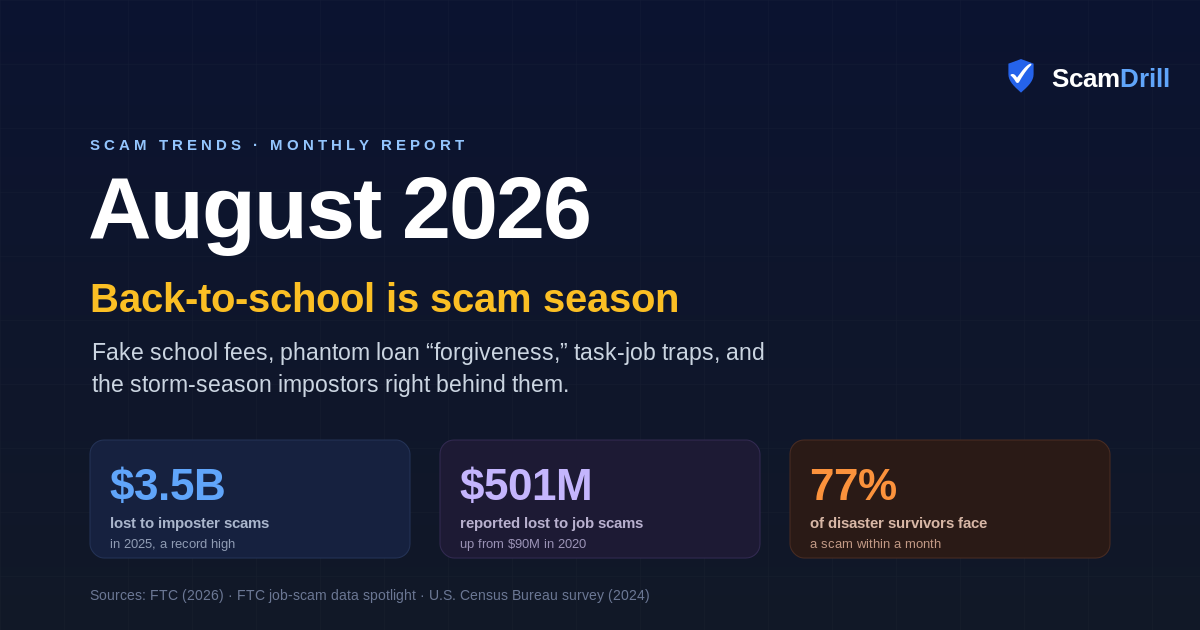
Scammers work a calendar, and in August the calendar says school. This month brings a rush of fake school fees and bogus e-commerce stores, phantom student-loan “forgiveness” that charges upfront for something the government gives free, and task-job traps aimed at students home for one more month. Running alongside all of it is peak Atlantic storm season and the FEMA impostors that follow every disaster. The defenses do not change: verify a message on a channel you chose yourself, and never pay an advance fee for aid, forgiveness, or a job.
Last month we tracked how imposters ride the summer’s big events, from the World Cup final to the Prime Day aftermath. If you missed it, the July trends report holds up. August keeps the same logic and swaps the merchandise. The event now is the first day of school, and the supporting cast is a season of storms. Below is what is moving this month, for households and for the organizations many of us run.
Keep the annual backdrop in mind while you read. People reported losing about $16 billion to fraud in 2025, the highest total on record, and $3.5 billion of it went to imposter scams alone, according to FTC data released in June. Almost every item below is one of those imposters wearing a back-to-school costume.
Back to school, back to the shopping cons
In late July, IRS Criminal Investigation put out its yearly back-to-school warning, and it named the pattern precisely. The season brings a spike in fraudulent e-commerce sites, plus messages that pretend to come from a school or a government agency and demand a “fee” or personal details. Investigators tied more than $24 million in cyber-related crime to their fiscal-year caseload, and noted that scams aimed at minors through gaming and social platforms climb right as the school year starts.
Two versions do most of the damage for families. The first is a storefront that looks like a real supplier of laptops, uniforms, or dorm gear, priced just low enough to feel like a steal, that only accepts gift cards, wire, or crypto and never ships. The second is a message claiming to be from a district, a coach, or a financial-aid office, asking a parent to pay a registration fee or confirm a student’s Social Security number. Neither is hard to defeat. Buy from retailers you already trust, and treat a suspiciously cheap site as a red flag rather than a bargain. When a “school” message asks for money or data, do not reply to it. Look up the school’s number yourself and call to confirm. Our full back-to-school scams guide walks through the checks room by room.
The tell that never changes
No real school, agency, or store will insist you pay a fee only by gift card, wire transfer, cryptocurrency, or a payment app. The FTC now points to how you are asked to pay as one of the clearest signs of a scam. If the payment method is irreversible and oddly specific, stop.
The financial-aid and loan-“forgiveness” trap
Tuition bills and FAFSA season put loan and aid scams back in heavy rotation. The single most useful fact here is also the simplest: every real federal forgiveness and repayment program is applied for free, directly, at StudentAid.gov. No company has a faster lane, a back door, or special access, so anyone charging an upfront fee to “secure” forgiveness is either breaking the rules or running a con. Charging that advance fee before delivering anything violates the FTC’s Telemarketing Sales Rule outright.
The enforcement record from this summer shows the stakes. In July the FTC won a permanent ban against an operator of a student-loan scheme that took more than $45.9 million by impersonating the U.S. Department of Education and promising forgiveness that never came. That followed an April action that shut down a separate operation which pulled at least $8.8 million from struggling borrowers using the same script. A related cousin targets homeowners with promises to erase mortgage debt or stop foreclosure for a fee; the moves are identical, and our mortgage-relief scam guide covers that side. Families sorting out aid should also watch for identity theft dressed up as help, which we break down in our guide to ghost-student FAFSA fraud.
Task-job traps go after students
August is prime hunting season for job scams, because students want one more paycheck before classes and recent grads are still looking. The fastest-growing version is the task scam. It opens with an unexpected text or WhatsApp message about easy remote work, some vague mention of rating products or “optimizing” apps. You complete a few simple tasks, a balance appears to grow, and then comes the pivot: deposit your own money, usually in crypto, to unlock the next batch and cash out. The balance is fiction and the deposit is gone.
The number to remember is the trajectory. Reported losses to job scams rose from about $90 million in 2020 to $501 million in 2024, and task scams made up close to 40 percent of the 2024 reports. If you have a student in the house, the one sentence worth repeating is that a legitimate employer never asks you to deposit money to unlock your earnings. We lay out the mechanics for younger workers in our micro-task scam guide, and the wider hiring-fraud picture in the fake remote job playbook.
Storm season brings its own impostors
August sits in the heart of Atlantic hurricane season, and disasters draw scammers the way picnics draw ants. A 2024 Census Bureau survey found that as many as 77 percent of disaster survivors encountered a scam within a month of the event. When a storm hits, three impostors show up fast, and knowing them in advance is most of the defense.
FEMA never charges a fee to apply for or receive aid, so a caller who wants payment to “process” your claim is an impostor, full stop. Storm-chasing contractors knock while the damage is fresh, promise a cheap fast fix, and want the whole amount before any work. Keep any deposit small, confirm the contractor is real and licensed, and never pay in full up front. And because fake charities spin up within hours of a disaster, run any appeal through Charity Navigator or the BBB Wise Giving Alliance before you give. If you need FEMA, reach it only through the official helpline at 800-621-3362.
Also moving this month
- Delivery texts ride the shipping wave. Dorm supplies and gear are in transit, so a fake “failed delivery, confirm your address” text lands on fertile ground. Check any package through the carrier’s own app, not a link. Our USPS smishing guide shows the tells.
- QR codes on campus. Stickers slapped over real codes on parking meters, flyers, and event posters send students to lookalike payment pages. Type the address when you can, and look at the domain before you pay. See our quishing guide.
- Heat-wave utility calls. August still brings imposters threatening same-day shut-off unless you pay by phone. Utilities do not take gift cards, and no real disconnection happens on one call’s notice. Hang up and dial the number on your bill. More in our utility shut-off guide.
For businesses: the school bell is an attack window
The same calendar logic hits organizations, and schools sit right in the blast radius. Districts and universities power their networks back up in August, onboard thousands of new accounts in a week, and process a flood of vendor invoices for the coming year. That combination is exactly what ransomware crews wait for. The United States logged the most education-sector ransomware attacks of any country in 2025, and reopening season is when the pressure to pay a ransom is highest, because a locked network on the first day of class is a crisis with a deadline.
Procurement season is the other soft spot, for schools and small businesses alike. When a company is placing real purchase orders and paying real invoices, a fake one blends in, and so does an email asking to update a vendor’s bank details before the next payment. The fix costs nothing. Brief whoever handles money and email, require a second approver above a set dollar threshold, and keep an out-of-band rule for any change to payment details, meaning you confirm on a phone number you already had, never one from the email itself. The specifics live in our guides to vendor email compromise and invoice fraud, social engineering aimed at small businesses, and, for schools specifically, K-12 ransomware after the federal cuts.
The pattern underneath
Strip away the costumes and every item here is one con. The scammer borrows a deadline you already care about, whether that is the first day of class, a tuition bill, a paycheck, a roof that needs fixing, or an invoice cycle. Then they add the three ingredients that never change: contact you did not ask for, urgency, and a payment you cannot reverse. Two of those three together is your signal to stop. Slow down, and verify on a channel you picked yourself.
Practice beats panic.
ScamDrill sends safe, realistic fake texts, voicemails, and emails to your family or your team on a rotating schedule, tuned to the scams trending right now. When someone clicks, they get a teachable moment instead of a real loss.
Start a free drill →Pick one item and run it past someone this week. Ask the student in your life what they would do if a “recruiter” asked them to deposit money to start earning. Ask a parent how they would confirm a school fee before paying it. Ask whoever pays your invoices what would happen if a vendor’s bank details changed tomorrow. The people who rehearse the answer are the ones who catch it live.
Sources: FTC imposter-scam data release (June 15, 2026) and FTC consumer alerts on debt relief and how you are asked to pay (July 2026); FTC press releases on student-loan debt-relief enforcement (April and July 2026); IRS Criminal Investigation back-to-school scam advisory (July 2026); FTC job-scam data spotlight on task scams; U.S. Census Bureau disaster-survey data on post-disaster scams (2024); New York State contractor and FEMA scam warning (July 2026); Comparitech education ransomware roundup (2026) and Center for Internet Security K-12 cybersecurity report.